

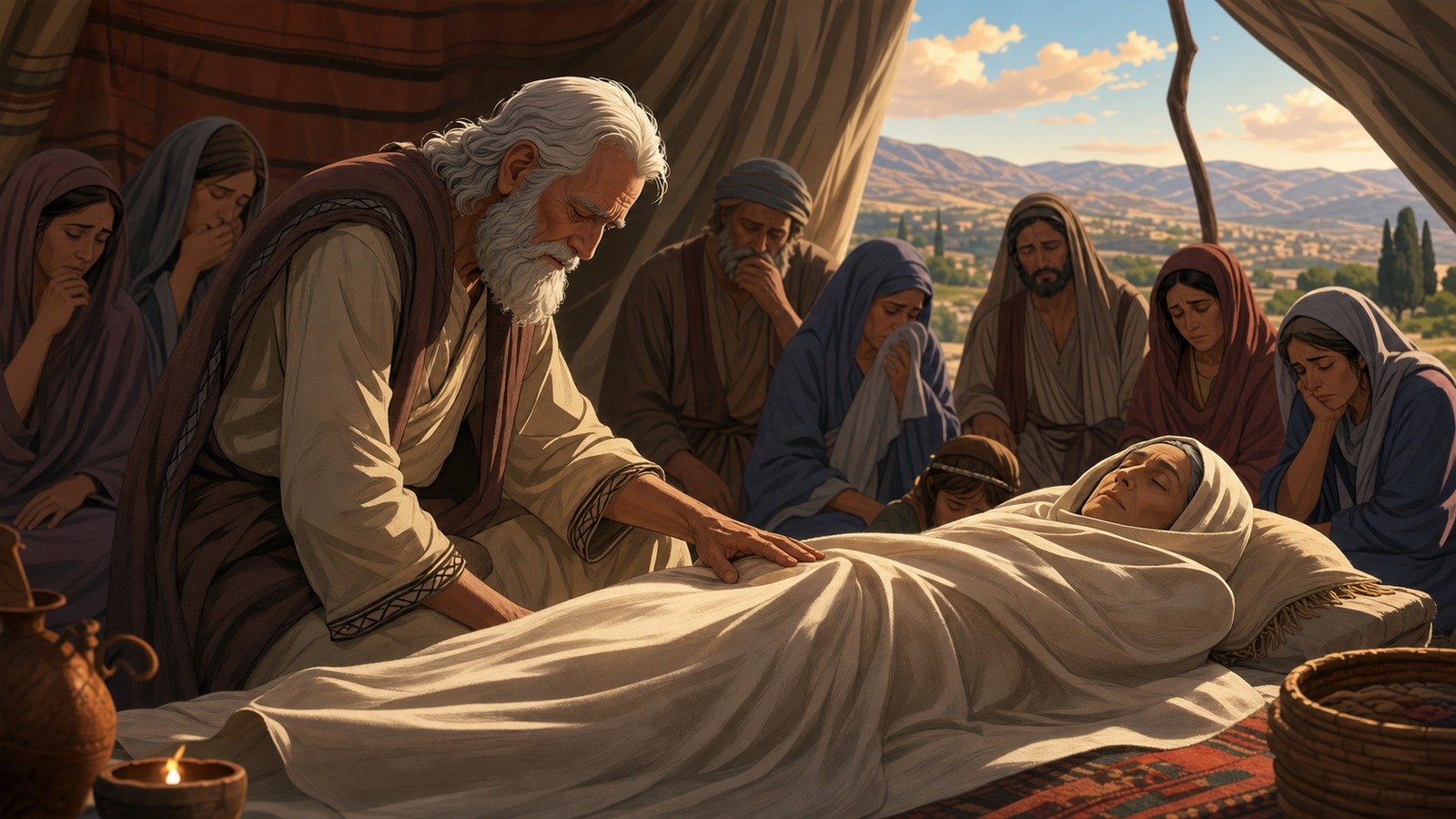
Sarah dies at 127 in Hebron, and Abraham mourns her, the first death of a matriarch recorded in the Bible.
Further context
3 min readSarah lived to be a hundred and twenty-seven and died at Kiriath Arba, which is Hebron, in the land of Canaan, and Abraham came to mourn for her and to weep over her.
That first figure is unique in the Hebrew scriptures. Sarah is the only woman whose age at death is given anywhere. Ages are recorded for dozens of men across the Old Testament and for no other woman at all, and her lifespan is counted out in exactly the way the patriarchs' are.
It fits the position she occupies. When the covenant was formalised it was stated explicitly that the promised son would come through her and through no other arrangement, and she was renamed at the same moment Abraham was, which happens to nobody else in these chapters. When the household split over Ishmael, Abraham was told to listen to her.
Isaac would be about thirty-seven, since she was ninety when he was born. Abraham is around a hundred and thirty-seven and will live another thirty-eight years.
The place is given carefully. Hebron sits in the Judean hill country roughly thirty kilometres south of Jerusalem, at about a thousand metres above sea level, and it has been the family's base since Abraham moved his tents to the great trees of Mamre after separating from Lot. Adding "in the land of Canaan" is not filler. It marks that she died inside the country promised to her descendants, in which the family still owned nothing whatever.
Mourning in that world involved tearing clothing, wearing sackcloth, sitting on the ground and a period of formal lament with the household and neighbours joining in. What comes next shows him rising from that to conduct business.
That business is why the episode exists at length. Her death takes two verses and the purchase of a place to bury her takes eighteen. A household living as resident foreigners has no ancestral tomb, and a death forces the question of where these people actually belong. The negotiation that follows produces the only piece of the promised land Abraham ever legally holds, and he pays a steep price for it in front of witnesses.
She is the first of the family to be buried in that cave, and Abraham, Isaac, Rebekah, Leah and Jacob follow her into it over the next century and a half. Choosing to bury her in Canaan rather than sending the body back to Harran, where the family still had relatives and land, was itself a statement about where they now considered home to be.
Later writers include her among those commended for faith, and one letter holds her up as an example to its readers. What she is remembered for in those places is not the laughter behind the tent, which is what she is best known for now, but the fact that she waited.
How she died and where Abraham was at the time are unknown. The verb used for his arrival suggests he came to her from somewhere else, which some readers take to mean he was out with the flocks, and the family had been living apart at Beersheba and Hebron in the years before. Nothing is made of it either way.
What the death does is end the first generation. Abraham has thirty-eight years left and spends them arranging things: a wife for his son, provision for the sons of his concubines, and a grave. Everything active in his life, the leaving, the wars, the arguments and the mountain, is behind him by the time he walks out of that tent to bargain with the Hittites.