

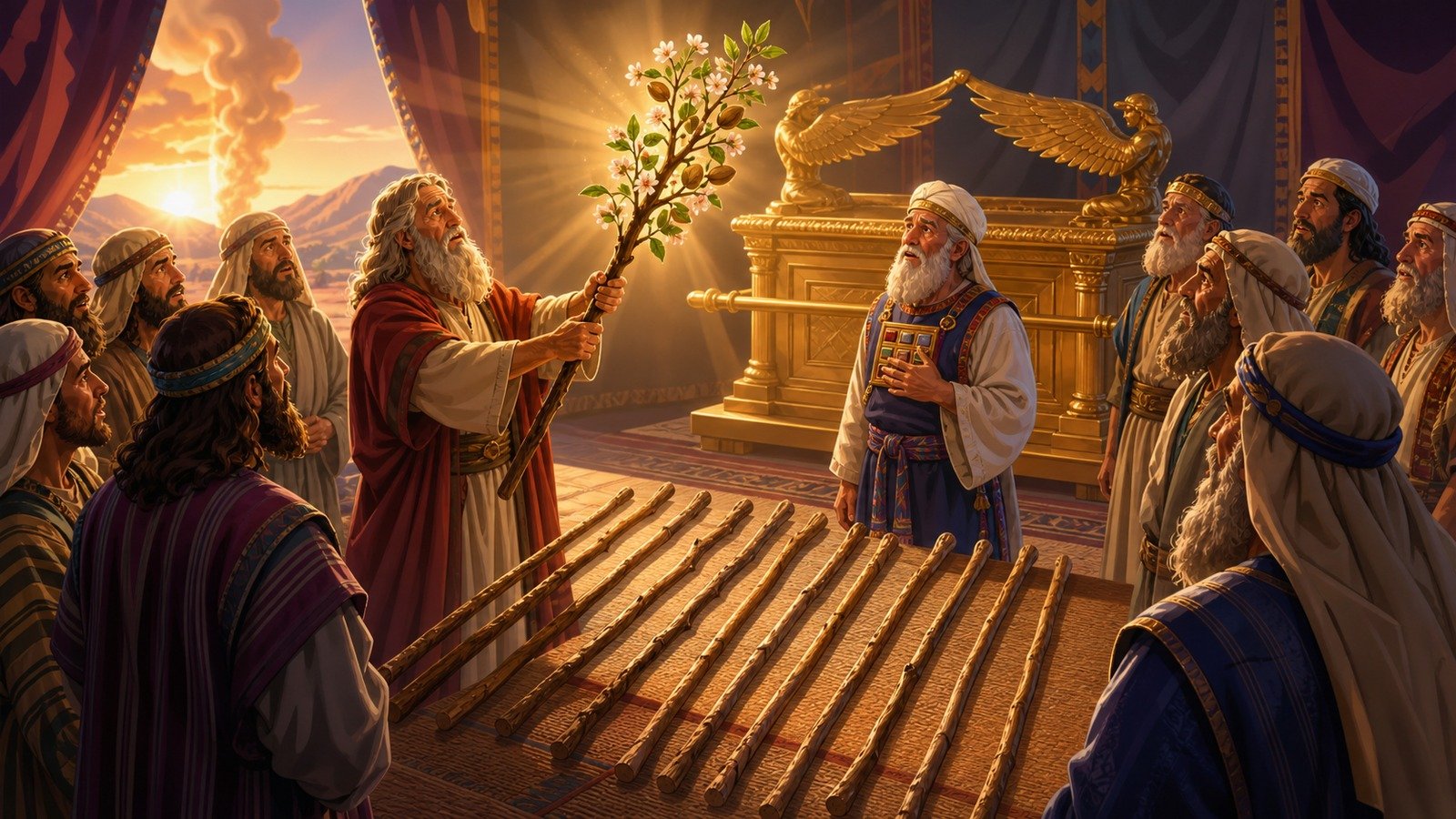
Following Korah's rebellion, each tribal leader's staff is placed before the ark overnight; only Aaron's sprouts, blossoms and produces almonds by morning, a sign confirming his priesthood before the whole community.
Further context
2 min readThe demonstration that follows the revolt is designed to settle the question without any further deaths. Twelve staffs are collected, one from the leader of each ancestral tribe, with the man's name written on his own. Aaron's name goes on the staff of Levi. They are placed in the tent in front of the ark, and the stated purpose is that the staff belonging to the man God chooses will sprout, and this will put an end to the constant grumbling.
The next day Aaron's staff has not only sprouted but has budded, blossomed and produced almonds. Four stages of growth that would take a living tree several weeks have happened overnight on a cut piece of dead wood, and the other eleven staffs are unchanged.
The choice of tree is not incidental. The almond is the first tree in the Levant to break dormancy, flowering in late January or February while everything else is still bare, which made it the standard image of something waking early. Hebrew plays on this: the word for almond (shaqed) sounds like the participle meaning watching or being alert (shoqed), and Jeremiah uses exactly that pun when he is shown an almond branch and told that God is watching to see his word fulfilled. The lampstand in the sanctuary was also decorated with almond blossom cups, so the image was already in the room.
Moses brings all twelve staffs out to the Israelites, they look at them, and each leader takes his own back. Aaron's is put back in front of the ark and kept there as a sign to the rebellious, so that their grumbling will end and they will not die. It is listed later, alongside a jar of manna and the stone tablets, among the contents of the ark.
The reaction is not gratitude. The Israelites say to Moses: we will die! We are lost, we are all lost! Anyone who even comes near the tabernacle of the LORD will die. Are we all going to die?
The demonstration has answered the question of who may approach and left them terrified of the answer, and what follows immediately is a detailed set of duties for the priests and Levites in guarding the sanctuary, which is the practical response to precisely that fear. The distance the rebels wanted to abolish turns out to be a protection rather than a privilege, and the community works that out only after two catastrophes and a dead stick covered in blossom.
The staffs are also a piece of legal procedure rather than a magic trick. Twelve identical objects, each publicly labelled with a name, are deposited overnight in a place nobody can enter, and are then brought out and returned to their owners in front of witnesses. Any of the twelve leaders could have inspected his own. The design is that of a test somebody expected to be challenged, which is what the previous two rebellions had made necessary.
Where this falls in the thirty-eight years between the refusal at Kadesh Barnea and the return to it cannot be established.