

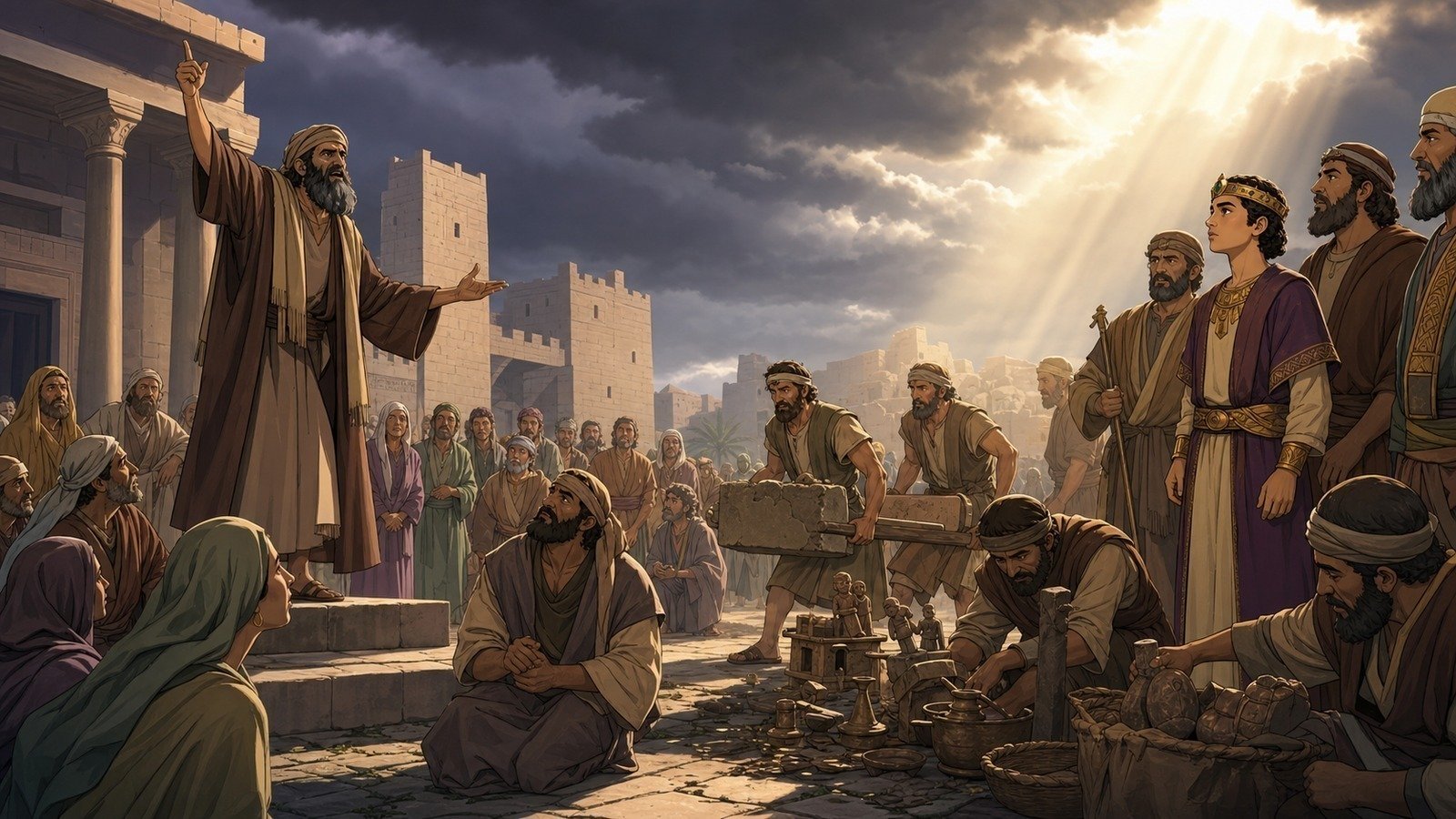
Zephaniah, identified in his own superscription as a descendant of Hezekiah, warns of a coming "day of the Lord" against Judah's idolatry, likely preaching before or alongside Josiah's reforms.
Further context
3 min readZephaniah's genealogy runs back four generations, which is unusual, and the fourth name is Hezekiah, which most take to mean the reforming king. If that is right, he is a member of the royal family attacking the royal court, and that would explain both his access and his specificity about who is doing what in Jerusalem.
He works under Josiah, and almost certainly before the reforms of that reign rather than after, because what he describes is a city where the shrines are still running.
The targets are named by function. The idolatrous priests, and those who bow down on the roofs to worship the starry host, and those who bow down and swear by the LORD and who also swear by Molek. That last group is the one he is most interested in: people doing both at once, hedging between two systems, which is exactly the condition Elijah had described a century and a half earlier as hobbling on two legs.
He also names the ones who are neither for nor against: those who are complacent, who are like wine left on its dregs, who think the LORD will do nothing, either good or bad. That is not idolatry. It is the assumption that nothing is at stake in any of it.
His central image is the day of the LORD, and he pushes it further than anyone before him. That great day is near and coming quickly. It will be a day of wrath, a day of distress and anguish, of trouble and ruin, of darkness and gloom, of clouds and blackness, a day of trumpet and battle cry. The Latin translation of two of those words, dies irae, became the opening of a medieval hymn used in the requiem mass for seven centuries and set to music by Mozart, Verdi and Berlioz.
The scope is not local. He describes judgement on Philistia, Moab, Ammon, Cush and Assyria, and Nineveh specifically, which is described as a city that says to itself, I am, and there is none besides me, and will become a desolation where flocks lie down and desert owls roost in the columns.
One phrase of his has had an afterlife nobody could have predicted. The Latin of two words from his description of the day of the LORD, dies irae, became the opening of a thirteenth-century hymn that entered the requiem mass and stayed there for seven hundred years, and the melody attached to it is quoted by composers from Berlioz to film scores as a shorthand for death.
The book ends somewhere else entirely. The final section addresses a restored remnant, a people meek and humble who trust in the name of the LORD, and contains a line that is unlike anything else in these books: the LORD your God is with you, he is mighty to save. He will take great delight in you; in his love he will no longer rebuke you, but will rejoice over you with singing.
Zephaniah works during Josiah's reign, most probably before the reform of 622 BC, since what he describes is a Jerusalem still full of foreign practice: people bowing on the roofs to the starry host, priests of Baal, those who swear by Molek, and officials and princes who are like roaring lions.
His central image is the day of the LORD, and he gives it its harshest form. A day of wrath, a day of distress and anguish, a day of trouble and ruin, a day of darkness and gloom, a day of clouds and blackness.
The Latin translation of that line, dies irae, became a medieval hymn and then the movement in the requiem mass that Mozart, Verdi and Berlioz all set.
He also has a phrase for the mentality he is attacking: those who are complacent, who are like wine left on its dregs, who think the LORD will do nothing, either good or bad.