

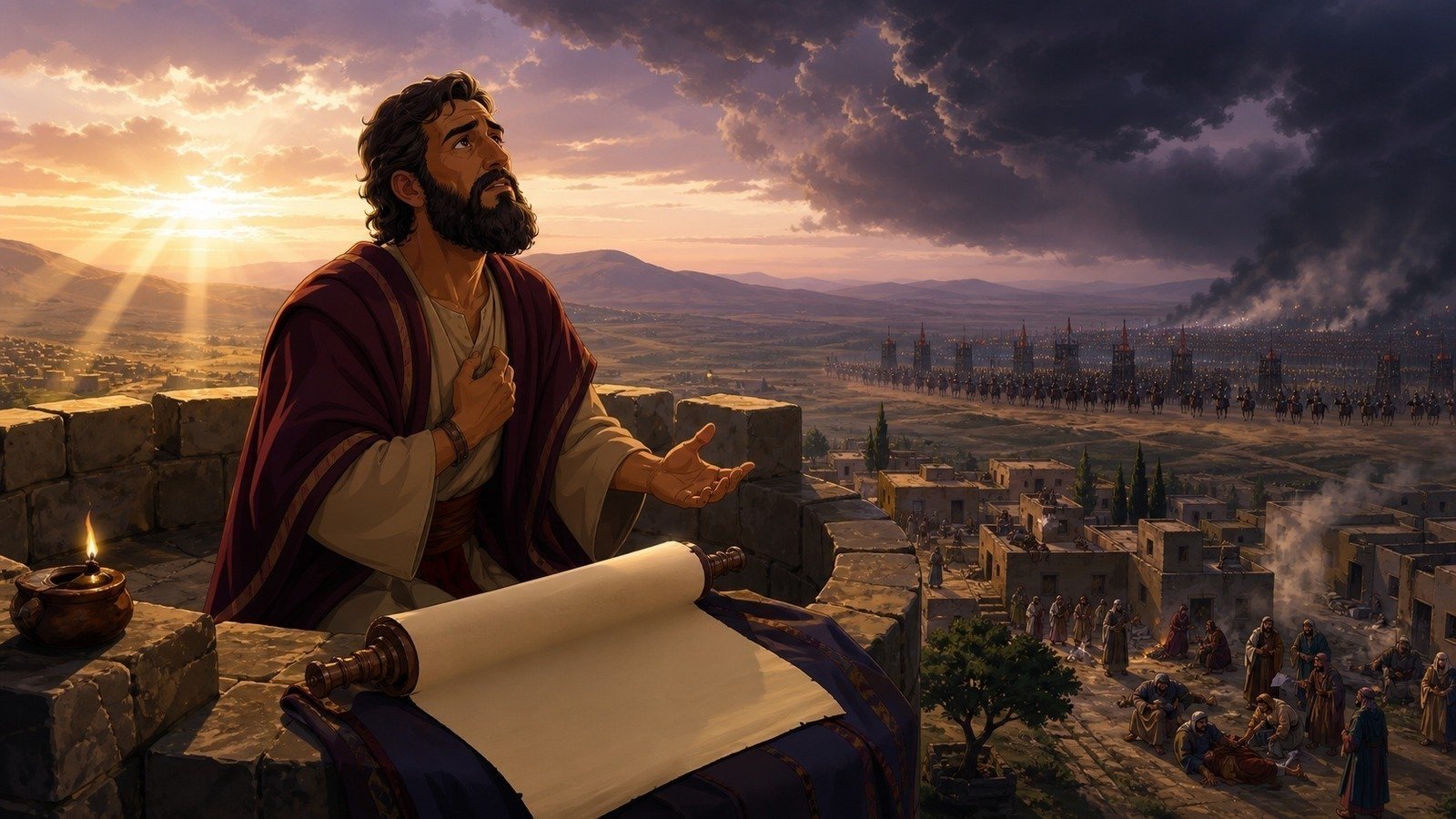
Habakkuk questions God directly about using the violent Babylonians to judge a sinful Judah, and is answered that "the righteous will live by his faith," a line Paul later builds central arguments on, before closing in a prayer of trust despite coming devastation.
Further context
3 min readHabakkuk is the only prophet whose book consists mostly of him arguing rather than delivering a message, and the argument is conducted in two rounds.
The first complaint is about his own country. How long, LORD, must I call for help but you do not listen? Or cry out to you, violence! but you do not save? Why do you make me look at injustice? Destruction and violence are before me; there is strife, and conflict abounds. The law is paralysed, and justice never prevails. The wicked hem in the righteous, so that justice is perverted.
The answer he gets is worse than the silence. God is raising up the Babylonians, that ruthless and impetuous people who sweep across the whole earth to seize dwellings not their own, whose horses are swifter than leopards, who gather prisoners like sand.
That produces the second and sharper complaint. Your eyes are too pure to look on evil; you cannot tolerate wrongdoing. Why then do you tolerate the treacherous? Why are you silent while the wicked swallow up those more righteous than themselves? He compares it to fish caught in a net by a fisherman who then worships his own net, which is an exact description of an empire deifying its own military power.
Then he says what he intends to do about it: I will stand at my watch and station myself on the ramparts; I will look to see what he will say to me, and what answer I am to give to this complaint. He is not walking away and he is not pretending to be satisfied. He is waiting.
The answer includes a sentence that carried an enormous distance: the righteous person will live by his faithfulness. Paul quotes it twice and the letter to the Hebrews once, and Luther's reading of it is one of the sparks of the Reformation. In its original setting it is an instruction about how to survive the interval between a question and an answer.
Five woes follow, aimed at the empire: piling up stolen goods, building a house by unjust gain, building a city with bloodshed, giving neighbours drink in order to gaze on their naked bodies, and making an idol and telling a lifeless block of wood to come to life.
The book ends with a poem set to music, with a musical instruction attached, and it closes on a position rather than a resolution. Though the fig tree does not bud and there are no grapes on the vines, though the olive crop fails and the fields produce no food, though there are no sheep in the pen and no cattle in the stalls, yet I will rejoice in the LORD.
He never gets an answer to the question he asked.
The structure is a genuine dialogue and there is nothing else quite like it. Habakkuk complains that God is doing nothing about violence and injustice in Judah. God answers that the Babylonians are being raised up to deal with it. Habakkuk's second complaint is much sharper than his first: why are you silent while the wicked swallow up those more righteous than themselves?
The answer given includes the sentence that Paul builds two letters on and that Luther read his way into the Reformation through: the righteous person will live by his faithfulness.
The second half is a series of five woes against the empire, and they are aimed at specific things: piling up stolen goods, building a city with bloodshed, getting neighbours drunk in order to look at them, and carving idols and telling wood to come to life.
It ends with a poem set to music, which is the only prophetic book to close with a musical direction.