

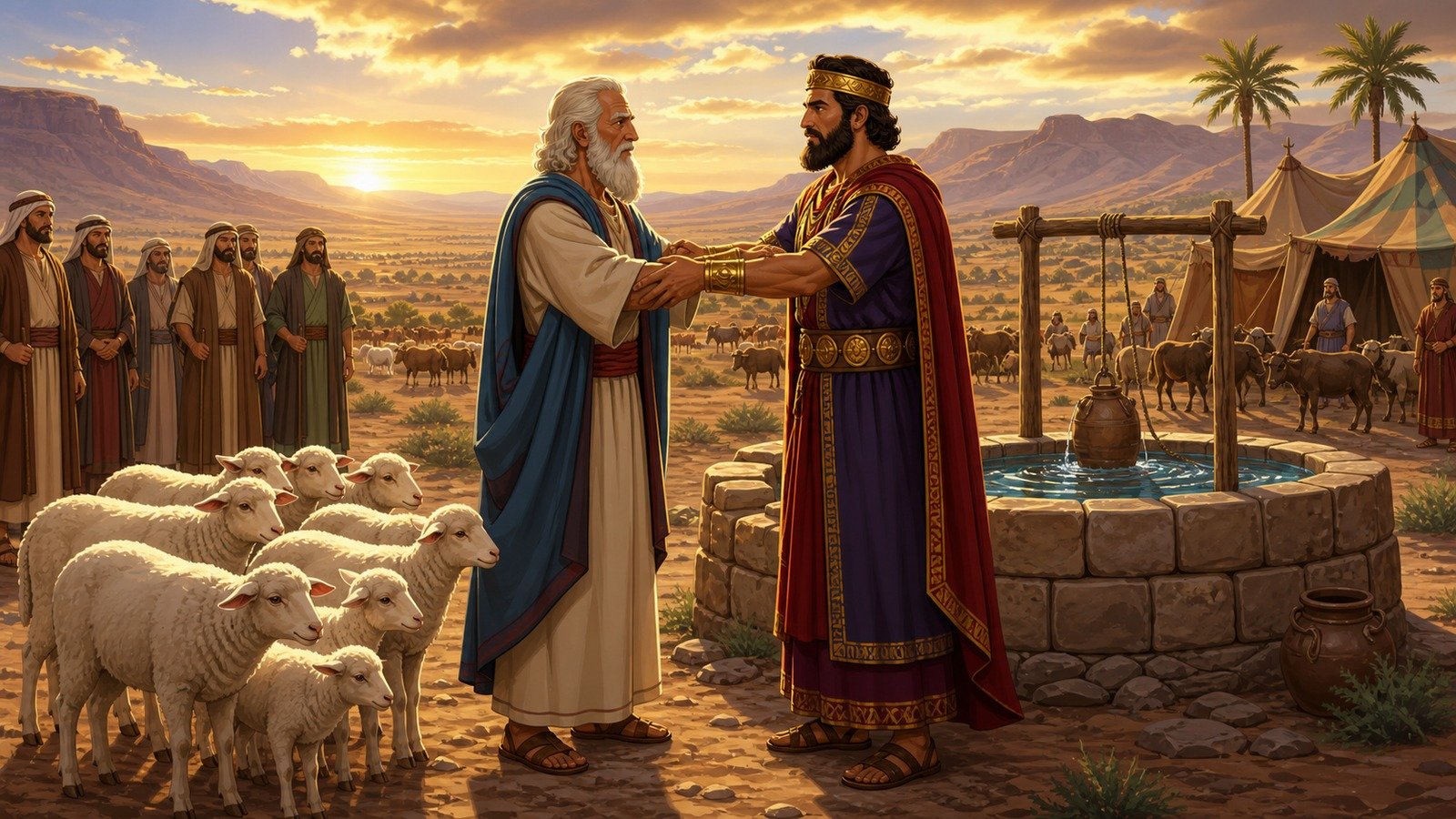
Abraham and Abimelech resolve a dispute over a well and formalise a mutual non-aggression treaty at Beersheba, which Abraham names for the oath ("well of the oath" or "well of seven") sworn there.
Further context
3 min readAbimelech arrives with Phicol, the commander of his forces, and the presence of an army commander signals that this is state business rather than a social call. The king opens with an observation: God is with you in everything you do. His request follows from it. Swear to me that you will not deal falsely with me or my children or my descendants, and show to me and to the country where you now live the same kindness I have shown to you.
Abraham swears, and then raises a grievance. A well he dug has been seized by Abimelech's servants. In the semi-arid Negev that is not a minor complaint. Digging a well was a substantial investment of labour, and control of water decided whether flocks could be kept in a district at all. Wells are the capital assets of these chapters, and disputes over them keep recurring.
Abimelech says he does not know who did it, that Abraham never told him, and that he has only heard of it today. The two then make a treaty, and Abraham gives sheep and cattle. He also sets seven ewe lambs apart from the flock, and when asked what they are for, says they are to be accepted as a witness that he dug the well.
The place takes its name from that, and the Hebrew supports two readings at once. The first element means well, and the second is both the number seven and the root behind the verb to swear an oath, which in Hebrew is literally to seven oneself. Beersheba records the seven lambs and the oath in the same word.
Abraham plants a tamarisk there and calls on the name of the Eternal God (El Olam). The tamarisk is a slow-growing tree that tolerates saline desert soil, and planting one is what somebody does who expects to be in a place for a long time.
This treaty is the first legal recognition he receives anywhere in the country. He has been promised the whole territory and holds none of it, and here a local king formally acknowledges his water rights and swears mutual non-aggression. The only other property he ever acquires is a burial cave.
One feature needs flagging. This is described as the land of the Philistines, and the Philistines as an archaeological presence on the southern coastal plain date from around 1200 BC, long after any plausible date for Abraham. Their arrival is marked by distinctive Aegean-style pottery at Ashdod, Ashkelon, Ekron and Gath. As with the camels earlier, the most economical explanation is that a later hand used the name current in the reader's own day for the region and its inhabitants.
Beersheba itself is a real place with a long history. The Iron Age town at Tel Be'er Sheva, with its well outside the gate, belongs to a much later period than the patriarchs, and the reason settlement kept recurring there is straightforward: it sits where several routes meet and where groundwater can be reached.
It also becomes the standard marker of the southern limit of the country. The phrase from Dan to Beersheba is used repeatedly in the later historical books to mean the whole land from top to bottom, and the southern end of that expression is this well, dug by a foreigner with no legal title to anything and secured by a treaty with a local king over seven ewe lambs.