

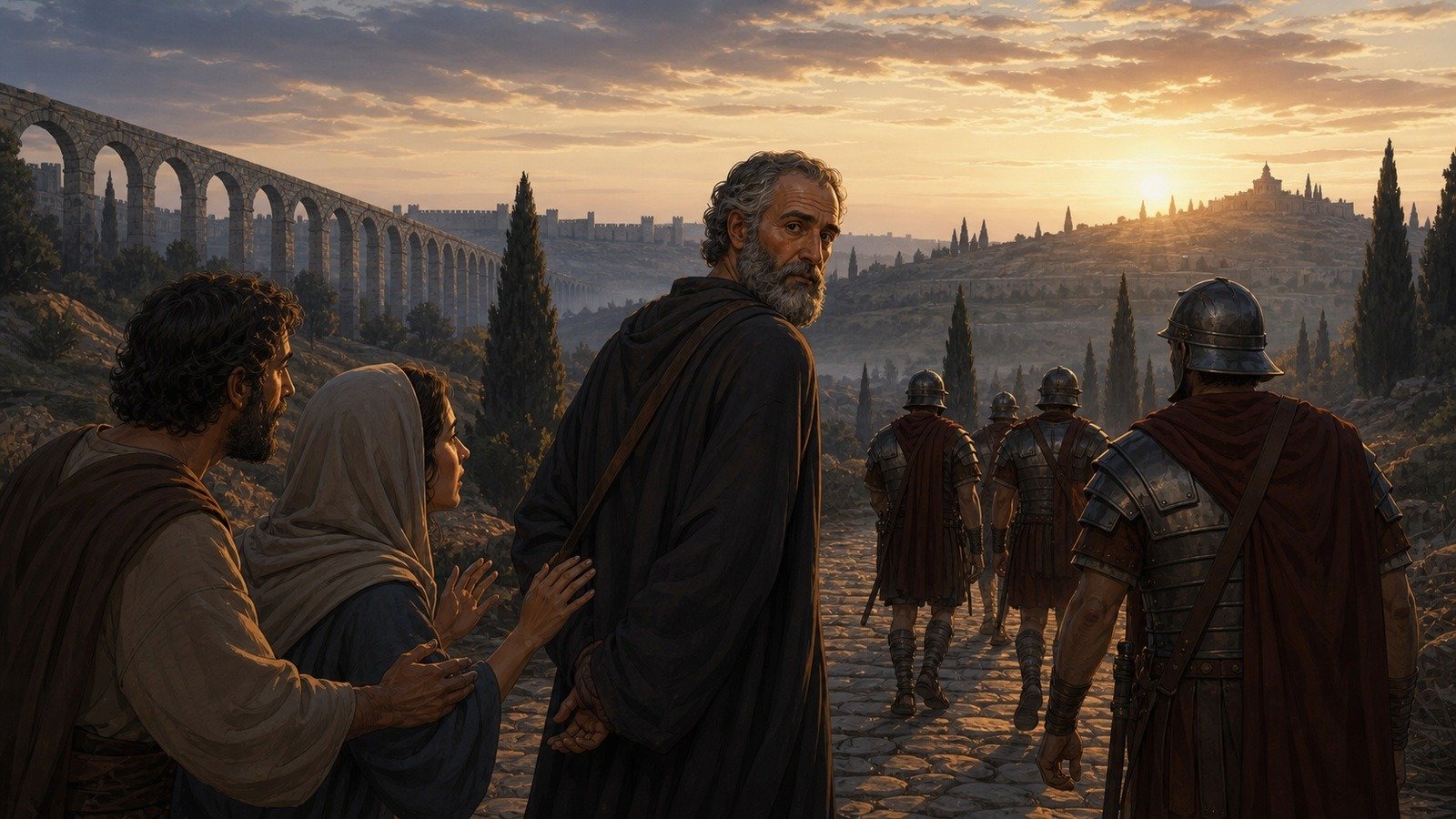
Church tradition, first recorded by writers such as Clement of Rome and later Eusebius, holds that Paul was executed in Rome under the emperor Nero, reportedly by beheading as a Roman citizen; the New Testament itself does not narrate his death.
No canonical Scripture reference (early church tradition, not narrated in the New Testament)
Further context
2 min readThe New Testament does not describe Paul's death. The record of the church's early years leaves him under house arrest in Rome, preaching without hindrance, and stops.
What is known comes from outside it, and the earliest source is very early indeed. Clement, writing from Rome to the church at Corinth around AD 96, says that Paul, after teaching righteousness to the whole world and reaching the limits of the west, bore testimony before the rulers and so departed from the world. That is roughly thirty years after the event, written in the city where it happened.
The limits of the west is generally taken to mean Spain, which Paul had told the Romans he intended to visit, and if he got there it requires a release from the imprisonment described and a further period of travel, which is also what the pastoral letters assume.
Later sources are more specific and less reliable. A second-century account of Paul's acts describes his beheading outside the city on the road to Ostia, and Eusebius, writing in the fourth century, cites a Roman writer of about AD 200 who pointed to the memorials of the two apostles, Peter's on the Vatican hill and Paul's on the Ostian Way.
Beheading rather than crucifixion is what the tradition consistently reports, and it follows from his status. A Roman citizen convicted of a capital offence was executed by the sword; crucifixion was for slaves and provincials.
The date is usually put between AD 64 and 68, in the persecution that followed the great fire at Rome in July 64. Tacitus describes what happened then in detail: Nero, to dispel the rumour that he had started the fire himself, fastened the guilt on a class hated for their abominations, called Christians by the populace. They were covered with the skins of beasts and torn to pieces by dogs, or nailed to crosses, or set alight to serve as lamps when daylight failed.
That paragraph, written by a hostile pagan historian around AD 116, is one of the earliest non-Christian references to the movement and to its founder, whom Tacitus says was executed under Pontius Pilate.
The basilica of St Paul Outside the Walls stands over the traditional burial site. A sarcophagus beneath the altar was examined in 2009 and found to contain bone fragments radiocarbon dated to the first or second century.
Nothing in Clement's letter says how Paul died, only that he bore testimony before the rulers and departed. The specific details all come from later sources with a taste for detail.
Whether he reached Spain is unresolved. No church there claims a foundation by him in any early source, which is an argument from silence and a reasonably loud one.
Tacitus's paragraph on the persecution says the victims were convicted not so much of arson as of hatred of the human race, which is what the movement looked like from outside when its members refused the civic gods.
Clement's letter to Corinth is the earliest Christian writing outside the New Testament, and its reason for mentioning Paul and Peter is not biographical: he is arguing that jealousy destroys, and he cites them as men destroyed by it.