

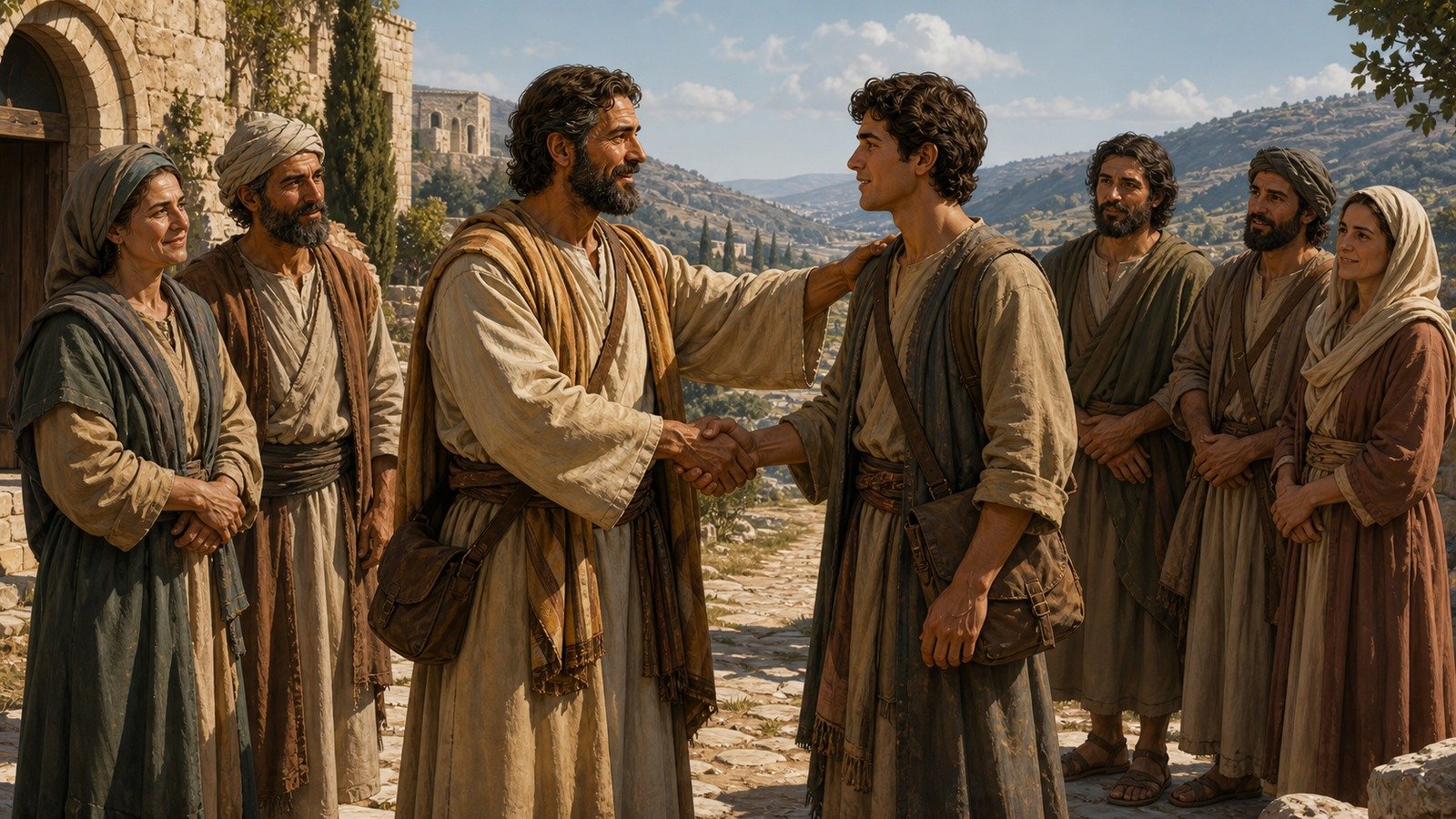
At Lystra, Paul recruits a young disciple named Timothy, son of a Jewish mother and Greek father, who becomes one of his closest and most frequently mentioned co-workers in the letters that follow.
Further context
2 min readAt Lystra, the town where Paul had been stoned and dragged out as dead, he finds a disciple named Timothy.
His mother was Jewish and a believer, and his father was a Greek. That combination created a specific legal and social problem. Under Jewish reckoning descent through the mother made him a Jew, so he was obliged to keep the law; but he had not been circumcised, presumably because his father would not permit it, which meant he was a Jew in an irregular position and everyone in two towns knew it.
The believers at Lystra and Iconium spoke well of him. Paul wanted to take him along on the journey, so he circumcised him because of the Jews who lived in that area, for they all knew that his father was a Greek.
That decision looks, on the surface, like a straight contradiction of everything Paul had just fought for in Jerusalem, and it was thrown at him as one. He had refused point blank to allow Titus, a Gentile, to be circumcised, and says so with some heat in a letter.
The distinction he is working with is consistent even if it is uncomfortable. Circumcision as a requirement for salvation he opposed absolutely. Circumcision as a practical arrangement, undertaken freely so that a man with a Jewish mother could enter synagogues without becoming the subject of the argument every time, he was willing to do. He states the principle himself: to the Jews I became like a Jew, to win the Jews.
Whether that is flexibility or inconsistency has been argued about for two thousand years, and Paul would have said the difference lies in whether anything is being demanded.
Timothy becomes the most frequently mentioned of his co-workers. He is named as co-sender of six letters, sent as an envoy to Corinth, Thessalonica and Philippi, described as a son to Paul, and left in charge at Ephesus. Two of the letters attributed to Paul are addressed to him personally.
He is also described as young, as having frequent stomach ailments, and as needing to be told not to let anyone look down on him, which is an unusually complete portrait of a man in the ancient world.
The last thing Paul is recorded writing is a request for him to come quickly, and to bring the cloak, the scrolls and Mark.
Timothy's father is mentioned only as a Greek and only in the past tense, which most readers take to mean he was dead by this point. His mother Eunice and grandmother Lois are named in a letter as women of sincere faith, and the same letter says he had known the Holy Scriptures from infancy, so the Jewish half of the household had done the teaching.
He was probably in his late teens or early twenties when Paul collected him.
He is described in one letter as having been given something through prophecy with the laying on of hands by the body of elders, which is the only glimpse of a formal commissioning of a co-worker anywhere in the letters.