

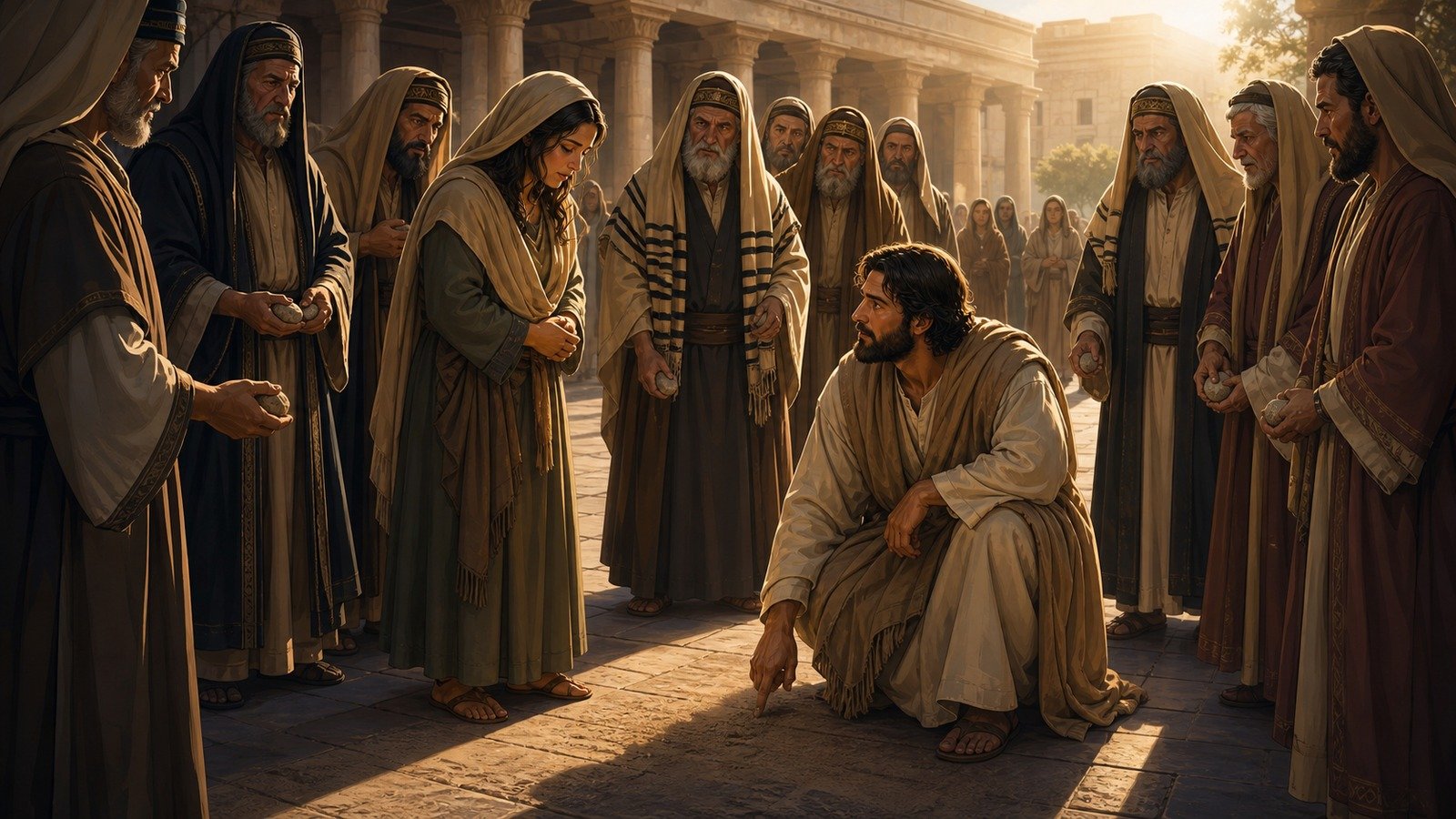
Religious leaders bring a woman caught in adultery to test Jesus, demanding he either endorse her stoning under the Law or contradict it; he defuses the trap with, "Let any one of you who is without sin be the first to throw a stone."
Further context
3 min readBefore anything else about this episode, a difficulty has to be stated plainly, because it is not hidden in modern Bibles and a reader will see a note about it.
The earliest and best Greek copies do not contain this story. It is absent from the great fourth-century manuscripts, unknown to the Greek commentators of the early centuries who work through the surrounding material verse by verse, and in the copies that do have it it wanders: most place it here, some put it elsewhere in the same book, and a group of manuscripts places it in Luke. Almost every scholar who works on the manuscripts concludes it was not part of the original book. A great many also judge that it is an authentic account of something that happened, circulating independently and eventually written down in the margin of a Gospel by a scribe who did not want to lose it. Those two judgements are compatible and are commonly held together.
The scene itself is a legal trap constructed carefully.
Teachers of the law and Pharisees bring a woman caught in adultery and make her stand before the group in the temple courts at dawn. They state the law: Moses commanded us to stone such women. Now what do you say?
The trap has two jaws. The law does prescribe death for adultery, though stoning specifically is prescribed for a betrothed girl, and by this period Jewish courts had made the evidential requirements so demanding that executions for it were vanishingly rare. Rome had also removed the right of capital punishment from Jewish courts. So if he says stone her, he is inciting an illegal execution and can be reported to the prefect. If he says let her go, he is setting aside the law of Moses in public.
The obvious question, which the passers-by would have asked immediately, is where the man was. Adultery requires two people and the law prescribed death for both, and only the woman is standing there.
He bends down and writes on the ground with his finger. What he wrote is unknown, and the guesses run from the sins of the accusers to the words of a prophet about those who turn away being written in the dust. The gesture itself, refusing to look at the woman on display, does something before a word is said.
When they keep questioning him he straightens up: let any one of you who is without sin be the first to throw a stone at her. Then he bends down and writes again.
They leave one at a time, the older ones first, until only the two of them are left.
Then, has no one condemned you? No one, sir. Neither do I condemn you. Go now and leave your life of sin.
Modern editions handle the problem differently. Some print the story in its traditional place inside brackets, some set it off with a note, and a few relegate it to a footnote or an appendix. None of them simply removes it, and the reason is partly its age: it was known to Latin writers in the fourth century, and the Latin version used across the western church for a thousand years included it.
Whatever a reader concludes about where it belongs, the thing being tested was real, and men who could produce a woman without producing the man she was caught with were not defending the law they were quoting.