

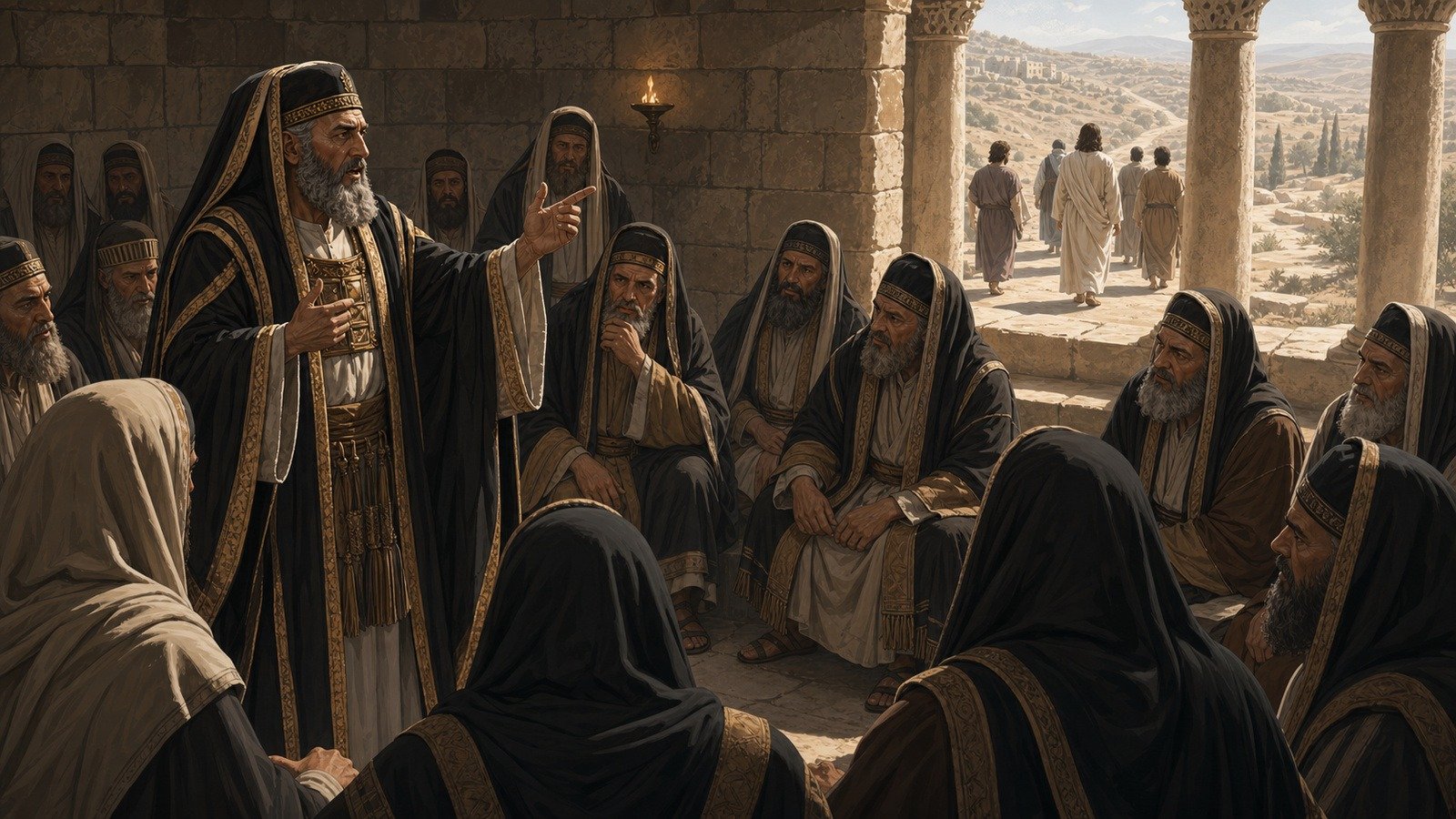
Alarmed by Lazarus's raising and the popular response to it, the chief priests and Pharisees convene the Sanhedrin; the high priest Caiaphas argues it is expedient for one man to die for the nation, and Jesus withdraws from public view to a town called Ephraim until the time is right.
Further context
3 min readThe council meets because of a man walking around Bethany who had been buried the week before, raised by Jesus in front of a crowd of mourners, and their reasoning is set out with unusual candour.
What are we accomplishing? Here is this man performing many signs. If we let him go on like this, everyone will believe in him, and then the Romans will come and take away both our temple and our nation.
Notice what is not disputed. Nobody in the room questions that things are happening; the problem is the crowds and what Rome would do about them.
That fear was rational. Judea had been under direct Roman administration since AD 6, and the prefect kept order with auxiliary troops garrisoned at the Antonia fortress overlooking the temple courts, with reinforcements coming up from Caesarea for the festivals precisely because festivals were when trouble started. Josephus records several messianic movements in the first century, and every one of them ended with soldiers. The council's authority over internal Jewish affairs existed at Rome's discretion and could be withdrawn.
Forty years later the Romans did come, and both the temple and the nation went, which is a bitter footnote to the argument.
Caiaphas, the high priest that year, cuts across the discussion. You know nothing at all. You do not realise that it is better for you that one man die for the people than that the whole nation perish.
That is a piece of political arithmetic, and it is the oldest one there is: sacrifice the individual to protect the institution. Caiaphas held the high priesthood for about eighteen years, an unusually long tenure under Roman prefects who removed high priests at will, which tells you he was skilled at exactly this kind of calculation. His ossuary, an ornate limestone bone box inscribed with the family name, was found in a burial cave south of Jerusalem in 1990.
The comment is then given a second meaning: he did not say this on his own, but as high priest he prophesied that Jesus would die for the nation, and not only for that nation but for the scattered children of God, to bring them together and make them one.
From that day on they plotted to take his life.
He no longer moves publicly among the people, and withdraws to a village called Ephraim near the wilderness, most probably the settlement identified with et-Taiyiba about twenty kilometres north-east of Jerusalem, on the edge of the barren country dropping towards the Jordan. It is a place chosen for being close enough to return and remote enough to be left alone.
Passover is approaching, and people arriving early to purify themselves stand in the temple courts asking each other whether he will come to the festival at all. Orders have been given that anyone knowing where he is must report it.
The composition of the council explains the alliance. It contained both Sadducees, drawn from the priestly families and holding the presidency through the high priest, and Pharisees, who had the confidence of ordinary people. The two parties disagreed about doctrine, about the oral law and about how far to cooperate with Rome, and they are shown here agreeing on a single practical point.
Caiaphas was the son-in-law of Annas, who had held the high priesthood before him and whose sons held it after, so what is being protected is a family position as well as a national one.