

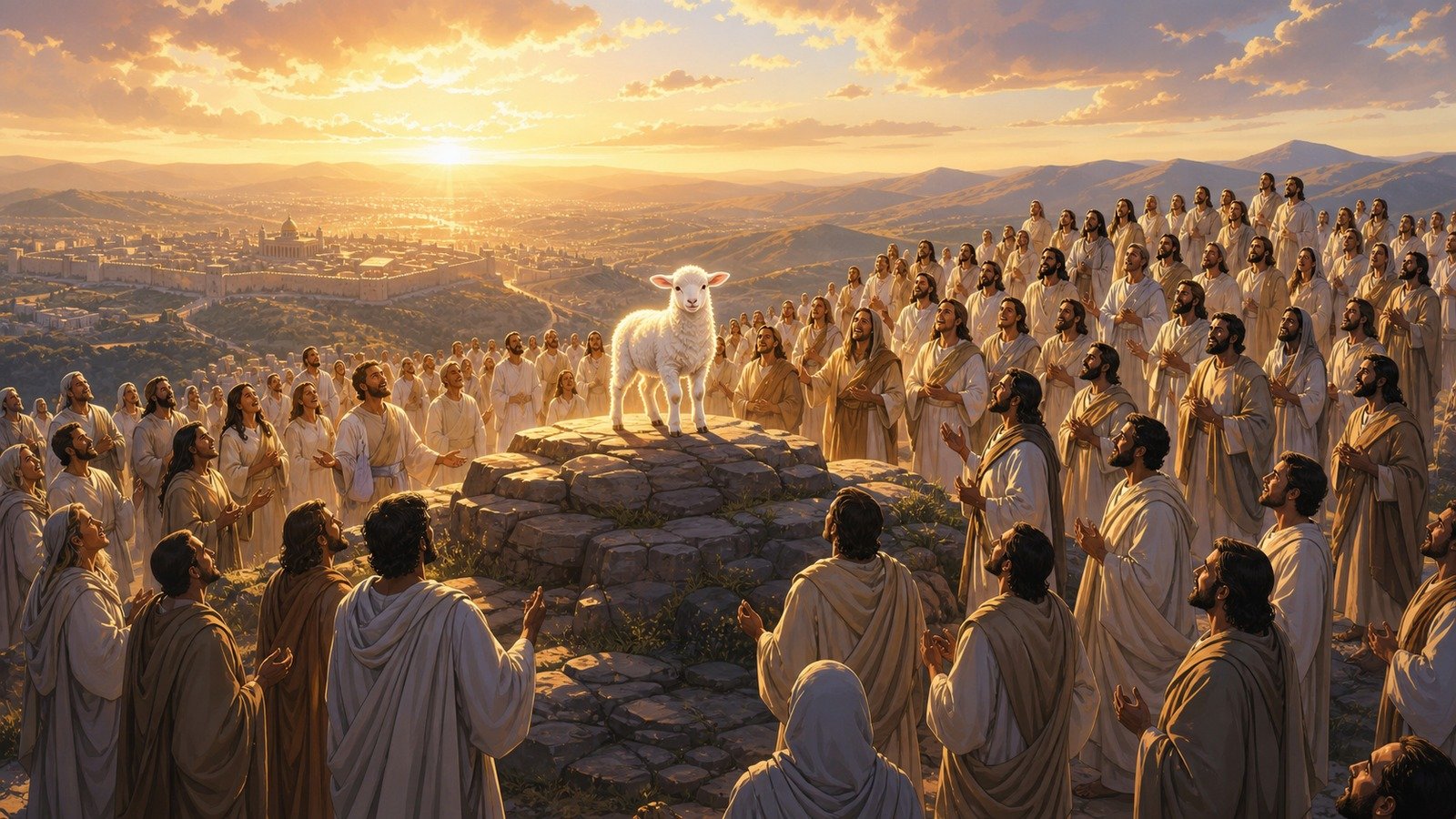
John sees the Lamb standing on Mount Zion with the 144,000, singing a new song only they can learn, described as having "kept themselves pure" and following the Lamb wherever he goes.
Further context
3 min readImmediately after the beast has been given authority over every tribe and nation, and after everyone has been marked on the hand or the forehead, John looks and sees the Lamb standing on Mount Zion.
The placing is the argument. Two chapters have just described a system that requires worship and kills those who refuse, and the answer offered is a picture of a crowd standing somewhere else.
With the Lamb are a hundred and forty-four thousand who have his name and his Father's name written on their foreheads. Against a mark on the forehead is set a name on the forehead, and the two are made deliberately parallel.
Mount Zion is the hill Jerusalem was built on, and by this period the name stood for the city and for the place God was said to have chosen. Whether the vision means an earthly or a heavenly Zion is unstated, and readers have taken it both ways.
John hears a sound from heaven like the roar of rushing waters and a loud peal of thunder, and then something quite different: the sound of harpists playing their harps. They sing a new song before the throne, and no one could learn it except the hundred and forty-four thousand.
Three things are said about them.
They did not defile themselves with women, for they remained virgins. That sentence has caused more discomfort than almost any other in the book, and it has been read in three ways: as literal celibacy, as an image drawn from the rule requiring soldiers on campaign to abstain, or, most commonly, as the standard prophetic image in which idolatry is described as adultery. The book calls the opposing city a prostitute a few chapters later, which supports the third reading.
They follow the Lamb wherever he goes.
And no lie was found in their mouths; they are blameless. Truthfulness is an odd item to put in that position until the surrounding chapters are remembered, in which a false prophet deceives the whole world with signs.
They are also described as offered as firstfruits to God and the Lamb, which in the law is the first portion of a harvest, given as a pledge that the rest is coming.
Whether these are the same hundred and forty-four thousand who were sealed earlier is generally assumed and never stated. There the number was counted out by tribe before judgement fell; here the same number is standing on the far side of it, which suggests the sealing worked.
The new song is one of several in the book, and the tradition of new songs runs through the psalms, where the phrase marks a fresh deliverance rather than a fresh composition. That no one else could learn it has been read as meaning a song about an experience only they had.
Nothing in the scene involves the beast at all. It has authority over every tribe and nation, and the crowd on the hill is not in its territory.
Firstfruits in the law were brought to the sanctuary at the start of a harvest and belonged to God, and the rest of the crop followed. Applying the term to a group of people implies that they are the beginning of something larger rather than the whole of it, which cuts against reading the number as a limit.
The harps are the only musical instruments named in the book apart from trumpets, and they belong to worship rather than to war.
Standing is the posture given to the Lamb when he was first seen, described as looking as if it had been slain and standing, and the crowd on the hill is doing the same thing.