

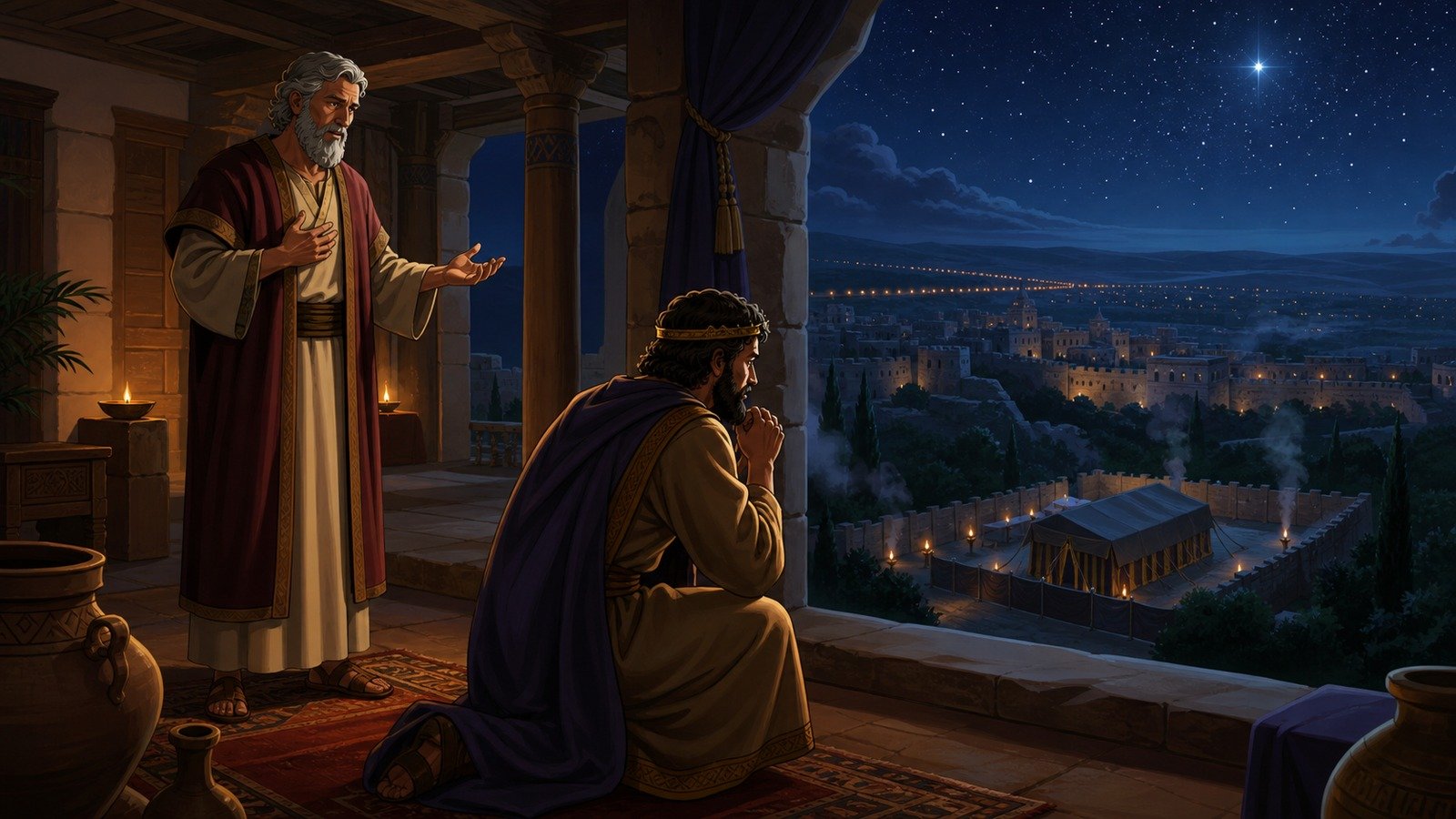
David proposes building God a permanent temple; instead, God promises through Nathan that David's own house, throne and kingdom will endure forever, a promise the New Testament repeatedly applies to Jesus as David's ultimate heir.
Further context
2 min readThe king is settled in his palace and the country is at peace, and he raises something with the prophet Nathan: here I am, living in a house of cedar, while the ark of God remains in a tent. Nathan tells him to go ahead and do whatever he has in mind, because the LORD is with him.
That night Nathan is told to go back and reverse it, and the message he carries is the most consequential thing anyone says to David.
It opens with a question that is close to teasing. Are you the one to build me a house to dwell in? I have not dwelt in a house from the day I brought the Israelites up out of Egypt to this day. I have been moving from place to place with a tent as my dwelling. Wherever I have moved, did I ever say to any of their rulers, why have you not built me a house of cedar?
Then the reversal that the whole thing turns on. You will not build me a house. I will build you a house.
The Hebrew word for house carries three meanings at once and all three are in play: a building, a dynasty and a household. David proposed a building. What he is given is a dynasty.
The terms are specific. His offspring will succeed him and will build the temple. God will establish that kingdom for ever. He will be a father to him and he will be a son. And here is the clause that separates this from every other covenant so far: when he does wrong, God will punish him with a rod wielded by men, but his love will never be taken away from him as it was taken from Saul. Failure is anticipated in the terms and does not void them.
His response is to go in and sit before the LORD, which is an unusual posture, and the prayer he prays is mostly astonishment. Who am I, Sovereign LORD, and what is my family, that you have brought me this far?
One clause is worth separating out because it is easy to skim. God says he took David from the pasture, from tending the flock, to be ruler over his people, and that he has been with him wherever he went and has cut off all his enemies. The whole covenant is prefaced by a summary of what has already been given, in the same order as the Sinai covenant, which opened with the deliverance from Egypt before any command was issued. The pattern is consistent: what is promised comes after a recital of what was done.
Everything later expectation of a coming king is built on this promise. The prophets return to it repeatedly when the actual descendants of David turn out badly, and by the time the monarchy has been destroyed and the line has stopped ruling anything, the promise of a throne established for ever has become the thing hope attaches to. Both genealogies at the front of the New Testament exist to establish that a particular man in Nazareth descends from this household.