

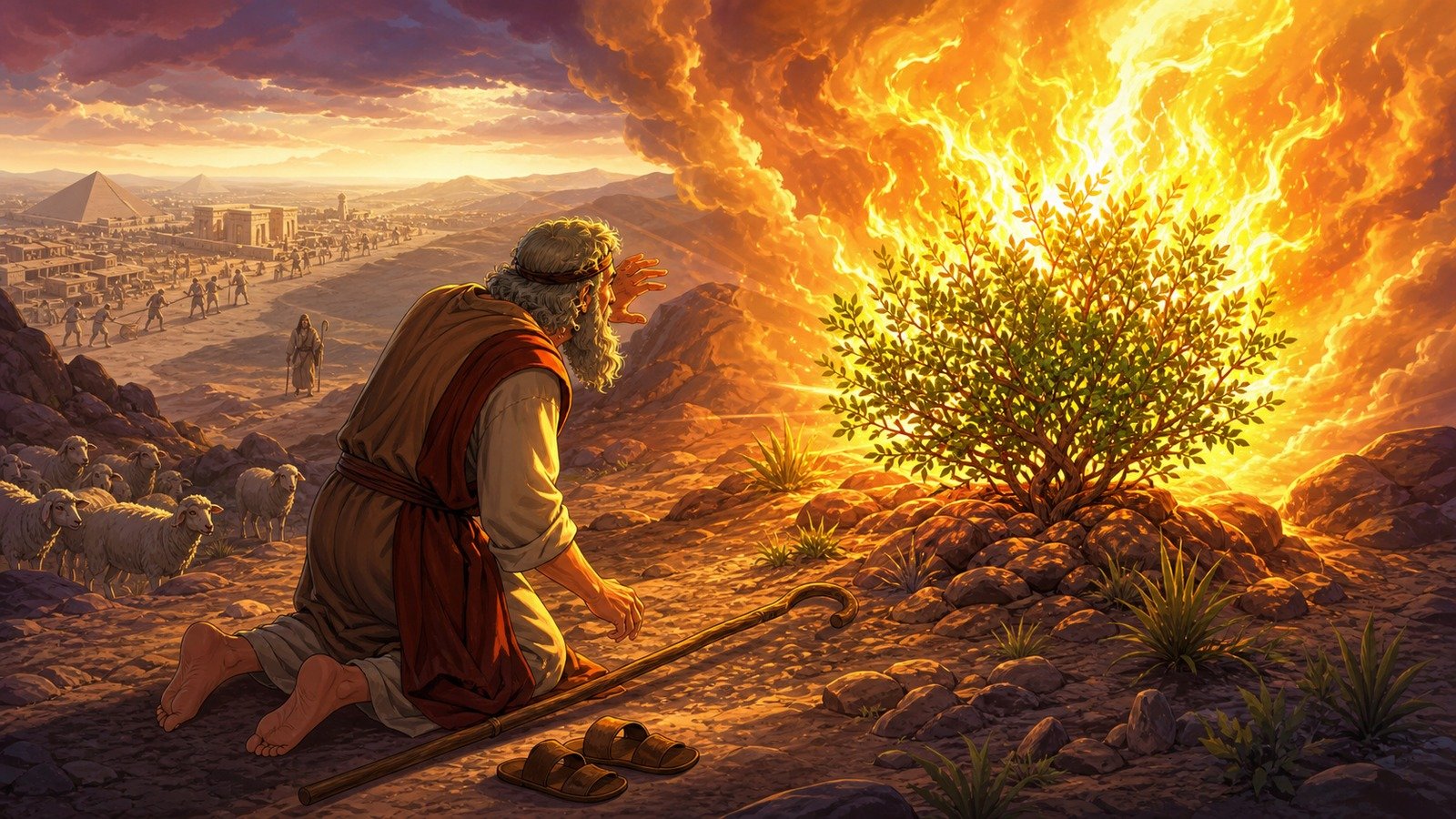
God appears to Moses in a burning bush that is not consumed, reveals his covenant name (YHWH, "I am who I am"), and commissions him to confront Pharaoh and lead Israel out of Egypt, despite Moses' repeated objections.
Further context
2 min readMoses is eighty years old and tending someone else's sheep. Forty years have passed in Midian, and the man who once killed an Egyptian in defence of his own people is a shepherd on the far side of a desert with a wife, a son and no prospects.
He leads the flock to Horeb, called the mountain of God, and sees a bush on fire that is not burning up. What catches his attention is the absence of destruction rather than the flame, and he turns aside to look, at which point he is addressed by name.
He is told to take off his sandals because the ground is holy, and then comes the self-identification: I am the God of your father, the God of Abraham, the God of Isaac and the God of Jacob. Jesus later quoted that sentence in an argument about resurrection, on the grounds that God speaks of those three in the present tense long after all of them were dead.
What is said next is expressed in terms of attention rather than power. I have indeed seen the misery of my people in Egypt. I have heard them crying out because of their slave drivers, and I am concerned about their suffering. So I have come down to rescue them. Then the commission: so now, go. I am sending you to Pharaoh.
He raises five objections in succession, and the sequence is the substance of the encounter.
Who am I, that I should go? The answer does not address his qualifications at all: I will be with you.
What is your name? The reply is ehyeh asher ehyeh, which can be rendered I AM WHO I AM or I WILL BE WHAT I WILL BE, since Hebrew does not divide tenses the way English does. The name given for use is the four consonants transliterated YHWH, related to the verb to be, and printed in most English Bibles as LORD in small capitals. Later Jewish practice avoided pronouncing it, substituting another word, which is why its original vocalisation is uncertain.
What if they do not believe me? Three signs are given: a staff that becomes a snake, a hand that turns leprous and is restored, and water from the Nile that becomes blood.
I have never been eloquent. I am slow of speech and tongue. The answer is a question about who gave the human mouth, and a promise to help him speak.
Please send someone else. Here God's anger burns against him, and Aaron is appointed as his mouthpiece.
One incident on the journey afterwards is among the most obscure anywhere. At a lodging place on the way, the LORD meets Moses and is about to kill him, and Zipporah takes a flint knife, circumcises their son, touches Moses' feet with the foreskin and says he is a bridegroom of blood to her. Three sentences, no reason supplied and nothing explained. Proposals connect it to the covenant of circumcision that he had neglected in his own household, which is the most economical reading, and no interpretation commands agreement.