

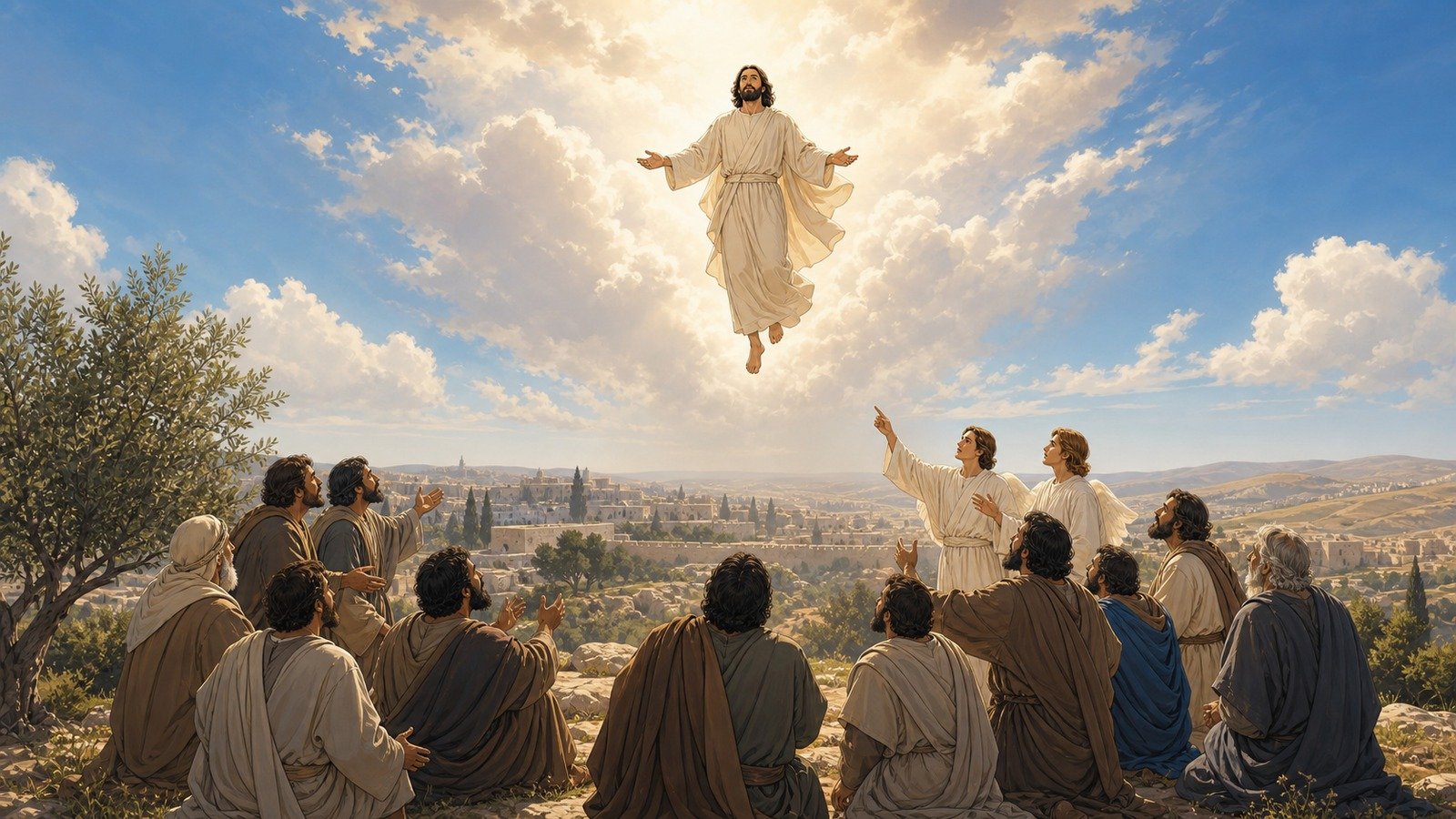
Having appeared to his disciples over forty days, teaching them about the kingdom of God, Jesus leads them out near Bethany, blesses them, and is taken up into a cloud out of their sight; two angels tell the watching disciples he will return "in the same way you have seen him go."
Further context
2 min readOver forty days after the crucifixion Jesus appears to the disciples repeatedly and speaks to them about the kingdom of God, and then it stops.
The forty days is stated only once, by Luke at the opening of his history of the church's first years, and it matches the pattern of forty-day periods that runs through the Bible: the flood, Moses on the mountain, Elijah's journey to Horeb, the wilderness temptation.
On the last occasion he tells them not to leave Jerusalem but to wait for the gift the Father promised. John baptised with water, but in a few days you will be baptised with the Holy Spirit.
Their question in reply shows where their minds still were. Lord, are you at this time going to restore the kingdom to Israel? After everything, they are asking about national independence, which is what almost anyone in that country would have been asking.
The answer neither confirms nor denies it. It is not for you to know the times or dates the Father has set by his own authority. But you will receive power when the Holy Spirit comes on you, and you will be my witnesses in Jerusalem, and in all Judea and Samaria, and to the ends of the earth.
That sentence is also the outline of everything that follows in the record of the early church: it begins in Jerusalem, spreads through Judea and Samaria, and ends with Paul preaching in Rome.
He leads them out to the vicinity of Bethany, on the eastern slope of the Mount of Olives, lifts up his hands and blesses them, and while he is blessing them he is taken up before their eyes, and a cloud hides him from their sight.
The cloud is the same image used at the transfiguration and at Sinai, where God is present and hidden at once.
Two men dressed in white stand beside them and ask why they are standing there looking into the sky. This same Jesus, who has been taken from you into heaven, will come back in the same way you have seen him go into heaven.
What the ascension means doctrinally is more than a departure. It marks the end of the appearances, the point after which the movement had no visible leader, and the beginning of a period of waiting that lasted ten days.
They return to Jerusalem with great joy, which is not the obvious reaction, and stay continually at the temple, praising God.
The Mount of Olives is about a kilometre from the temple mount, separated by the Kidron valley, and rises to roughly eight hundred metres, which puts the city and the temple platform in full view from the western slope.
The place has been marked since the fourth century, and a small octagonal shrine now stands on the traditional site.
Christian teaching has made a good deal of what the ascension implies rather than what it describes: that the risen body went somewhere, that the man who lived in Galilee is not a memory, and that the waiting the disciples were told to do has an end.