
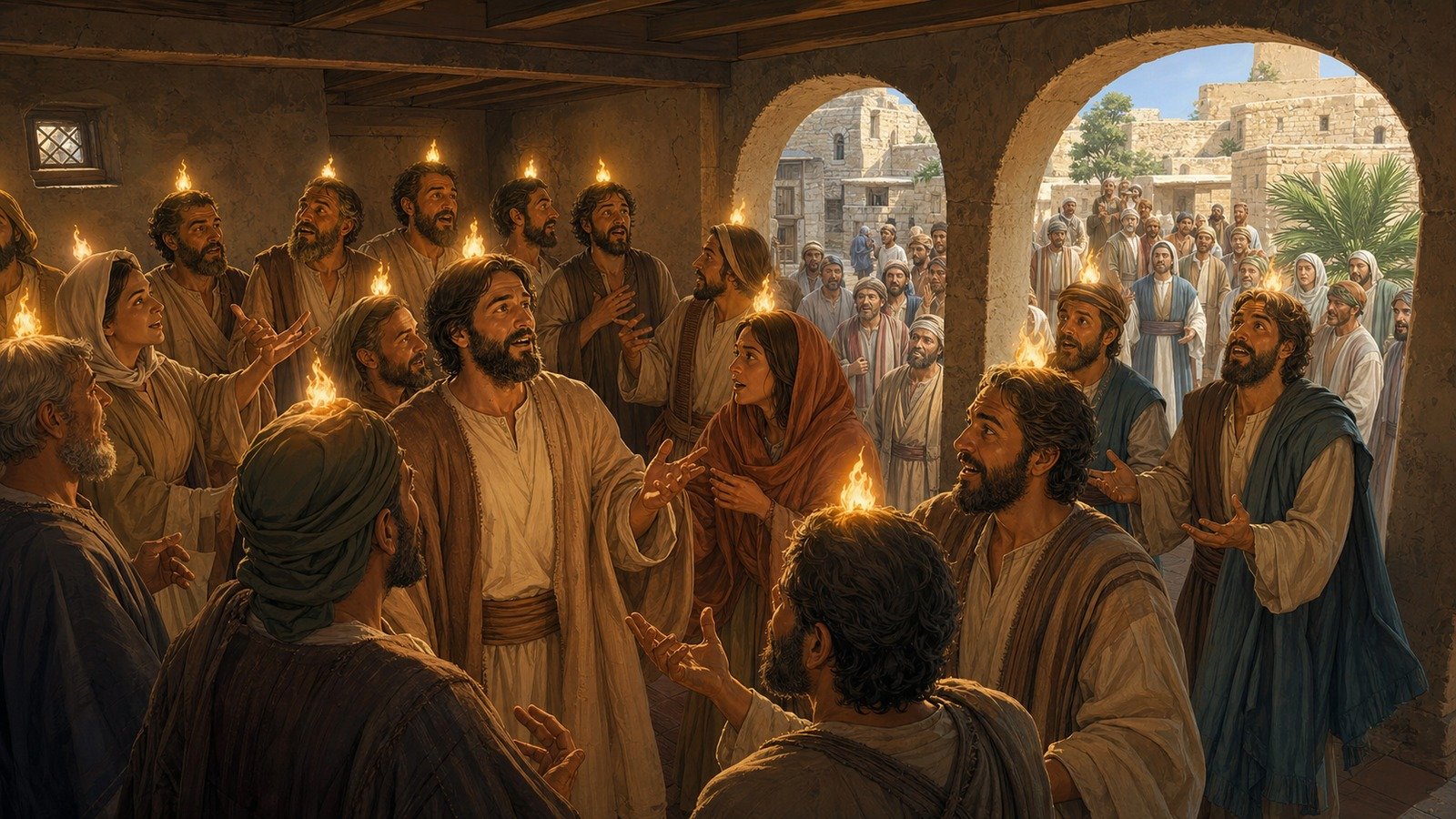
Fifty days after Passover, the gathered disciples experience what they describe as a sound like a rushing wind and tongues of fire, and begin speaking in other languages; pilgrims from across the Mediterranean world each hear their own tongue being spoken.
Further context
2 min readPentecost is the Greek name for the Feast of Weeks, held fifty days after Passover. It was a harvest festival marking the wheat crop, one of the three occasions when Jewish men were required to come to Jerusalem, and by the first century it had also become associated with the giving of the law at Sinai.
That association matters, because what is described has the same furniture: wind, fire and a mountain of people.
The believers, about a hundred and twenty of them, are all together in one place when a sound like the blowing of a violent wind comes from heaven and fills the whole house. The word for wind and the word for spirit are the same in both Hebrew and Greek, and the pun is unavoidable in either.
What appear to be tongues of fire separate and come to rest on each of them, and all of them are filled with the Holy Spirit and begin to speak in other languages.
The crowd that gathers is the point of the episode. Jerusalem was full of Jews from across the empire and beyond, and the list given is geographical and specific: Parthians, Medes and Elamites; residents of Mesopotamia, Judea and Cappadocia, Pontus and Asia, Phrygia and Pamphylia, Egypt and the parts of Libya near Cyrene; visitors from Rome, both Jews and converts to Judaism; Cretans and Arabs.
Each of them hears the believers speaking in his own language. Utterly amazed, they ask: are not all these who are speaking Galileans? Then how is it that each of us hears them in our native language?
Whether that is a miracle of speaking or of hearing has been argued both ways, and the wording supports either.
Some in the crowd make a jibe: they have had too much wine.
What the episode reverses is stated nowhere and has been noticed by readers for centuries. At Babel a single language was confused and people were scattered. Here people from every language under heaven understand the same thing at once.
Peter stands up with the eleven to answer the accusation, and points out that it is nine in the morning.
The languages named cover an arc from Persia to north Africa to Rome, and the list is roughly a map of where Jews were living in the first century, which is also, within thirty years, a map of where churches existed.
The tongues of fire divide and rest on each person individually, which is the detail that distinguishes this from the pillar of fire or the burning bush. Whatever is being described, it is distributed rather than concentrated, and that is the same point the quotation from Joel is making.
The hundred and twenty is given earlier as the number gathered in Jerusalem, and it is worth setting against the three thousand baptised the same day. The movement multiplied roughly twenty-five times in an afternoon.
Speaking in other languages recurs twice more in the record of the early church, both times when a new group is brought in: a Roman officer's household, and a group of disciples at Ephesus. On each occasion the point being made is about who has been included, and there is an audience present to notice it.