

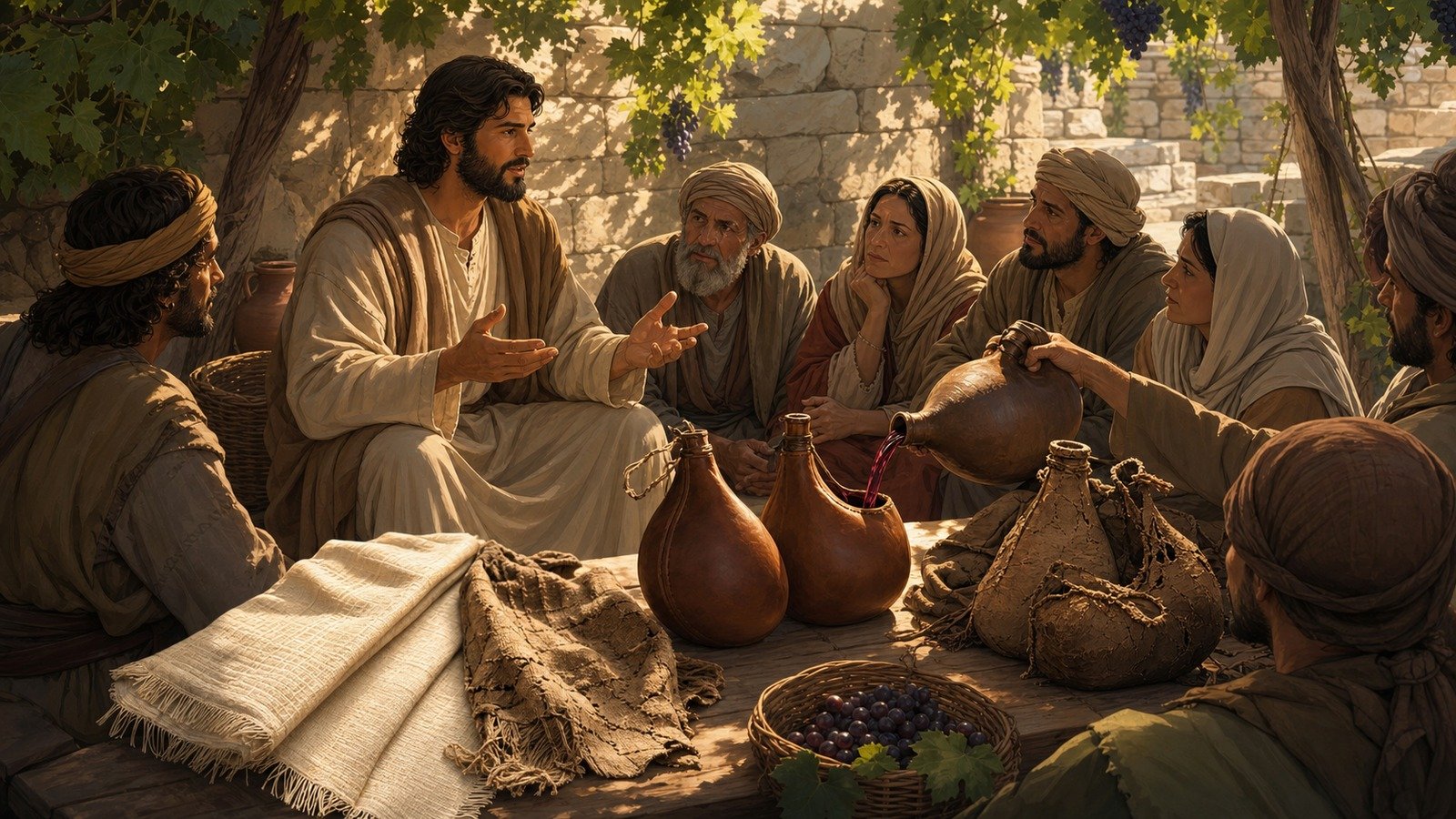
Asked why his disciples do not fast as John's do, Jesus answers with short parables about new cloth on an old garment and new wine in old wineskins, framing his own ministry as something too new to force into old religious patterns.
Further context
3 min readThe question comes from John the Baptist's own disciples, which is worth registering, since they are not hostile. How is it that we and the Pharisees fast often, but your disciples do not fast?
The law required a fast on one day a year, the Day of Atonement. Everything beyond that was voluntary, and the devout fasted twice a week, on Mondays and Thursdays, as a discipline and as an expression of mourning for the state of the nation. Two groups who took their religion seriously are asking why a third apparently does not.
The first answer is an image from a wedding. How can the guests of the bridegroom mourn while he is with them? Weddings suspended fasting obligations, and the point being made is about timing rather than about the practice. A week-long celebration is not the moment for a discipline of grief.
Then a clause that darkens it immediately: the time will come when the bridegroom will be taken from them, and then they will fast. The verb for taken away is not gentle, and this is the first indication in the sequence that the end is going to be violent.
The two illustrations that follow are about materials, and both are practical observations any villager would recognise.
Nobody sews a patch of unshrunk cloth onto an old garment. New cloth shrinks the first time it is washed, and it will pull away from the old fabric and make the tear worse.
And nobody pours new wine into old wineskins. Skins were made from whole hides, sewn and sealed, and they stretched as the wine fermented and then hardened. A skin that has already been stretched once has no give left, and fresh must, still fermenting, will split it, and both the wine and the skin are lost.
What is being described is not a preference for the new over the old. It is a statement that what is arriving cannot be fitted into the existing arrangements as a patch or a top-up, and that trying to do so damages both.
Fasting in this period carried a political charge as well as a religious one. The twice-weekly fast was partly mourning for a nation under foreign rule and a temple whose leadership was appointed by it, and to abstain from that mourning was to say something about the situation. The wedding image says it plainly: this is not the week for it.
Luke adds a line the others do not, and it is a piece of dry realism about people rather than about religion: no one after drinking old wine wants the new, for they say the old is better. He is not saying they are wrong about the wine. He is observing that nobody enjoys having their settled taste disturbed, which is an accurate description of what the objectors are experiencing.
The question comes from John's disciples, which is the detail that makes it awkward. Their teacher was in prison, they fasted, the Pharisees fasted, and this group did not.
Fasting beyond the one day the law required had become a mark of seriousness, and twice a week was the practice of the strict.
The answer is a question about a wedding: how can the guests of the bridegroom mourn while he is with them? Weddings were the one occasion when fasting was suspended entirely, and the image says that the present situation is a celebration rather than a period of waiting.
Then the two illustrations, both of them about material damage. Nobody sews a patch of unshrunk cloth on an old garment, because the patch pulls away and makes the tear worse. Nobody pours new wine into old wineskins, because the skins have already stretched and the fermenting wine will split them.
Neither image is about improvement. Both are about incompatibility.