

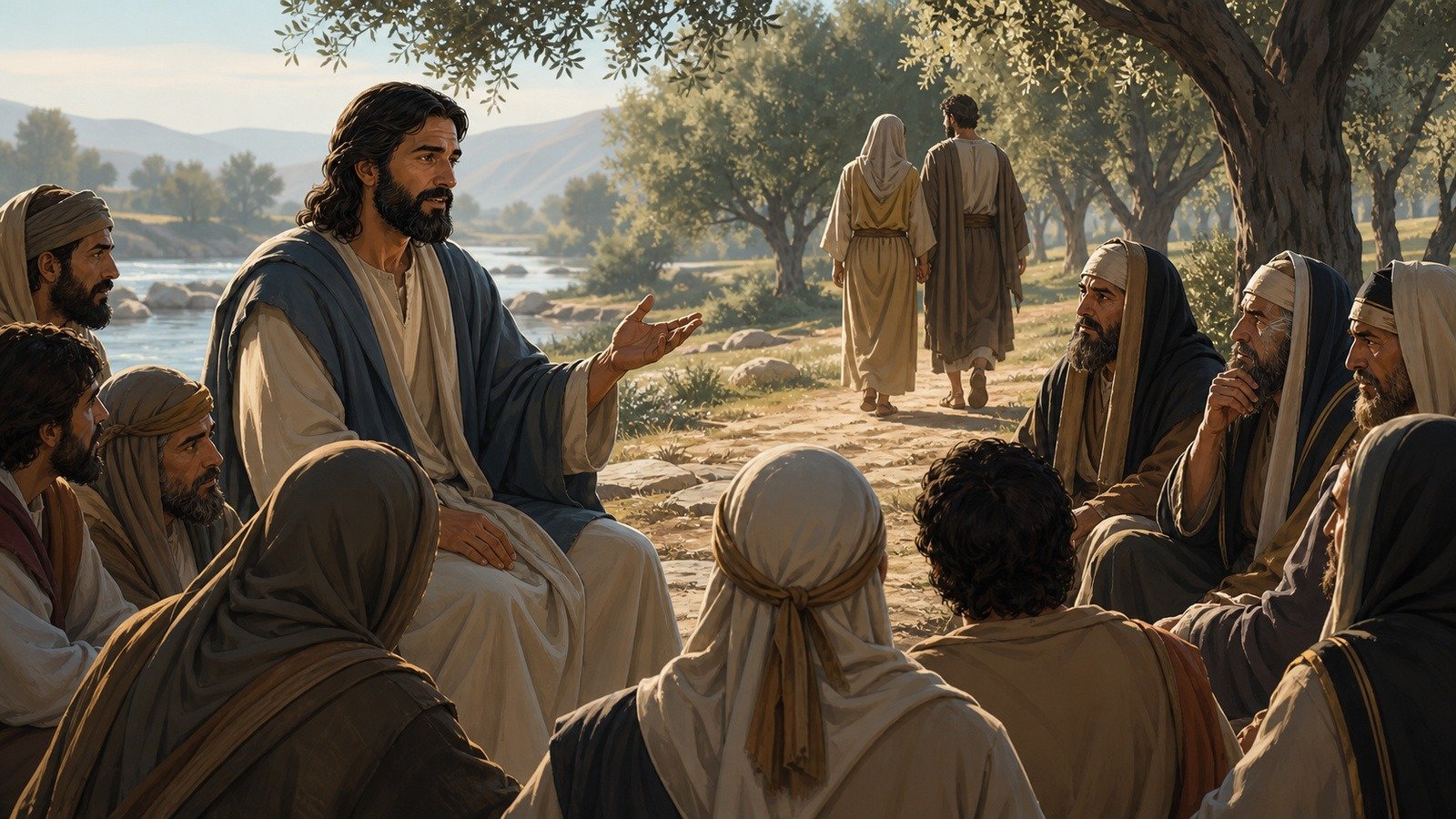
Tested by Pharisees on the grounds for divorce, Jesus points back to God's original design in creation, "the two will become one flesh," treating Moses' allowance for divorce as an accommodation to human hard-heartedness rather than the ideal.
Further context
3 min readSome Pharisees come to test Jesus with a question that was being argued about in his lifetime: is it lawful for a man to divorce his wife for any and every reason?
The wording is precise, because it names one side of a live dispute. The law permitted a man to write his wife a certificate of divorce if he found something indecent about her, and everything turned on that phrase. The school of Shammai held it meant sexual immorality and nothing else. The school of Hillel read the two words separately and allowed divorce for almost anything, including spoiling a meal. A later teacher is recorded permitting it if a man found a woman he preferred. Hillel's reading had won in practice.
Divorce in that world was a male right exercised by handing over a document, and the woman had no equivalent power. The certificate did protect her in one respect, since it proved she was free to remarry rather than an abandoned wife whose status was uncertain, and without remarriage a woman without family support had very little.
He does not choose a side in the debate. He goes behind it.
Have you not read that at the beginning the Creator made them male and female, and said, for this reason a man will leave his father and mother and be united to his wife, and the two will become one flesh? So they are no longer two, but one flesh. Therefore what God has joined together, let no one separate.
The argument moves from what was permitted to what marriage is. The phrase one flesh describes a union that is not dissolved by paperwork any more than a family relationship is.
Their comeback is the obvious one: why then did Moses command that a man give his wife a certificate of divorce and send her away?
The reply corrects the verb. Moses permitted you to divorce your wives because your hearts were hard. But it was not this way from the beginning. A concession regulating something already happening is treated as exactly that.
Then the ruling, with an exception in Matthew's version and without one in Mark's: anyone who divorces his wife, except for sexual immorality, and marries another woman commits adultery. Mark adds the reverse case, a woman divorcing her husband, which was not possible in Jewish law but was under Roman law, and Herodias had done it.
The disciples' reaction is telling: if this is the situation between a husband and wife, it is better not to marry.
Christians have disagreed about the exception clause, and about a further ground Paul later discusses, for as long as there have been churches, and denominations still divide over it.
Both schools argued from the same handful of words in the same sentence, which is a reminder of how much weight a phrase could carry in a legal system built on a short text and a long tradition of interpreting it.
The practical position of a divorced woman is the thing modern readers most often miss. She returned to her father's household if it existed and would take her, and if it did not she had very few options that were not degrading. A ruling restricting a husband's freedom to dismiss his wife was, in that setting, a protection of the party without power, which is not how the disciples heard it.