

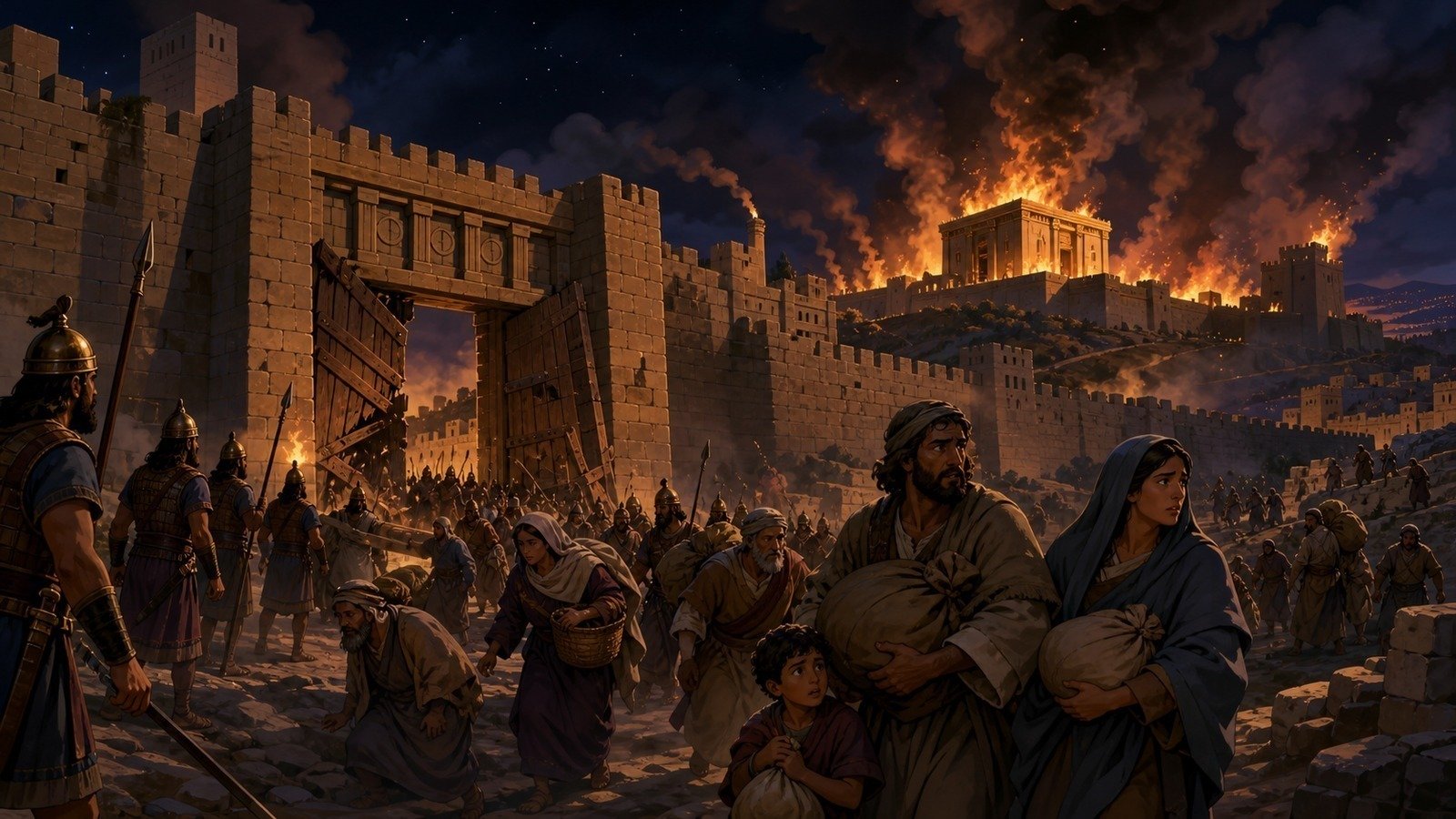
After an eighteen-month siege, Babylonian forces breach Jerusalem's walls, burn the Temple, palace and city, execute Zedekiah's sons before his eyes and then blind him, and deport most of the remaining population, ending the kingdom of Judah as a sovereign state.
Further context
3 min readThe siege lasts about eighteen months. By the ninth day of the fourth month the famine is so severe that there is no food for the people to eat, and the city wall is breached that night.
The king and the whole army run for it in the dark, out through the gate between the two walls near the king's garden, and head for the Jordan valley. The Babylonian army pursues and catches Zedekiah on the plains of Jericho, and his soldiers scatter.
What is done to him is deliberate and is designed to be the last thing he sees. He is taken to Nebuchadnezzar at Riblah in Syria and sentence is passed. They kill his sons in front of him, and then put out his eyes, bind him with bronze shackles and take him to Babylon. Jeremiah had told him twice that he would see the king of Babylon with his own eyes and would be taken there, and Ezekiel had said in exile that he would be brought to Babylon but would not see it, and readers noticed the apparent contradiction for centuries. Both were accurate.
A month later the commander of the imperial guard arrives and burns the temple, the royal palace and every important building, and the whole Babylonian army breaks down the walls around the city. The bronze pillars, the movable stands and the great bronze basin are broken up and the metal carried off, and the inventory of what was taken is itemised down to the pots, shovels, wick trimmers, dishes and sprinkling bowls.
The senior priests, the officers and sixty leading men are executed at Riblah. The rest of the population, apart from the poorest, are deported.
The date is either 587 or 586 BC depending on how the Babylonian regnal year is reconciled with the Judaean one, and both figures appear in reputable work.
The archaeology is unambiguous. Excavations across the City of David have found a destruction layer of collapsed buildings, ash, arrowheads and smashed pottery, including a room full of burnt wood and iron known as the Burnt Room and a house where a hoard of clay seal impressions was baked hard by the fire that destroyed the building. Several of those bear the names of officials mentioned by name in the surviving records of the reign.
One survivor is worth naming. Jeremiah is found among the prisoners in chains at Ramah and released by the Babylonian commander, who tells him he may come to Babylon and be looked after, or stay. He stays, and goes to Mizpah to join the governor, which is the choice that eventually puts him on a road into Egypt against his will.
Four hundred years after Solomon dedicated it, the building is gone, the royal line has stopped ruling, and the land promised to Abraham is an imperial province. Everything the nation had been given, it has now lost, and the writers who record it do not soften any part of that.
The siege lasts about eighteen months, from January 588 to July 587 BC, and it ends when the famine inside is so severe that the wall is breached and the army flees at night through a gate between the two walls.
Zedekiah is caught on the plains of Jericho, taken to Nebuchadnezzar at Riblah, and sentenced there. His sons are killed in front of him, and then his eyes are put out, so that the last thing he saw was that.
A month later Nebuzaradan, commander of the imperial guard, burns the temple, the palace and every important building, and the walls are pulled down. The bronze pillars, the movable stands and the Sea are broken up and the metal carried to Babylon, and the temple fittings are listed item by item, down to the pots, shovels, wick trimmers and dishes.
Lachish, one of the last fortified towns to fall, has yielded a group of ostraca written during the campaign, one of which reports that the signal fires of a neighbouring town can no longer be seen.