

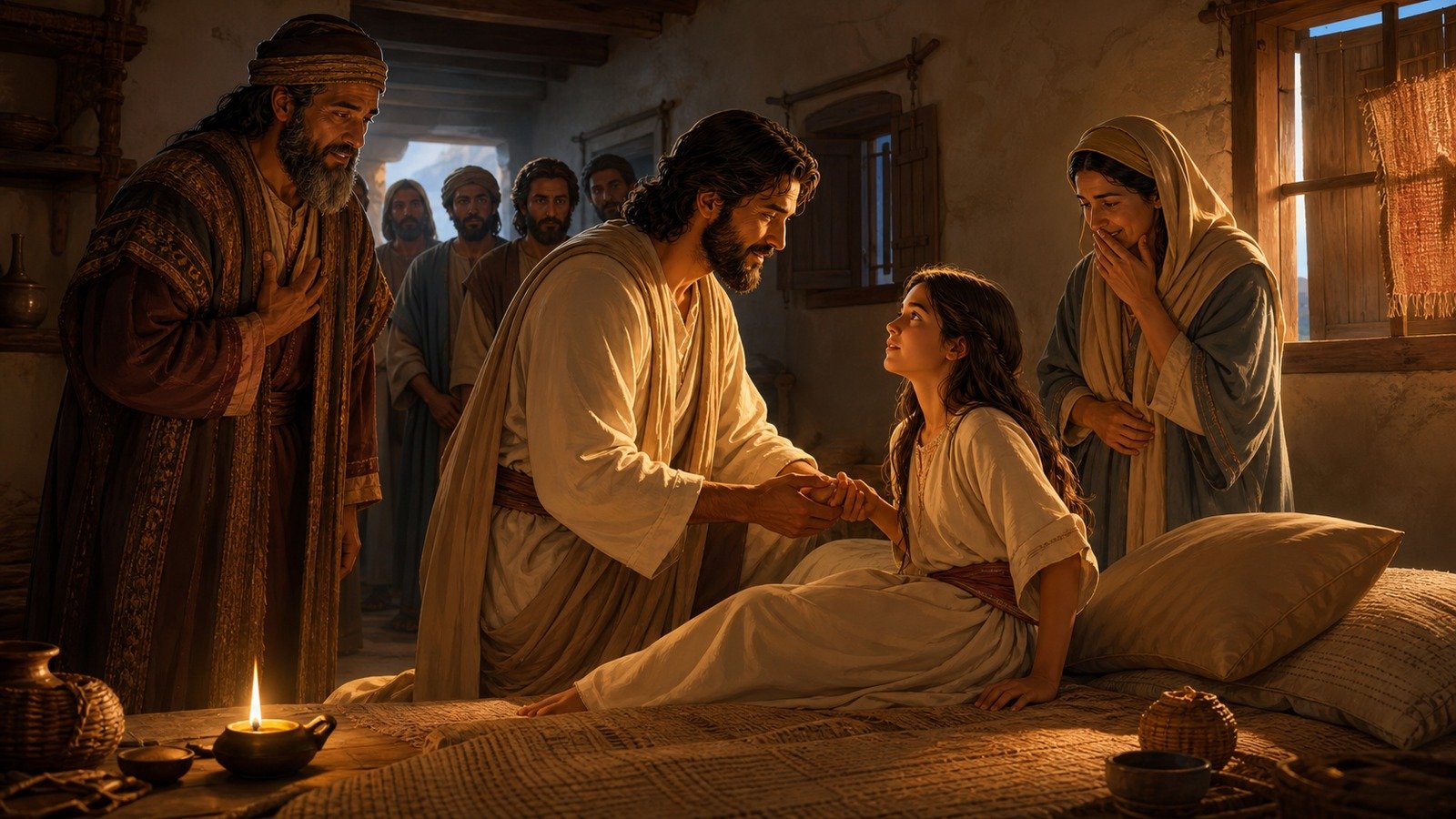
A synagogue leader named Jairus begs Jesus to heal his dying daughter; by the time Jesus arrives she has died, but he raises her regardless, telling the astonished witnesses to keep it quiet.
Further context
2 min readJairus is a synagogue leader, which is an administrative office rather than a priestly one, responsible for arranging the services and the building. He is a man of standing in the community, and he falls at Jesus' feet in front of a crowd and pleads earnestly: my little daughter is dying. Please come and put your hands on her so that she will be healed and live.
They set off, and the crowd presses in, and on the way the journey is interrupted by a woman in the crowd, which takes time he does not have.
While he is still speaking to her, men arrive from the house with the message: your daughter is dead. Why bother the teacher any more?
What Jesus says to Jairus, overhearing it, is two sentences: do not be afraid; just believe.
He allows only Peter, James and John to come with him, and when they reach the house there is a commotion, with people crying and wailing loudly. Professional mourners were hired even by families of modest means, and flute players were customary, so the noise is an institution rather than spontaneous grief.
He asks why they are making all this commotion and wailing, and says the child is not dead but asleep, and they laugh at him. That laughter is worth registering; these are people who knew perfectly well what a dead child looked like.
He puts them all out, takes the parents and the three disciples, and goes in where the child is. Then he takes her by the hand and says two Aramaic words, preserved untranslated: Talitha koum, which means little girl, get up. Mark keeps several such phrases in the original language, and this is one of the places where the Aramaic Jesus actually spoke comes through the Greek.
She stands up and walks around, and she was twelve years old. Then a sentence that is entirely characteristic and is easy to miss: he gave strict orders not to let anyone know about this, and told them to give her something to eat.
Two things are worth holding together. The girl is twelve, and the woman whose interruption delayed him had been bleeding for twelve years. The two episodes are deliberately interleaved in all the accounts that carry them, and the number is the hinge.
Touching a corpse made a person unclean for seven days. He takes her hand.
Jairus is named, which is unusual, and his office matters. A synagogue leader was a lay official responsible for the building and for arranging who read and who spoke, a man of standing in the town, and by this point the synagogue authorities and Jesus were not on comfortable terms. Falling at his feet in front of a crowd cost him something.
The delay caused by the woman in the crowd is what makes the story what it is. He is stopped on an urgent errand, and while he is stopped the messengers arrive to say the child is dead and there is no point troubling the teacher further. What he says to the father is addressed to a man who has just heard that the interruption cost him everything: do not be afraid, just believe.