

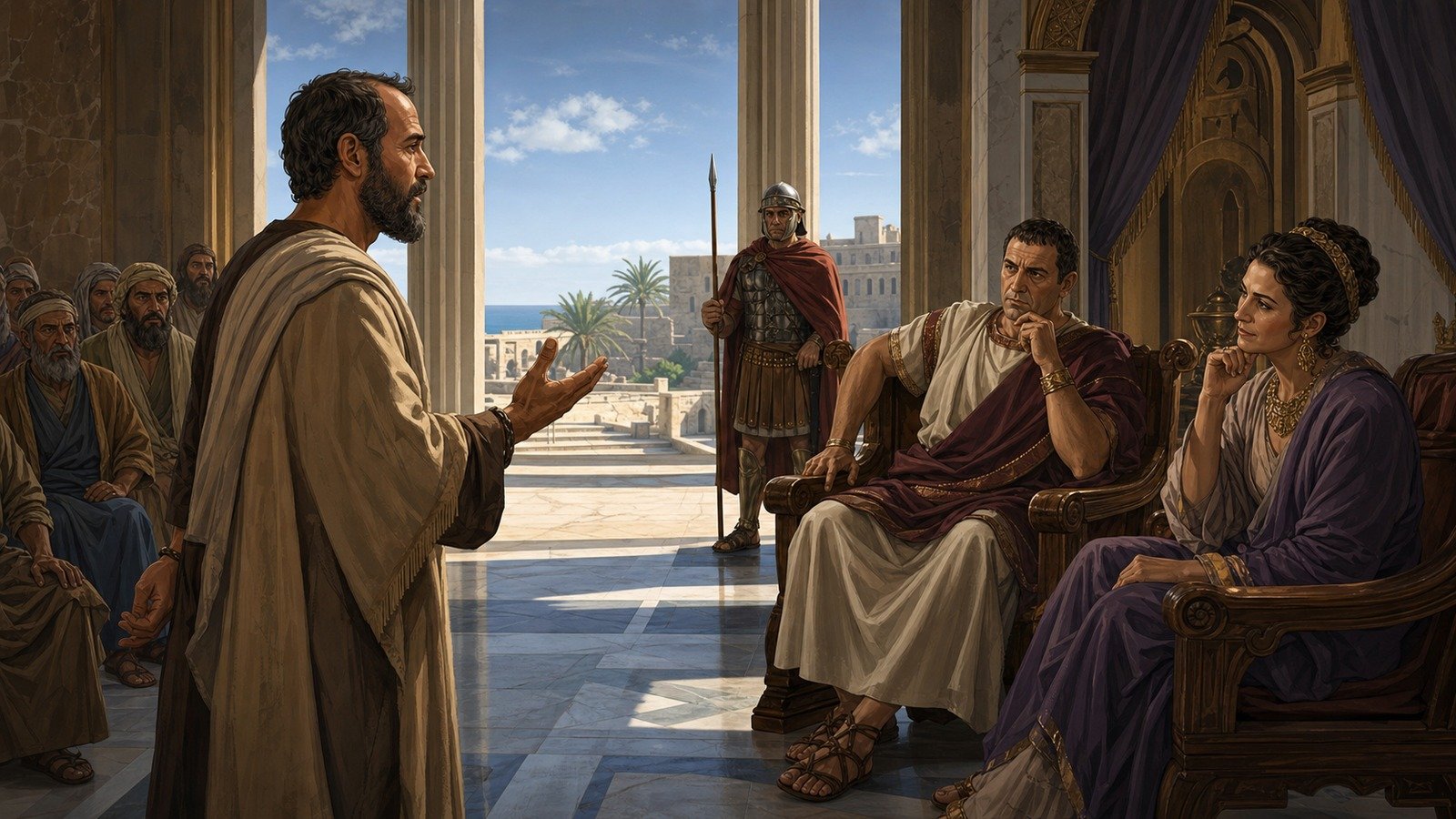
Accused before the governor Felix of stirring up riots and desecrating the Temple, Paul defends himself and speaks candidly with Felix and his wife Drusilla about faith and self-control; Felix, hoping for a bribe, leaves Paul in custody for two years without a verdict.
Further context
2 min readFive days after Paul reaches Caesarea, the high priest Ananias comes down with some of the elders and a lawyer named Tertullus, and they bring their charges before the governor.
Tertullus opens with flattery so thick it is almost a joke: we have enjoyed a long period of peace under you, and your foresight has brought about reforms in this nation. Felix's record was the opposite. Tacitus, writing a generation later, says of him that he exercised the power of a king with the spirit of a slave, and Josephus describes his term as marked by assassinations, brigandage and a massacre of Jews at Caesarea.
The charges are three. Paul is a troublemaker stirring up riots among the Jews all over the world. He is a ringleader of the Nazarene sect. And he tried to desecrate the temple.
The first is a political charge a Roman governor had to take seriously. The second and third are religious matters he would not.
Paul answers each in order and denies the factual ones flatly: my accusers did not find me arguing with anyone at the temple, or stirring up a crowd in the synagogues or anywhere else in the city, and they cannot prove to you the charges they are now making against me.
Then a statement that concedes the middle charge while redefining it: I admit that I worship the God of our ancestors as a follower of the Way, which they call a sect. I believe everything that is in accordance with the Law and that is written in the Prophets, and I have the same hope in God as these men themselves, that there will be a resurrection of both the righteous and the wicked.
He also points out that the men who actually saw him in the temple, the Jews from Asia, are not present, and ought to be.
Felix adjourns, saying he will decide when the commander Lysias comes down, and Lysias never comes.
Several days later he sends for Paul with his wife Drusilla, who was Jewish, a daughter of Agrippa I, and had left her first husband for Felix while still in her teens. As Paul discourses on righteousness, self-control and the judgement to come, Felix is afraid and says: that is enough for now! You may leave. When I find it convenient I will send for you.
He also hoped for a bribe, and sent for him frequently and talked with him.
Two years pass.
Felix was recalled to Rome shortly afterwards to answer for the massacre at Caesarea, and Josephus says he escaped punishment only because his brother Pallas was a favourite of Nero. Before leaving he did the new governor a favour: he left Paul in prison, to grant a favour to the Jews.
Drusilla died with her son at Pompeii in the eruption of AD 79, according to Josephus.
Tertullus is the only professional advocate named in the New Testament, and hiring one to appear before a governor was normal practice for a provincial delegation with a case to make in Latin or formal Greek.