

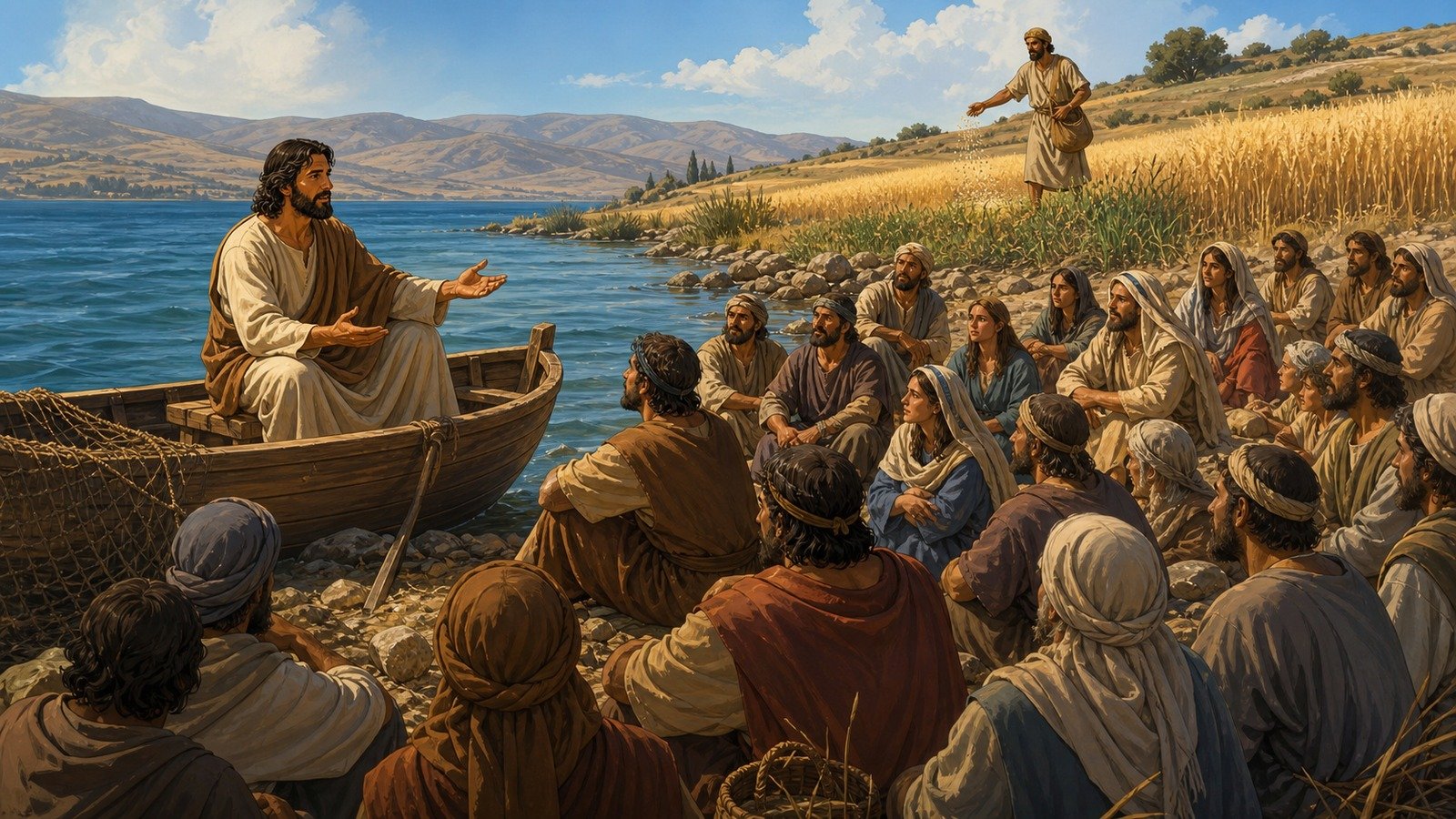
Jesus teaches extensively in parables, including the sower, the weeds among the wheat, the mustard seed and the yeast, explaining to his disciples privately that the form itself both reveals truth to the receptive and conceals it from the indifferent.
Further context
2 min readThe crowd is so large that Jesus gets into a boat and sits in it while the people stand on the shore, which is the same trick with the water as an amphitheatre used earlier.
What he tells them is a sequence of short stories about seed, weeds, yeast, treasure, a pearl and a net, and every one of them is drawn from things a Galilean villager handled that week.
The first is the longest. A farmer scatters seed. Some falls on the path and the birds take it. Some falls on rocky ground with shallow soil, springs up quickly and withers when the sun comes up. Some falls among thorns and is choked. Some falls on good soil and produces a crop, a hundred, sixty or thirty times what was sown. Broadcasting seed by hand across a field that included a footpath, a shelf of limestone under thin soil and uncleared thorn scrub is exactly how it was done, and every listener had walked past all four kinds of ground.
Then something unexpected. The disciples ask why he is teaching this way, and the answer is that the parables both reveal and conceal, and he quotes the commission given to Isaiah about people ever hearing but never understanding. A method usually described as making difficult ideas accessible is being described as doing something else as well.
The interpretation he supplies makes the four soils four kinds of hearing rather than four kinds of person, and the seed is the message.
The others are shorter. Weeds sown among wheat by an enemy, and the instruction to let both grow until harvest rather than risk pulling up the wheat. The plant that grows from the smallest of seeds into something birds nest in. Yeast worked through sixty pounds of flour, which is an enormous batch. Treasure found in a field, and a merchant who sells everything for one pearl, both of which involve a man giving up everything he has and going away happy about it.
And a net let down into the lake that catches all kinds of fish, sorted on the shore afterwards.
A parable is not an illustration attached to a lesson. It is a story that leaves the hearer to work out where they are standing in it, and several of these end without any explanation at all.
The setting is given as a boat pushed a little way out from the shore, with the crowd standing on the beach, which is a practical arrangement: water carries sound, and a slight rise of ground behind a listener does the rest. The natural amphitheatres along that shoreline have been tested by acoustic engineers and carry an unamplified voice to several thousand people.
Why he taught this way is asked directly, and the answer given is uncomfortable. Parables reveal and conceal at the same time, opening the matter to anyone willing to go further and closing it to anyone who is not. A story can be enjoyed and set down; it cannot be argued with in the way a proposition can, and it works on a listener afterwards rather than at the time.