

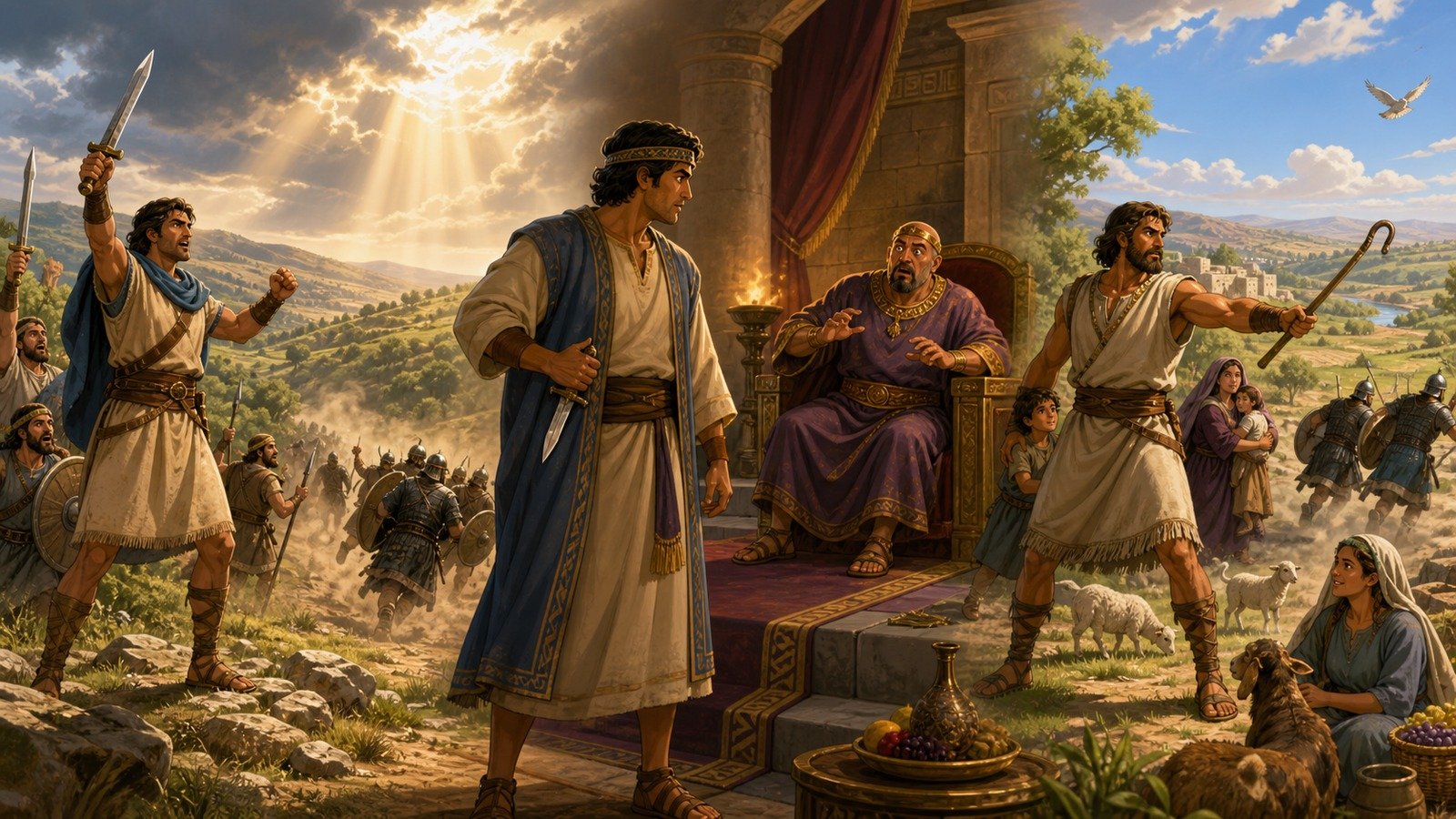
Three early judges deliver Israel from successive oppressors: Othniel from Aram-Naharaim, Ehud from Moab through the assassination of King Eglon, and Shamgar from the Philistines. Each victory is followed by a period of peace before the cycle repeats.
Further context
2 min readThree deliverers, and the amount of space each gets is wildly uneven.
Othniel is Caleb's younger relative and had already taken a town during the conquest and won Caleb's daughter as a result. His account is the shortest and the most formulaic: Israel does evil, is handed over to a Mesopotamian king for eight years, cries out, the Spirit of the LORD comes on Othniel, he wins, and the land has peace for forty years. He is the template against which everyone after him gets measured, and every one of them falls short of it in some way.
Ehud gets the longest and most detailed treatment, and it is told with a relish that is difficult to miss. Israel is subject to Eglon king of Moab, described as a very fat man, for eighteen years. Ehud is a Benjamite and left-handed, which is stated because it matters: he makes a double-edged sword about half a metre long and straps it to his right thigh under his clothing, where a search of a right-handed man would not look.
He delivers the tribute, sends the carriers away, and comes back saying he has a secret message for the king. Eglon dismisses his attendants, and Ehud says, I have a message from God for you. The king rises from his seat and Ehud drives the sword into his belly with his left hand, and it goes in so far that the handle sinks in after the blade and the fat closes over it. He locks the doors and goes out, and the servants wait outside for an embarrassingly long time assuming their master is relieving himself, until they finally fetch a key. He is dead on the floor and Ehud is long gone.
The whole thing is a political assassination described with attention to weapon length, clothing, handedness, room layout and the exact reason nobody came in. Nothing is said about whether any of it was admirable.
Shamgar gets one sentence. He struck down six hundred Philistines with an oxgoad and saved Israel. An oxgoad is a long wooden pole with an iron tip used for driving cattle, which is what a farmer would have to hand when there were no weapons, and the same shortage of iron weapons turns up again a few centuries later under Saul.
That single line also contains the first mention of the Philistines as Israel's enemies, and they dominate the rest of the period.
The deliverance is also geographically limited every time. Othniel deals with a threat from the north-east, Ehud with Moab across the Jordan, Shamgar with Philistines in the south-west. None of them raises a national army or acts for the whole country, and the peace that follows each one is described as belonging to the land rather than to the nation. What is being described is a series of local emergencies handled locally, which is what a confederation without a central government looks like when it works at all.
Whether these three overlapped is unknown, and the round figures of forty and eighty years for periods of peace are used throughout the book in a way that suggests approximation rather than counting.