

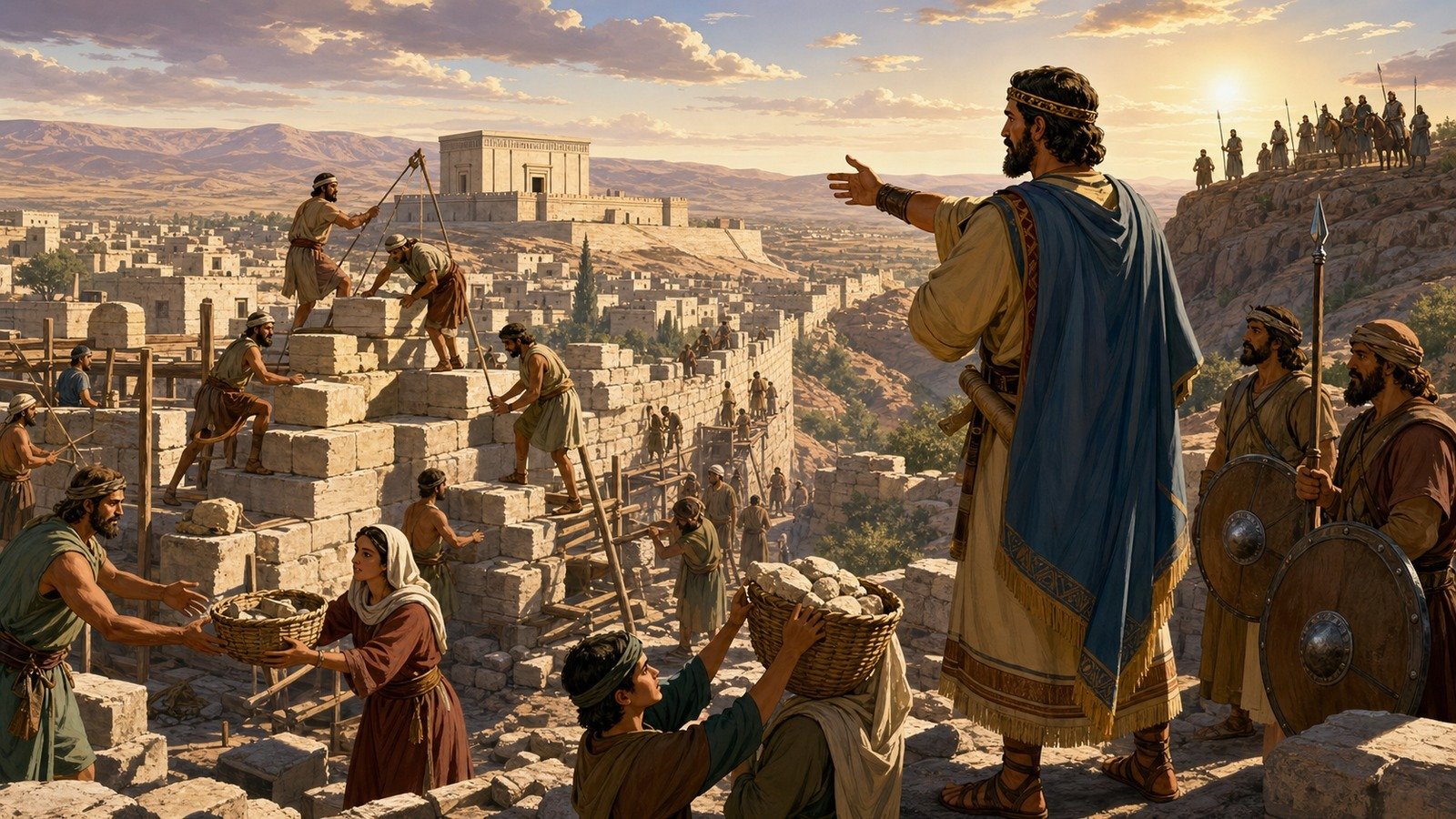
Grieved by reports of Jerusalem's ruined walls, Nehemiah, cupbearer to Artaxerxes I, secures royal permission and resources to return and organise the city's defence rebuilding, completing the walls in just fifty-two days despite sustained opposition and sabotage attempts.
Further context
3 min readNehemiah is cupbearer to Artaxerxes I at the winter capital of Susa, which is a position of considerable trust with daily access to the king, and he is in Persia rather than in Judah.
His brother arrives from Jerusalem and he asks about the survivors and the city, and the answer is that those who survived the exile are in great trouble and disgrace, the wall is broken down and the gates have been burned with fire. He sits down and weeps, and mourns and fasts and prays for days.
Four months later the king notices his face and asks why he looks sad when he is not ill, and the reaction recorded is honest: I was very much afraid. Showing distress in front of a Persian monarch was not safe, and he says so.
What he asks for is precise, and he has evidently prepared it. A period of leave. Letters to the governors of the province beyond the Euphrates for safe conduct. And a letter to the keeper of the royal forest for timber for the gates of the citadel, the city wall and a house for himself. He is granted all of it, with cavalry officers as escort.
His first act on arriving is to tell nobody. He goes out at night with a few men, on one animal, and inspects the ruined walls and the burnt gates in the dark, and at one point the rubble is too deep for the animal to get through. Only after the survey does he put the case to the officials: come, let us rebuild the wall of Jerusalem, and we will no longer be in disgrace.
The organisation is the most impressive administrative feat in these books. The wall is divided into sections and each is assigned to a group by name, and the list runs to forty-two work parties: priests, goldsmiths, perfume-makers, merchants, district rulers, men from Jericho and Tekoa and Gibeon, and a man called Shallum who worked with the help of his daughters. Everyone builds the stretch in front of their own property.
The opposition is continuous and it escalates through mockery, threatened attack, and then attempts to lure him into a meeting or to discredit him. His answers are famous for their brevity. To an invitation to a conference on the plain of Ono: I am carrying on a great project and cannot go down. Why should the work stop while I leave it and go down to you? Four times the same request and the same answer.
The wall is finished in fifty-two days, and the reaction of the surrounding peoples is recorded: they lost their self-confidence, because they realised this work had been done with the help of our God.
The news that reaches him at Susa is specific: the survivors are in great trouble and disgrace, the wall of Jerusalem is broken down and its gates have been burned with fire.
His reaction is to sit down and weep, and then to fast and pray for days before doing anything, and when he finally speaks to the king it is because his face gives him away. The king asks why he looks sad when he is not ill, and Nehemiah says what he felt: I was very much afraid.
Cupbearer was a position of real trust, since the man tasted what the king drank, and it gave daily private access.
Once in Jerusalem he inspects the walls at night, telling no one, riding round the ruins until the gaps become impassable for the animal. Then he calls the leaders together, and the work is organised by section, with families building the stretch nearest their own houses.