

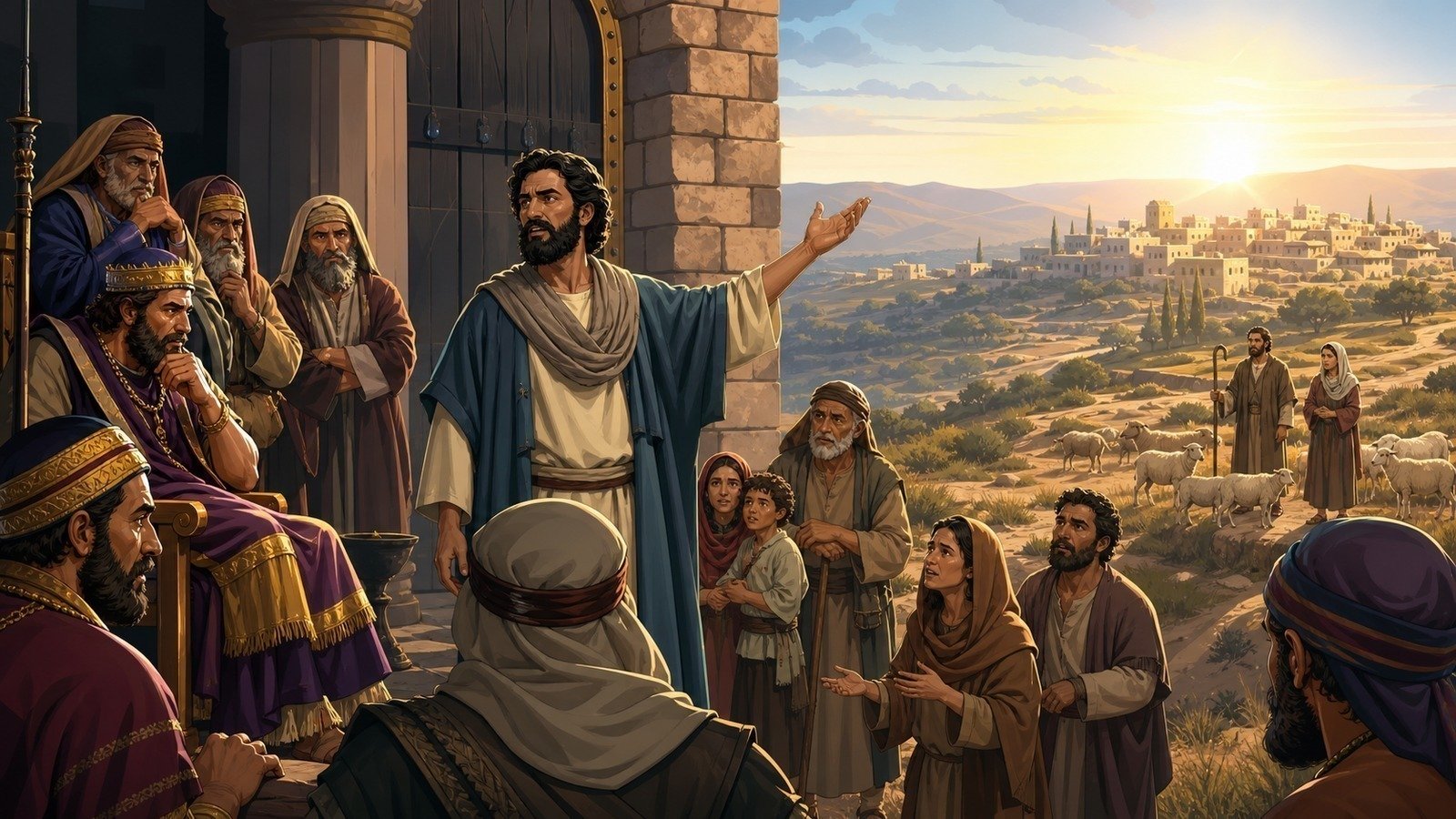
A contemporary of Isaiah, Micah condemns corrupt leadership in both kingdoms, summarises true religion as acting justly, loving mercy and walking humbly with God, and names Bethlehem as the birthplace of a future ruler over Israel.
Further context
3 min readMicah is from Moresheth, a small town in the Judean lowlands about forty kilometres south-west of Jerusalem, near the frontier the Assyrians would come through. That location is the difference between him and Isaiah, who worked at the royal court in the capital. Micah is writing from the country that gets overrun first.
His indictment is aimed at people with power and he names their methods. They covet fields and seize them, and houses, and take them, defrauding people of their homes and their inheritance. They tear the skin from my people and the flesh from their bones, eat their flesh, break their bones in pieces and chop them up like meat for the pan. Rulers judge for a bribe, priests teach for a price, prophets tell fortunes for money, and all of them lean on the LORD and say, is not the LORD among us? No disaster will come upon us.
The answer to that complacency is the sentence that got him remembered a century later: therefore because of you, Zion will be ploughed like a field, Jerusalem will become a heap of rubble, the temple hill a mound overgrown with thickets.
That prediction has an unusual afterlife. A hundred years later, when Jeremiah is on trial for his life for saying much the same thing, some of the elders stand up and quote Micah by name, point out that Hezekiah did not put him to death but repented, and Jeremiah is acquitted. It is the only place in the Hebrew scriptures where one prophet's words are cited as legal precedent to save another's life.
Two passages from him are quoted constantly.
The first is the ruler from Bethlehem: but you, Bethlehem Ephrathah, though you are small among the clans of Judah, out of you will come for me one who will be ruler over Israel, whose origins are from of old, from ancient times. When Herod asks his advisers where the Messiah is to be born, this is what they read out to him.
The second is his summary of what is actually required, delivered as the answer to a man asking whether God wants thousands of rams or ten thousand rivers of olive oil or his firstborn child: he has shown you, mortal, what is good. And what does the LORD require of you? To act justly, to love mercy and to walk humbly with your God.
He also shares several lines with Isaiah almost word for word, about beating swords into ploughshares and sitting under one's own vine and fig tree, and which of them had them first is unknown.
Moresheth's position matters for how he sounds. The lowland towns he lists by name in a series of grim puns were on the route Sennacherib's army took in 701 BC, and Lachish, which he singles out, was besieged and destroyed in that campaign; the reliefs showing it were carved for the Assyrian palace at Nineveh and are now in the British Museum. He is writing about places he could see from his own fields.
Micah is contemporary with Isaiah, and the two men use some of the same material. The famous lines about beating swords into ploughshares and spears into pruning hooks appear in both books in almost identical wording, and nobody knows which of them wrote it first or whether both were quoting something older.
The difference between them is social position. Isaiah moves in the court and addresses kings directly. Micah is from a country town and his anger is aimed at landowners and officials who covet fields and seize them, who tear the skin from my people and the flesh from their bones.
He also predicts the destruction of Jerusalem in plain terms: Zion will be ploughed like a field, Jerusalem will become a heap of rubble.
A century later, when Jeremiah is on trial for his life for saying the same thing, the elders quote Micah as a precedent and it saves him.