

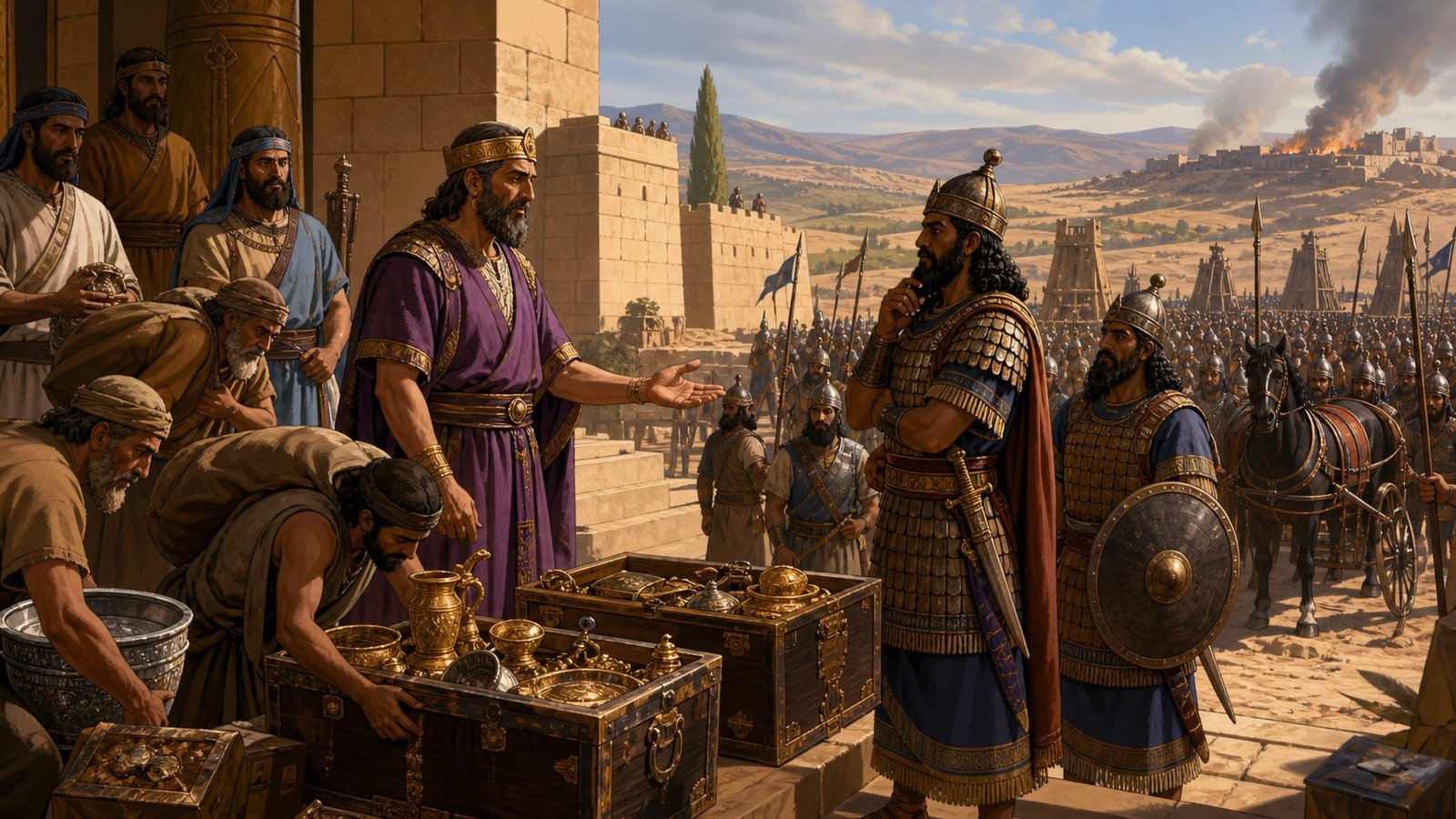
Menahem secures his rule with notable brutality against a rebellious town, then pays a heavy tribute to Tiglath-Pileser III of Assyria to keep his throne, an early sign of Israel's coming subjugation.
Further context
3 min readTen years, held together by money. Tiglath-Pileser III comes against the land, and Menahem gives him a thousand talents of silver to gain his support and strengthen his own hold on the kingdom.
The purpose of that payment is stated plainly and it is not national defence. It is to buy an empire's backing for a usurper who had murdered his way to the throne one month after the previous murder. He is paying Assyria to keep him in place against his own people.
How he raises it is the detail that makes the reign intelligible. The sum is worth converting. A thousand talents of silver is roughly thirty tonnes of metal, which is an enormous transfer of wealth out of a small kingdom in a single payment, and it is being handed over not for peace but for the personal security of the man who ordered it.
He exacts the money from every wealthy man in Israel, fifty shekels of silver from each, to give to the king of Assyria. A thousand talents at that rate implies something in the order of sixty thousand men of property, and the whole land-owning class of the northern kingdom is assessed in a single levy.
This is one of the best-attested moments in the whole period, because Tiglath-Pileser III recorded it himself. His annals list Menahem of Samaria among the rulers who paid him tribute, alongside kings of Damascus, Tyre and elsewhere. An Israelite king's name appears in the tax records of the Assyrian empire, and the two accounts agree.
Assyria at this point is not the intermittent raider it had been for two centuries. Tiglath-Pileser reorganised the empire on a permanent administrative footing, replacing tribute-taking expeditions with provinces, governors and mass deportation as a routine instrument of policy. Any state that resisted was annexed and its population moved elsewhere, which broke the connection between a people and its land and made rebellion much harder to organise. That is the machine now standing on Israel's northern frontier.
The verdict on Menahem is the usual one, and it sits oddly beside a reign spent selling the country's wealth to a foreign empire to stay alive: he did evil in the eyes of the LORD and did not turn away from the sins of Jeroboam.
He dies in his bed, which almost nobody in this stretch manages, and his son succeeds him and lasts two years.
Hosea, watching this happen, describes Israel as a silly dove, easily deceived, calling to Egypt and turning to Assyria, and as a flat loaf not turned over, burnt on one side and raw on the other, with foreigners sapping his strength and him not realising it.
Ten years, and the reign is defined by a payment. Menahem gave Pul, the throne name of Tiglath-Pileser III, a thousand talents of silver to gain his support and strengthen his own hold on the kingdom.
The money is raised by a levy of fifty shekels from every wealthy man in Israel, and a thousand talents is roughly three million shekels, which means about sixty thousand men were assessed. It is the only tax figure given anywhere in these books precise enough to be worked backwards.
Assyrian records confirm the tribute. An inscription of Tiglath-Pileser III lists Menahem of Samaria among the rulers who paid, alongside kings of Tyre, Damascus and Byblos.
What the payment bought was a protector against his own people, which is what the phrase to strengthen his own hold means.