

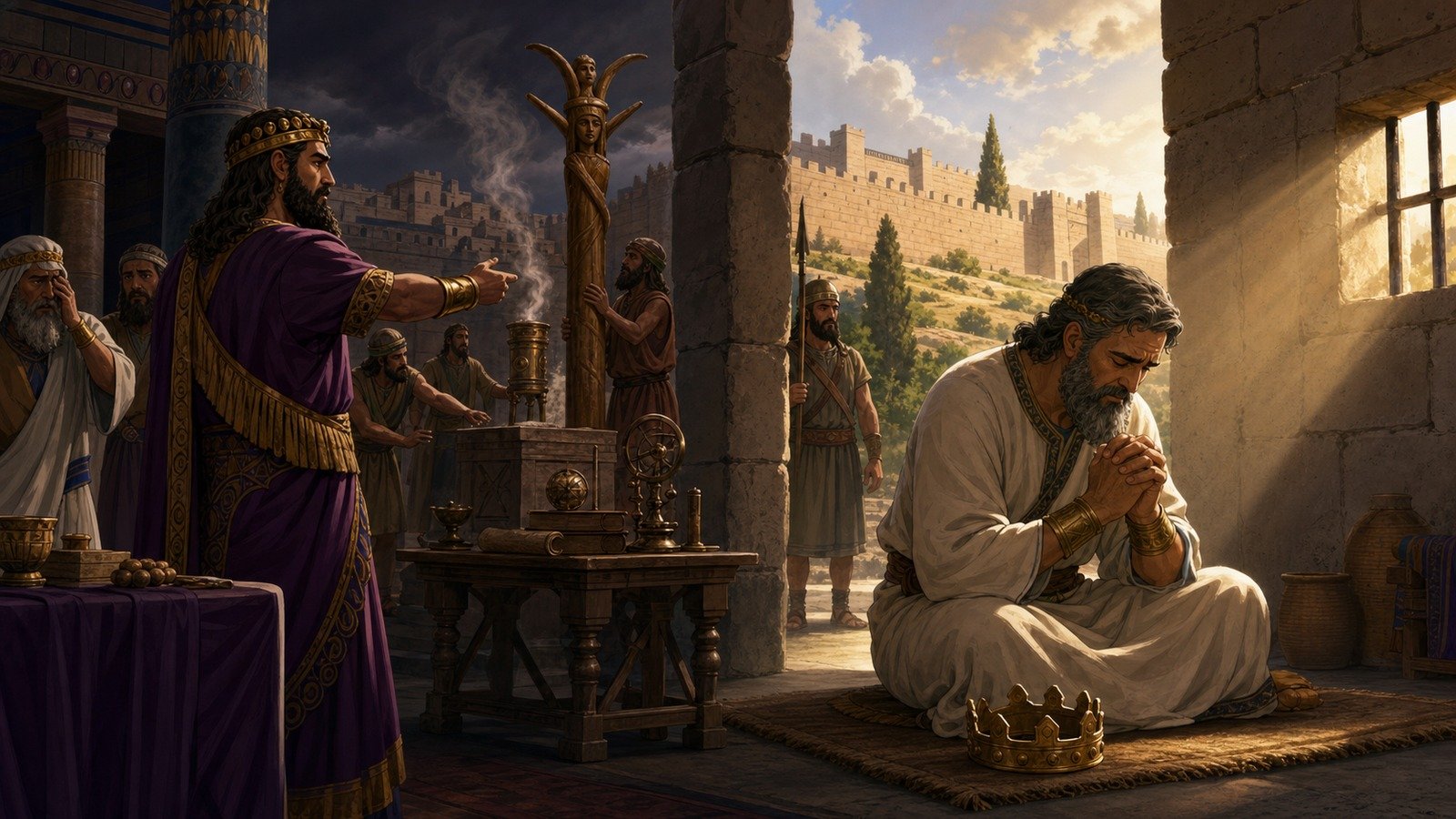
Manasseh reverses Hezekiah's reforms, restoring pagan altars, practising divination, and reportedly sacrificing his own son; 2 Chronicles records a later imprisonment in Babylon that leads to genuine repentance.
Further context
3 min readManasseh reigns fifty-five years, the longest of any king of either kingdom, and the worst. He is twelve when he takes the throne and he undoes everything his father did.
The list is comprehensive. He rebuilds the high places Hezekiah had destroyed, erects altars to Baal, makes an Asherah pole, and bows down to the starry hosts. He builds altars to those in the temple courts, in the building of which God had said his Name would be. He sacrifices his own son in the fire, practises divination and witchcraft, and consults mediums and spiritists. He puts a carved Asherah pole inside the temple itself.
The summary is that he led them astray so that they did more evil than the nations the LORD had destroyed before the Israelites, and that he shed so much innocent blood that he filled Jerusalem from end to end. Later Jewish tradition holds that Isaiah was among those killed, sawn in two, and a New Testament letter's reference to people who were sawn in two is generally taken to allude to it.
The judgement pronounced is the one the exile is eventually traced back to. Jerusalem will be wiped clean as one wipes a dish, wiping it and turning it upside down, and even Josiah's reforms two generations later do not avert it.
The other history of the period adds something the main one leaves out entirely. The Assyrians take him with hooks, put a bronze shackle on him and lead him to Babylon, and in his distress he seeks the favour of the LORD and humbles himself greatly. He is restored to Jerusalem, removes the foreign gods and the image from the temple, throws the altars out of the city and restores the altar of the LORD.
That episode appears in only one of the two histories, and its historicity has been argued over for a long time. What can be said for it is that Assyrian records do name Manasseh as a loyal vassal of both Esarhaddon and Ashurbanipal, supplying materials and troops, and that Ashurbanipal is known to have summoned vassal kings to Babylon and to have restored some of them after periods of detention. A summons to Babylon rather than to Nineveh is an odd detail for anyone to invent.
Fifty-five years is longer than the reigns of David and Solomon put together, and it comes immediately after the most thorough reformer the country had produced. A boy of twelve reverses his father's work and then has more than half a century to entrench the reversal, which is why the judgement pronounced on his reign is not lifted by the reformer who follows him.
Whether or not it happened, the reforms did not last. His son Amon reverts within two years, and the country continues on the course that ends with the Babylonians.
Fifty-five years is the longest reign of any king in either kingdom, and the list of what he did fills a page: rebuilt the high places his father had destroyed, erected altars to Baal, made an Asherah pole, bowed down to all the starry hosts, built altars to them in both courts of the temple, sacrificed his own son in the fire, practised divination and consulted mediums and spiritists.
He also shed so much innocent blood that he filled Jerusalem from end to end.
The chronicler adds what the other account does not: that the Assyrians took him to Babylon with a hook in his nose and bound in bronze shackles, that he humbled himself and prayed, and that he was restored to his throne and removed the foreign gods.
Assyrian records list Manasseh of Judah among vassals paying tribute to Esarhaddon and Ashurbanipal, so he was certainly summoned east at some point.