

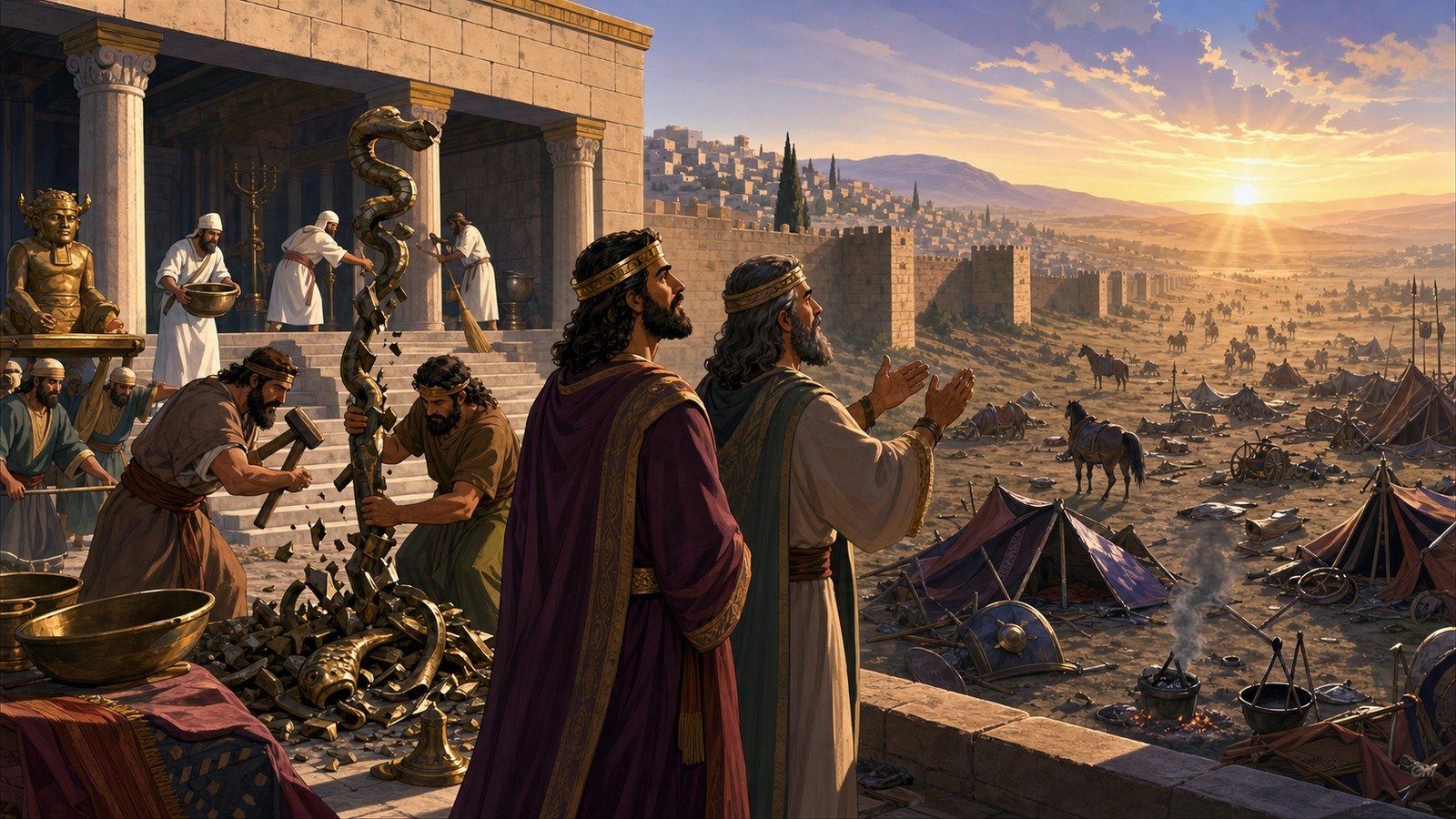
Hezekiah reverses his father's policies, removing idolatrous shrines and even the bronze snake from Moses' day once it became an object of worship. When Sennacherib of Assyria besieges Jerusalem in 701 BC after Hezekiah's rebellion, the city is spared following Isaiah's prophecy and a sudden destruction of the Assyrian camp.
Further context
3 min readHezekiah reigns twenty-nine years, and the assessment is the highest given to any king of Judah: he trusted in the LORD, the God of Israel. There was no one like him among all the kings of Judah, either before him or after him.
His reforms go further than any predecessor's. He removes the high places, which every reformer before him had left standing, smashes the sacred stones and cuts down the Asherah poles. He also breaks into pieces the bronze snake Moses had made, because up to that time the Israelites had been burning incense to it, and he gives it a dismissive name meaning merely a piece of bronze. Destroying a genuine relic of the wilderness because it has become an object of worship is a decision very few reformers would make.
The tunnel is the physical monument of his reign. Facing an Assyrian invasion, he blocks the springs outside the city and cuts a channel through solid rock from the Gihon spring to a reservoir inside the walls, over five hundred metres of tunnel driven from both ends simultaneously. It still carries water. An inscription found in it in 1880, now in Istanbul, describes the moment the two teams met: while there were still three cubits to be cut through, the voice of each was heard calling to the other, because there was a fissure in the rock on the right and on the left. It is one of the oldest Hebrew inscriptions in existence and it was written by the workmen.
Sennacherib invades in 701 BC, takes the fortified cities of Judah, and Hezekiah pays three hundred talents of silver and thirty of gold, stripping the gold from the temple doors to find it. It is not enough. A field commander is sent to Jerusalem and delivers a speech in Hebrew deliberately, so that the men on the wall can hear it, mocking any hope of Egyptian help and any hope of divine help, and listing the gods of other cities that failed.
Hezekiah takes the letter into the temple and spreads it out before the LORD. Isaiah's answer is a poem contemptuous of the invader, and that night the angel of the LORD strikes down a hundred and eighty-five thousand in the Assyrian camp, and Sennacherib withdraws and is later murdered by two of his sons in a temple.
Sennacherib's own account, on a clay prism now in the British Museum, describes shutting Hezekiah up in Jerusalem like a bird in a cage, lists the tribute and the forty-six captured towns in detail, and never claims to have taken the city. That silence, in a document written to celebrate a campaign, is the most eloquent thing in it.
The tunnel Hezekiah cut to bring the Gihon spring inside the walls runs about five hundred and thirty metres through solid rock and still carries water. An inscription cut by the workmen, found in 1880, describes the moment the two teams digging from opposite ends heard each other's picks through the stone.
Jar handles stamped with a royal seal and the word belonging to the king, found in quantity across Judah and dating to this reign, indicate a state-organised system of supply depots prepared before the invasion.
The reforms were thorough. He removed the high places, smashed the sacred stones and cut down the Asherah poles, and he broke into pieces the bronze snake Moses had made, because up to that time the Israelites had been burning incense to it.
Sennacherib's prism claims forty-six fortified towns taken and does not claim Jerusalem.