

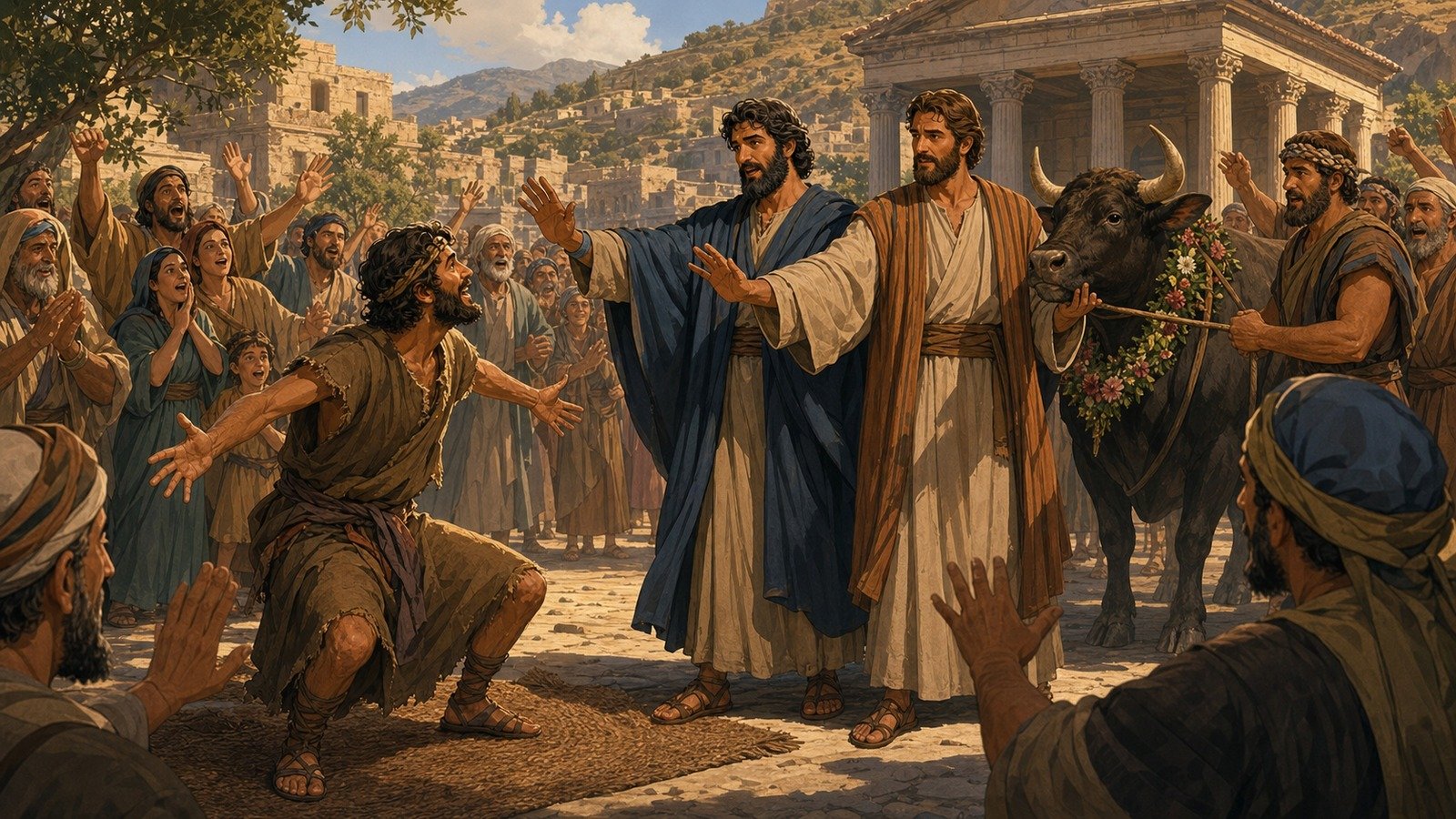
Paul heals a man lame from birth at Lystra, and the astonished crowd tries to offer sacrifices to Paul and Barnabas as the gods Hermes and Zeus; the two barely restrain them, insisting they are only men bringing good news.
Further context
2 min readLystra was a small Roman colony about thirty kilometres south-west of Iconium, established by Augustus as a garrison settlement in unsettled hill country. Latin inscriptions have been found there, but the local population spoke Lycaonian, and there is no mention of a synagogue.
Sitting there is a man lame in his feet, who had been that way from birth and had never walked.
Paul looks straight at him, sees that he has faith to be healed, and calls out: stand up on your feet! The man jumps up and begins to walk.
Then the crowd shouts in Lycaonian, which means Paul and Barnabas do not understand a word of it, and that delay is the reason the situation gets as far as it does.
The gods have come down to us in human form! They call Barnabas Zeus and Paul Hermes, because he was the chief speaker.
There is a local legend behind this, recorded by Ovid and set in the same region. Zeus and Hermes came to Phrygia disguised as travellers and were turned away from a thousand homes, until an elderly couple, Philemon and Baucis, took them in and offered what little they had. The gods rewarded them and destroyed everyone else.
A town that knew that story would have had a strong incentive not to make the same mistake twice.
The priest of Zeus, whose temple was just outside the town, brings bulls and wreaths to the city gates because he and the crowd want to offer sacrifices to them.
When the two of them finally grasp what is happening, they tear their clothes and rush into the crowd shouting: we too are only human, like you.
The short speech that follows is the first recorded address to a purely pagan audience, and it contains no Scripture at all, because none of it would have meant anything. It argues instead from the natural world: the living God, who made the heavens and the earth and the sea and everything in them, who has shown kindness by giving you rain from heaven and crops in their seasons; he provides you with plenty of food and fills your hearts with joy.
Even with these words, they had difficulty keeping the crowd from sacrificing to them.
The healing at Lystra is described in almost the same words as the healing at the temple gate by Peter, down to the man being lame from birth and jumping up. Whether the parallel is the writer's arrangement or simply what happened, the two apostles are being presented as doing the same work.
Zeus and Hermes appear together in inscriptions from this region, and a stone altar dedicated to the two of them jointly has been found near Lystra, which is as close as archaeology comes to confirming a crowd's reflexes.
That Paul's first recorded sermon to pagans argues from rain and harvests rather than from Scripture is the model for the later Athens address, and both start from what the audience already accepted rather than from what they did not.