

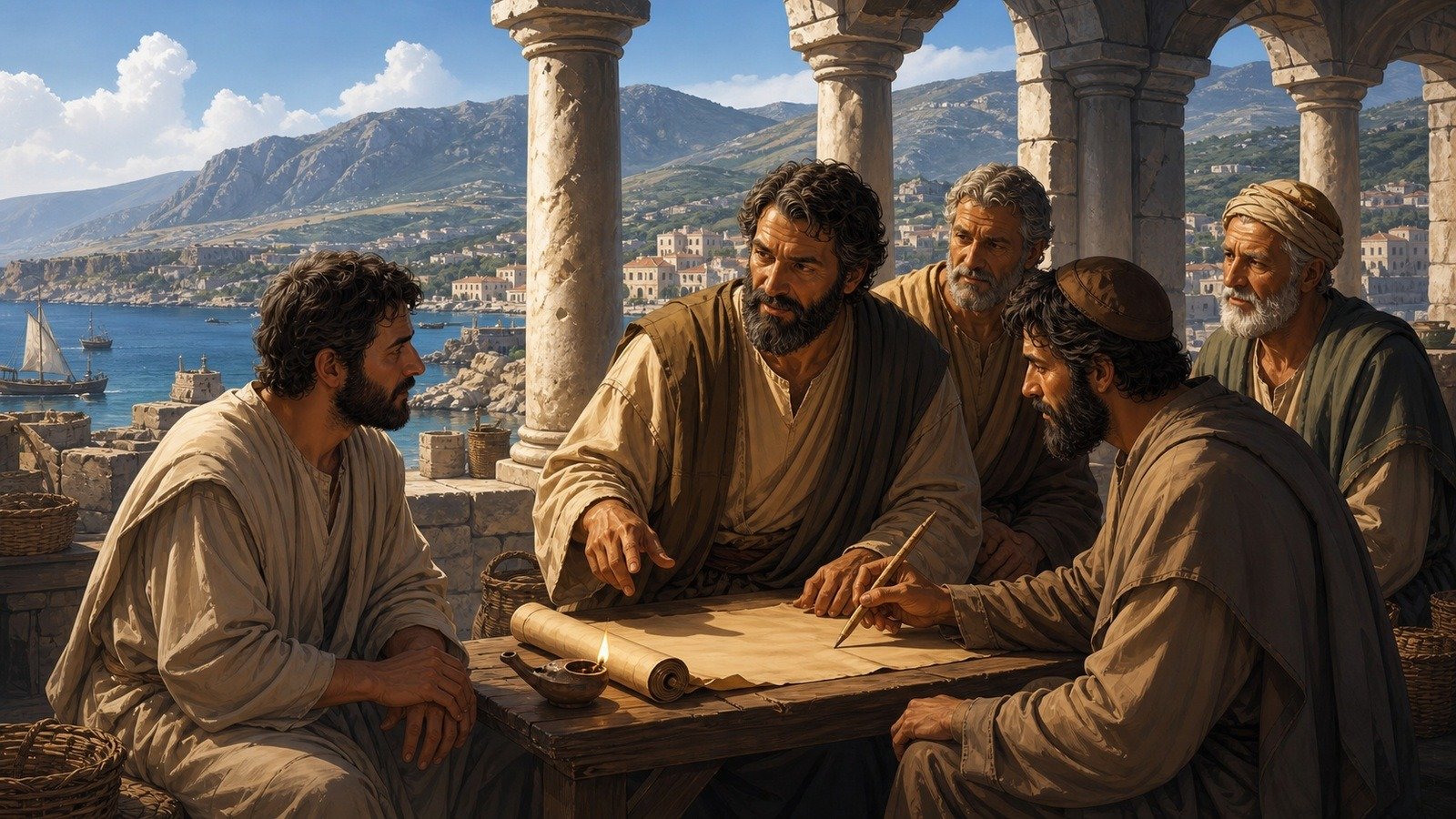
Paul writes to Titus, left to organise the church on Crete, giving qualifications for elders and practical instruction for different groups within the congregation; it shares the disputed authorship question of the other two pastoral letters.
Further context
2 min readTitus had been left on Crete to put in order what was left unfinished and to appoint elders in every town, and the letter tells him how to do it.
He is one of Paul's most trusted colleagues and appears nowhere in the record of the church's early years, which is one of the puzzles of that book. He is mentioned thirteen times in the letters: taken to Jerusalem as a test case and pointedly not circumcised, sent to Corinth during the worst of the trouble there and bringing back the news that reconciled them, and put in charge of the collection.
Crete was a large island with a poor reputation. Paul quotes a local writer about it, and the quotation is famously awkward: one of Crete's own prophets has said it: Cretans are always liars, evil brutes, lazy gluttons. This saying is true. The line is attributed to Epimenides, a Cretan, which turns it into the old logical puzzle about a Cretan calling all Cretans liars.
The instructions for appointing elders are almost identical to those given for Ephesus, and they are again about character. Blameless, faithful to his wife, with children who believe, not overbearing, not quick-tempered, not given to drunkenness, not violent, not pursuing dishonest gain, hospitable, loving what is good, self-controlled, upright, holy and disciplined.
Then instructions for groups within the congregation: older men, older women, younger women, young men, and slaves. The older women are told to teach the younger, which is one of the few places where a teaching role is described explicitly.
The reason given for all of it is repeated three times and it is entirely public-facing: so that no one will malign the word of God, so that those who oppose may have nothing bad to say about us, so that in every way they will make the teaching about God our Saviour attractive.
A congregation on Crete was being watched, and the argument is that its behaviour was the argument.
Two doctrinal statements sit inside the practical material, and both are compressed to the point of being formulas, which suggests they were already in use. One begins, the grace of God has appeared that offers salvation to all people. The other says God saved us not because of righteous things we had done, but because of his mercy.
Crete had a Jewish population, and Cretans are listed among the nationalities present at Pentecost, which may be how the message first reached the island.
Titus is not mentioned once in the record of the church's early years, despite being one of Paul's most trusted men. Why that is has been asked for centuries, and one old suggestion is that he was Luke's brother, which would explain a deliberate omission and is otherwise unsupported.
The quotation about Cretans is one of only three places where Paul quotes a Greek writer, and all three are in contexts where he is speaking to or about non-Jews.
Titus is described as Paul's true son in the faith and as his partner and co-worker, and the two men appear to have trusted each other with the most difficult assignments: Corinth at its worst, and Crete from scratch.