

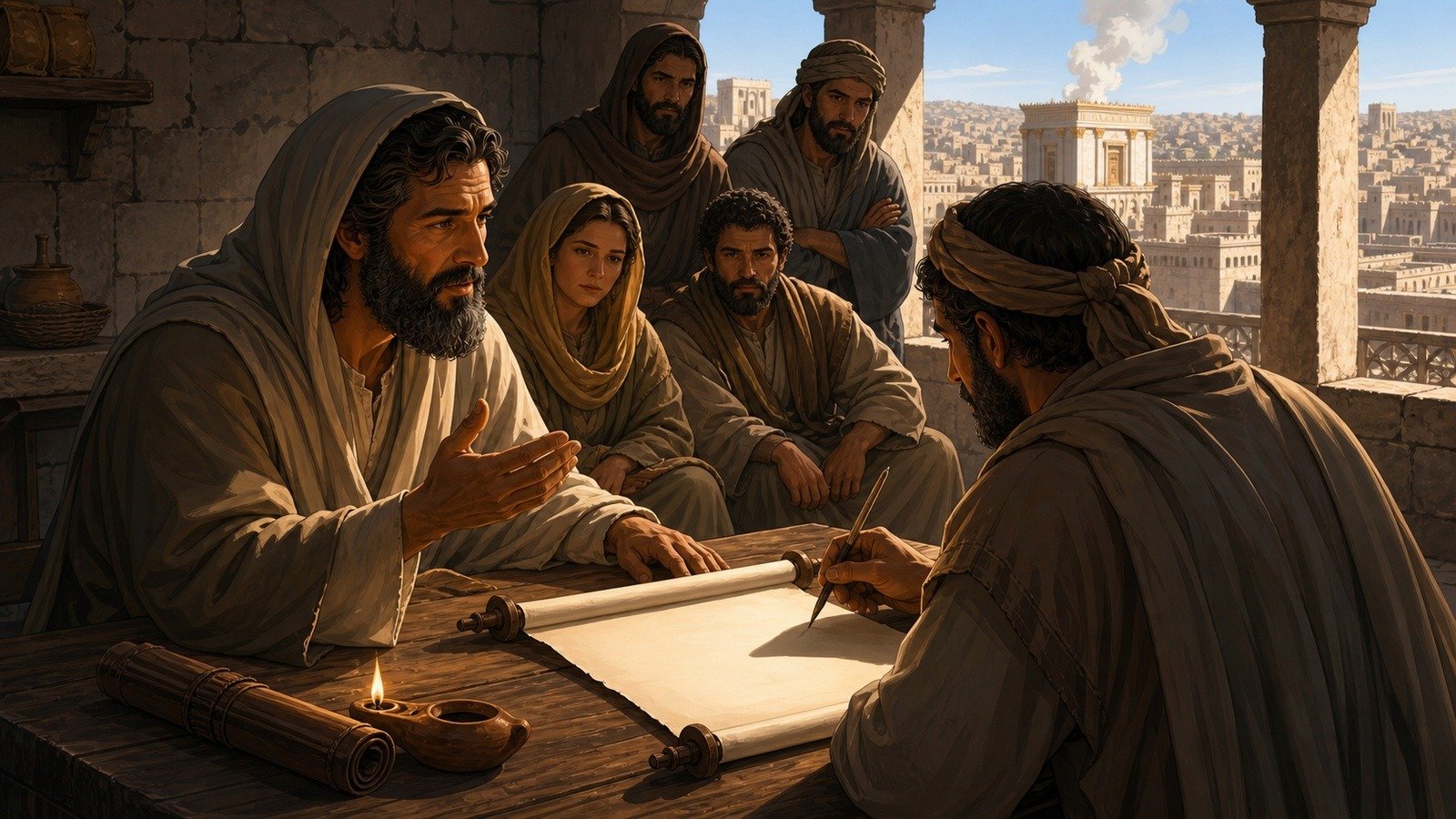
An anonymous, carefully argued letter presenting Jesus as the great high priest whose sacrifice surpasses the entire Old Testament sacrificial system, written to Jewish Christians apparently tempted to abandon their faith under pressure; its author was already disputed in the early church, with Paul, Barnabas, Apollos and others all proposed without consensus.
Further context
2 min readThe letter to the Hebrews has no named author, and nobody knows who wrote it.
That is not a modern doubt. Origen, in the third century, said the thoughts were the apostle's but that who actually wrote it God alone knows, and the eastern and western churches disagreed about it for centuries. The letter names no author, gives no address, and opens without any greeting at all, which no other letter in the New Testament does.
The candidates proposed over the years include Paul, Barnabas, Apollos, Luke, Clement of Rome and Priscilla. The case against Paul is strong on internal grounds: the Greek is the most polished in the New Testament, the style is quite unlike his, and the writer places himself among those who received the message from those who heard the Lord, which Paul was always careful to deny of himself.
Who it was written to is nearly as uncertain, though the content points to Jewish believers under pressure to return to the synagogue, quite possibly at Rome, and quite possibly before the temple was destroyed in AD 70, since the sacrificial system is discussed in the present tense.
The argument is a single sustained comparison, and it works by superiority. The Son is greater than the prophets, greater than the angels, greater than Moses, and a priest of a different order altogether.
That priesthood is the heart of it. Israel's priests were descended from Aaron, served in a tent and then a temple, and offered sacrifices that had to be repeated endlessly. The writer produces a different figure from the book of Genesis, Melchizedek, a priest-king of Salem who appears without genealogy, blesses Abraham and disappears, and argues from the silence about his ancestry.
The conclusion is that there is now a high priest who offered himself once for all, and that the whole apparatus of the older covenant was a shadow of what was coming.
The letter also contains the most sustained warnings against falling away anywhere in the New Testament, and they have caused enormous difficulty in traditions that hold believers cannot be lost.
And it contains the roll call of faith, which runs from Abel through Noah, Abraham, Moses, Rahab and the judges to those who were tortured, jeered at, flogged, sawn in two, and wandered in deserts and mountains, living in caves and in holes in the ground.
The Greek of this letter is the most sophisticated in the New Testament, with a carefully controlled rhetorical structure and vocabulary drawn from the Greek Old Testament rather than the Hebrew.
Its inclusion in the canon was slow and contested, and it was accepted in the west largely on the assumption that Paul wrote it, which almost nobody now holds. The book stayed and the reason for keeping it did not.
The letter's warnings about falling away are addressed to people who had already suffered, had their property confiscated and stood publicly beside those in prison, which is the context that makes them intelligible.
The letter's central claim, that a single sacrifice has replaced a continuous one, would have been very difficult to write after AD 70 without mentioning that the sacrifices had stopped, which is one of the stronger arguments for an early date.