

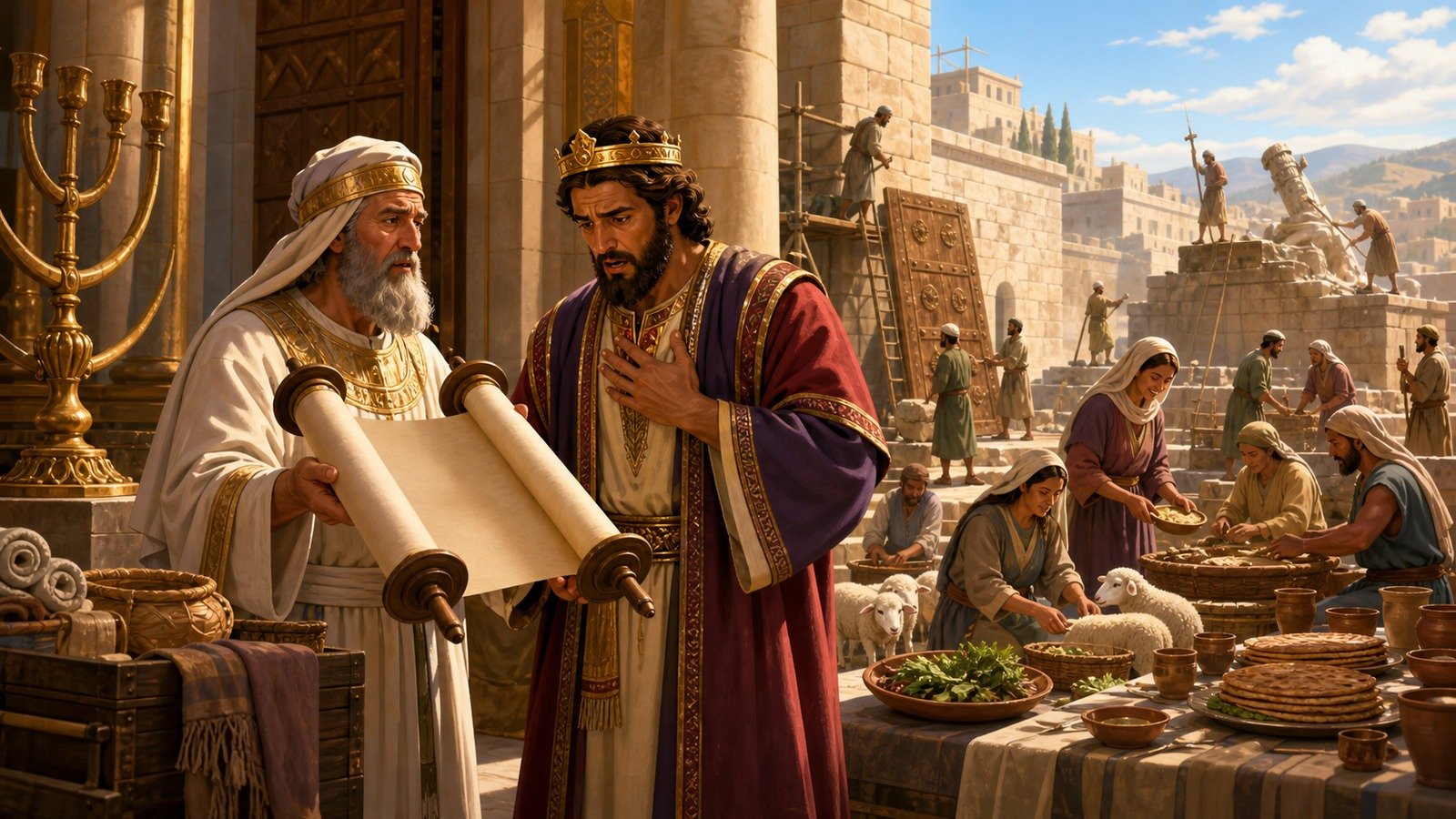
Crowned at eight, Josiah initiates Temple repairs during which a copy of the Law is rediscovered; its reading provokes sweeping reforms, the destruction of pagan altars across both former kingdoms, and a national Passover celebration. He dies in battle against Pharaoh Necho at Megiddo in 609 BC.
Further context
3 min readThirty-one years, and the assessment matches Hezekiah's: he did what was right in the eyes of the LORD and did not turn aside to the right or to the left. He begins seeking God at sixteen, starts purging the shrines at twenty, and in his eighteenth year, aged twenty-six, orders repairs to the temple on the model Joash had used.
During the work Hilkiah the high priest finds the Book of the Law in the temple. It is read to the king, and he tears his robes, because the curses in it describe exactly what has been happening.
What that scroll was is one of the standard questions of Old Testament scholarship. The reforms that follow correspond very closely to the specific requirements of Deuteronomy, including the centralisation of all sacrifice at one sanctuary, which is why most scholars identify it with some form of that book. Positions range from a document composed in Josiah's own reign, to a much older text recovered after being lost during Manasseh's fifty-five years, and the debate has run since the early nineteenth century.
The reforms are the most thorough in the country's history. The articles made for Baal and Asherah are burned in the Kidron valley. The priests appointed to the high places are removed. The Asherah pole is taken out of the temple, burned and ground to powder. The quarters of the male shrine prostitutes inside the temple are torn down. The Topheth in the Valley of Ben Hinnom, where children had been sacrificed, is desecrated. The horses dedicated to the sun are removed from the entrance.
He then goes north, outside his own borders into former Israelite territory, and demolishes the altar at Bethel that Jeroboam had built three hundred years earlier, burning human bones on it. A prophet from Judah had announced by name that a king called Josiah would do exactly that, and the tomb of that prophet is pointed out to him and left undisturbed.
Then a Passover is held on a scale nobody living had seen: not since the days of the judges had any such Passover been observed.
None of it changes the outcome. The judgement announced over Manasseh's reign stands, and he is told he will be spared seeing it.
The Passover held that year is described as unlike any since the days of the judges, which is a claim about four centuries. What made it unusual was not its scale but its location: everyone came to Jerusalem, because the scroll required a single sanctuary and every local shrine in the country had just been demolished.
He dies at Megiddo, aged thirty-nine, intercepting Pharaoh Necho, who is marching north to support the last remnant of Assyria against Babylon. The Babylonian Chronicle records that Egyptian campaign in the same year, which is one of the tightest correlations anywhere between these histories and a Mesopotamian record.
Thirty-one years, and the reform begins in his eighteenth, when the high priest Hilkiah reports finding the Book of the Law during temple repairs.
What that scroll was is one of the standard questions of biblical scholarship. Its contents produce a reform focused on centralising worship at one sanctuary and destroying the high places, which is the specific programme of Deuteronomy, and most scholars identify it with some form of that book.
The scale of what followed is described in detail: the Asherah pole burned in the Kidron valley and its ashes scattered over the graves of the common people, the quarters of the male shrine prostitutes torn down, the high places from Geba to Beersheba desecrated, the altar at Bethel pulled down and the bones from the tombs on the hillside burned on it.
Then a Passover was kept of a kind that had not been observed since the days of the judges.