

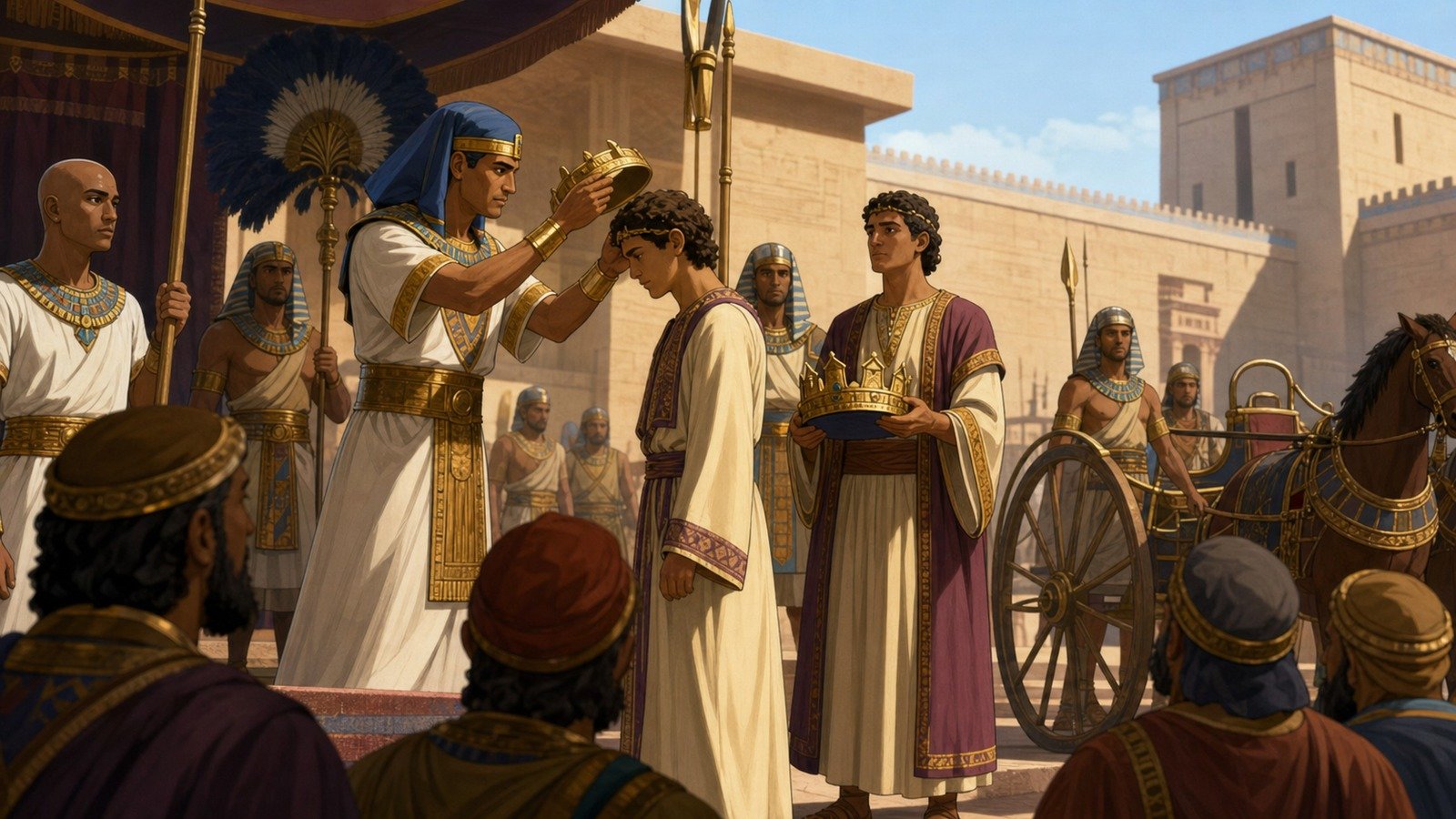
Josiah's son Jehoahaz reigns only three months before Pharaoh Necho deposes him and deports him to Egypt, installing his brother Jehoiakim in his place.
Further context
3 min readThe people of the land take Josiah's son and make him king in his father's place, and he lasts three months.
He is not the eldest. His brother Eliakim is two years older, and choosing the younger man is a deliberate political act by the landowning class, presumably because he was expected to continue his father's anti-Egyptian line. Josiah had just died trying to stop Necho's army, so the choice reads as a statement about which side Judah intends to be on.
Necho settles it. On his way back from the Euphrates he summons the new king to his headquarters at Riblah in Syria, puts him in chains, and takes him to Egypt, where he dies. Judah is fined a hundred talents of silver and a talent of gold.
The Pharaoh then appoints the elder brother, changes his name from Eliakim to Jehoiakim, and installs him. Changing a vassal's throne name is a standard assertion of authority in that world, the same move Nebuchadnezzar makes a few years later with the last king of Judah.
The independence Josiah had spent thirty-one years building lasts three months past his death. A foreign king removes the man Judah chose, imposes the man Judah passed over, renames him, and sets the tax.
Jeremiah, working in Jerusalem throughout, refers to the deported king by a shortened form of his name and tells the country not to weep for the dead king but for the one who is gone, because he will never return or see his native land again. Coming immediately after a national funeral for Josiah, that is an instruction to grieve for the living instead.
His three months get four sentences and the standard bad verdict, and it is difficult to see what a king could have done in twelve weeks to earn it, other than presumably leaving the shrines his father had demolished alone.
The people of the land who put him on the throne are the same body that had installed his grandfather and would install his nephew. They act four times across two centuries and always in a crisis, and always to keep a son of David in Jerusalem. What they had no capacity to do was stop a foreign army from removing whoever they chose.
Jeremiah's word for him uses a shortened form of the name, which is how a person is referred to informally, and the effect in a public oracle is to strip the king of his title as he leaves. He is the first king of Judah to die outside the country, and the first to be removed by a foreign power rather than by his own officials or by illness.
What the episode establishes is the position Judah is now in. Assyria has collapsed, Babylon is rising, Egypt is trying to prop up the remnant of the old order, and a small kingdom on the coastal road between them has no capacity to choose. Over the next twenty-two years it changes overlord twice, rebels twice, and is destroyed.
Three months, and he never governs anything. Necho deposes him at Riblah in the land of Hamath, which is where the Egyptian army was camped, and takes him to Egypt, where he dies.
Riblah on the Orontes appears again a generation later as the place where Nebuchadnezzar sits in judgement on the last king of Judah. It was the standing forward headquarters for any army operating in Syria, at the point where the roads from Egypt and Mesopotamia meet.
A levy of a hundred talents of silver and a talent of gold is imposed on the country, and Jehoiakim raises it by taxing the people of the land according to their assessments.
Jeremiah tells the country not to mourn for the dead king but to weep for the one taken away, because he will never return.