

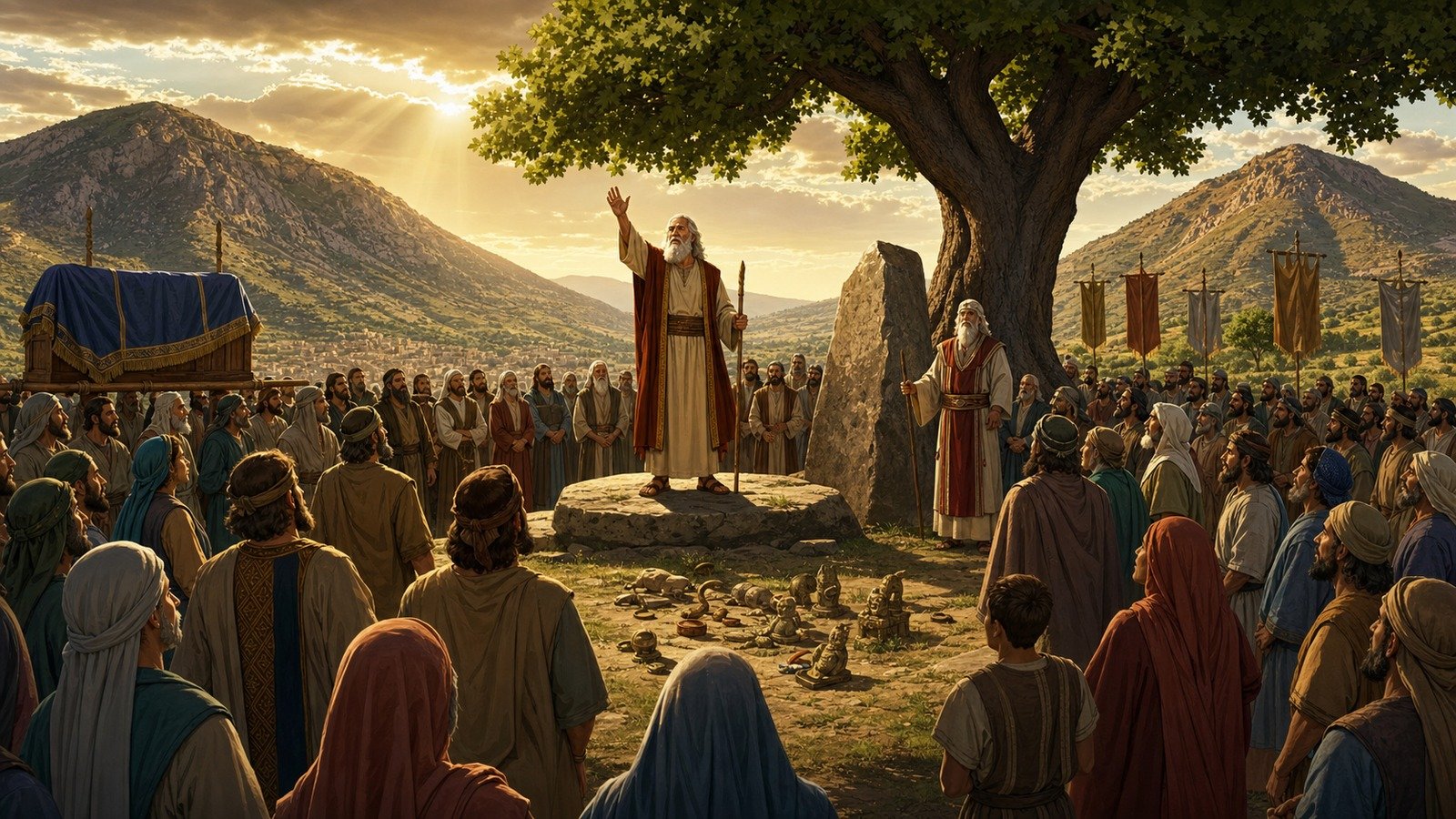
In his final address, Joshua reviews God's faithfulness and challenges Israel to choose whom they will serve; the assembled people renew the covenant, "as for me and my household, we will serve the Lord."
Further context
2 min readJoshua is old and well advanced in years, and he calls the whole nation together at Shechem, the valley between Mount Ebal and Mount Gerizim where the law had been read publicly at the start of the campaign, and where Abraham had built his first altar in the country.
He begins with history and he starts it further back than anyone expects: long ago your ancestors, including Terah the father of Abraham and Nahor, lived beyond the Euphrates and worshipped other gods. The national story opens with idolatry rather than with a call, and the point is made to people who are about to be asked to give something up.
He runs forward through Abraham, Isaac, Jacob, Egypt, the sea, the wilderness, Balaam, the crossing and the conquest, quoting throughout in the first person as God's own summary of what he did. One line in it is unusually candid: I gave you a land on which you did not toil and cities you did not build; you live in them and eat from vineyards and olive groves that you did not plant.
Then the demand. Throw away the gods your ancestors worshipped beyond the Euphrates and in Egypt, and serve the LORD. That instruction, delivered after a generation in the country, means household gods were still in circulation, and the same thing had to be dealt with by Jacob at the same site centuries earlier.
The choice is put in terms that make refusal a live option: if serving the LORD seems undesirable to you, then choose for yourselves this day whom you will serve, whether the gods your ancestors served or the gods of the Amorites in whose land you are living. But as for me and my household, we will serve the LORD.
The people answer that they will serve the LORD, and he tells them they are not able to. You are not able to serve the LORD. He is a holy God; he is a jealous God. He will not forgive your rebellion and your sins. They insist, and he makes them witnesses against themselves, sets up a large stone under the oak near the holy place, and says the stone has heard all the words spoken and will be a witness against them if they are untrue to their God.
A leader ending his career by telling the nation that it will fail, and arranging a rock to testify against it, is not the usual shape of a farewell speech.
Shechem is also a deliberate choice of ground. Abraham built his first altar in the country there and was told his offspring would receive the land. Jacob buried his household's foreign gods under an oak at the same place and bought the field where Joseph's bones now lay. The nation is being asked to renew a commitment in the exact spot where its ancestors made and remade theirs, standing on land bought with silver by a man who owned nothing else in the country.