

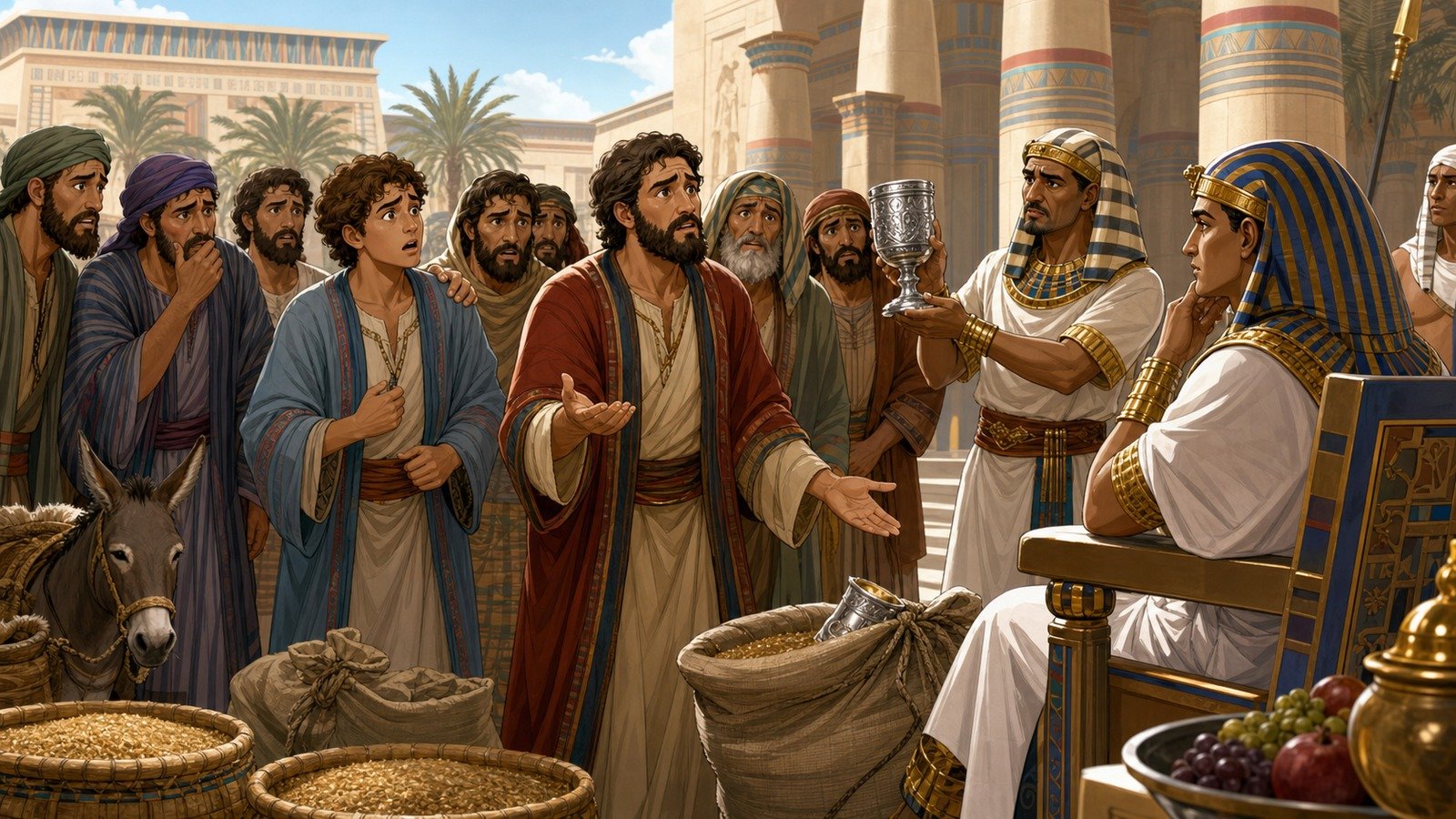
The brothers return with Benjamin; Joseph tests them further with a silver cup planted in Benjamin's sack, and Judah's offer to take Benjamin's punishment himself shows the brothers have genuinely changed since selling Joseph into slavery.
Further context
2 min readThe grain runs out and Jacob tells his sons to go back for more, as though the condition attached to it had never been stated. Judah spells it out: the man warned us solemnly that we would not see his face again unless our brother is with us.
What Judah then offers is different in kind from Reuben's earlier proposal to have his own two sons killed. He puts himself up as the guarantee. I myself will guarantee his safety; you can hold me personally responsible. If I do not bring him back, I will bear the blame before you all my life. Jacob gives way, and his instructions are those of a frightened man managing risk: take the best products of the land as a gift, balm, honey, spices, myrrh, pistachio nuts and almonds; take double the silver; take back the silver that was returned, in case it was a mistake.
In Egypt they are taken to Joseph's house and assume the worst, explaining the returned silver to the steward before anyone has accused them of anything. His answer is unexpected: do not be afraid, your God, the God of your father, has given you treasure in your sacks. Simeon is brought out to them.
The meal that follows unsettles them twice. Egyptians could not eat with Hebrews, because that was detestable to them, so three tables are set: one for Joseph, one for the Egyptians and one for the brothers. Egyptian distaste for the customs of Asiatic foreigners is well attested. Then the brothers are seated in order of age, from the firstborn to the youngest, and they look at each other in astonishment, because nobody in Egypt should know their birth order. Benjamin is served five times as much as anyone else.
The trap is then set. Joseph's silver cup is hidden in Benjamin's sack, the brothers are overtaken on the road, and the steward accuses them of theft. They are confident enough to offer a death sentence for whoever has it. The search begins with the eldest and ends with the youngest, and the cup is found. They tear their clothes and go back.
The proposal put to them is the test itself: the one who had the cup will become a slave, and the rest may go home to their father in peace. It offers them exactly the situation they created twenty-two years earlier. Rachel's remaining son can be left in Egypt as a slave, and they can walk back to Jacob without him, and nobody will blame them.
Judah's speech in reply runs seventeen verses and is the longest anyone makes in the whole book. It retells the exchange from the beginning, dwells on how attached the old man is to the boy, and says that if he goes back without him his father will die. Then the substitution: let your servant remain here as a slave in place of the boy, and let the boy return with his brothers.
Judah is the brother who proposed selling Joseph for silver. He is now offering his own freedom to keep Rachel's other son out of slavery, and he does it without knowing who is listening.