

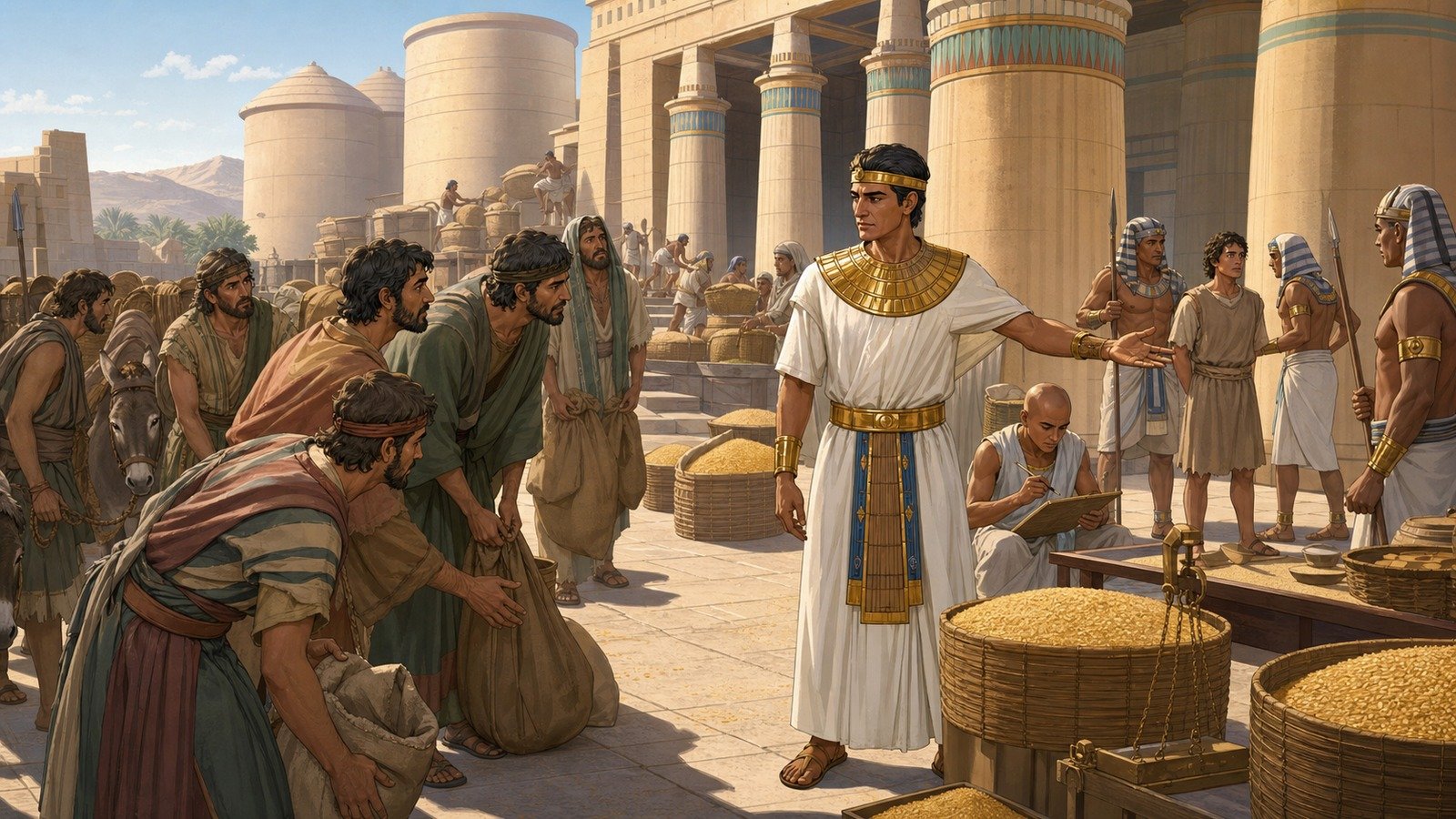
Famine drives Joseph's brothers to Egypt for grain; Joseph, unrecognised, accuses them of spying, holds Simeon hostage, and demands they return with their youngest brother Benjamin to prove their honesty.
Further context
3 min readThe famine reaches Canaan and Jacob asks his sons why they keep looking at each other when there is grain in Egypt. Ten of them go. Benjamin stays behind, because his father is afraid harm might come to him. He has twelve sons and treats one of them as irreplaceable, which is the same policy that produced the crisis in the first place.
They arrive and bow down before the governor with their faces to the ground. He recognised his brothers, but they did not recognise him. He was seventeen when they last saw him and is now approaching forty, shaven, dressed as an Egyptian official and speaking through an interpreter.
He accuses them of being spies who have come to see where the land is unprotected, which was a plausible charge on Egypt's north-eastern frontier and which he repeats until they answer it with their family history. Your servants were twelve brothers, the sons of one man, who lives in the land of Canaan. The youngest is now with our father, and one is no more.
He puts them in custody for three days and then changes the terms. One brother will stay and the rest may take grain home, on condition that they bring the youngest back. Simeon is chosen and bound in front of them, which is a considered choice: he is the second son, and the one who led the massacre at Shechem.
The conversation they then have among themselves is the reason for the whole manoeuvre. Surely we are being punished because of our brother. We saw how distressed he was when he pleaded with us for his life, but we would not listen. Reuben answers that he told them not to sin against the boy and they would not listen to him either. That is the first indication anywhere that Joseph begged, and the first that any of them regretted it. They say it in front of him because they assume he cannot understand, since he has been using an interpreter throughout. He turns away and weeps, then comes back and carries on.
He orders their silver put back in their sacks along with the grain. When one of them opens his sack at the overnight stop and finds it, the reaction is not relief. Their hearts sank and they turned to each other trembling and said, what is this that God has done to us? A gift they cannot explain frightens them more than the accusation did.
The accusation of spying is not arbitrary. Egypt's north-eastern frontier was watched continuously, with a chain of forts along the road into Canaan and officials recording who crossed and why. A group of ten foreign men arriving together during a famine, without women or children and without goods to trade, is precisely the profile a border official would question. The charge is plausible enough that they answer it with their entire family history rather than dismissing it.
Jacob's response when they get home is the bleakest thing he says anywhere. You have deprived me of my children. Joseph is no more and Simeon is no more, and now you want to take Benjamin. Everything is against me. Reuben offers a guarantee that shows how badly he has misread his father, promising that Jacob may put his own two sons to death if Benjamin is not brought back. It is refused, and the family is left holding grain and no plan.