

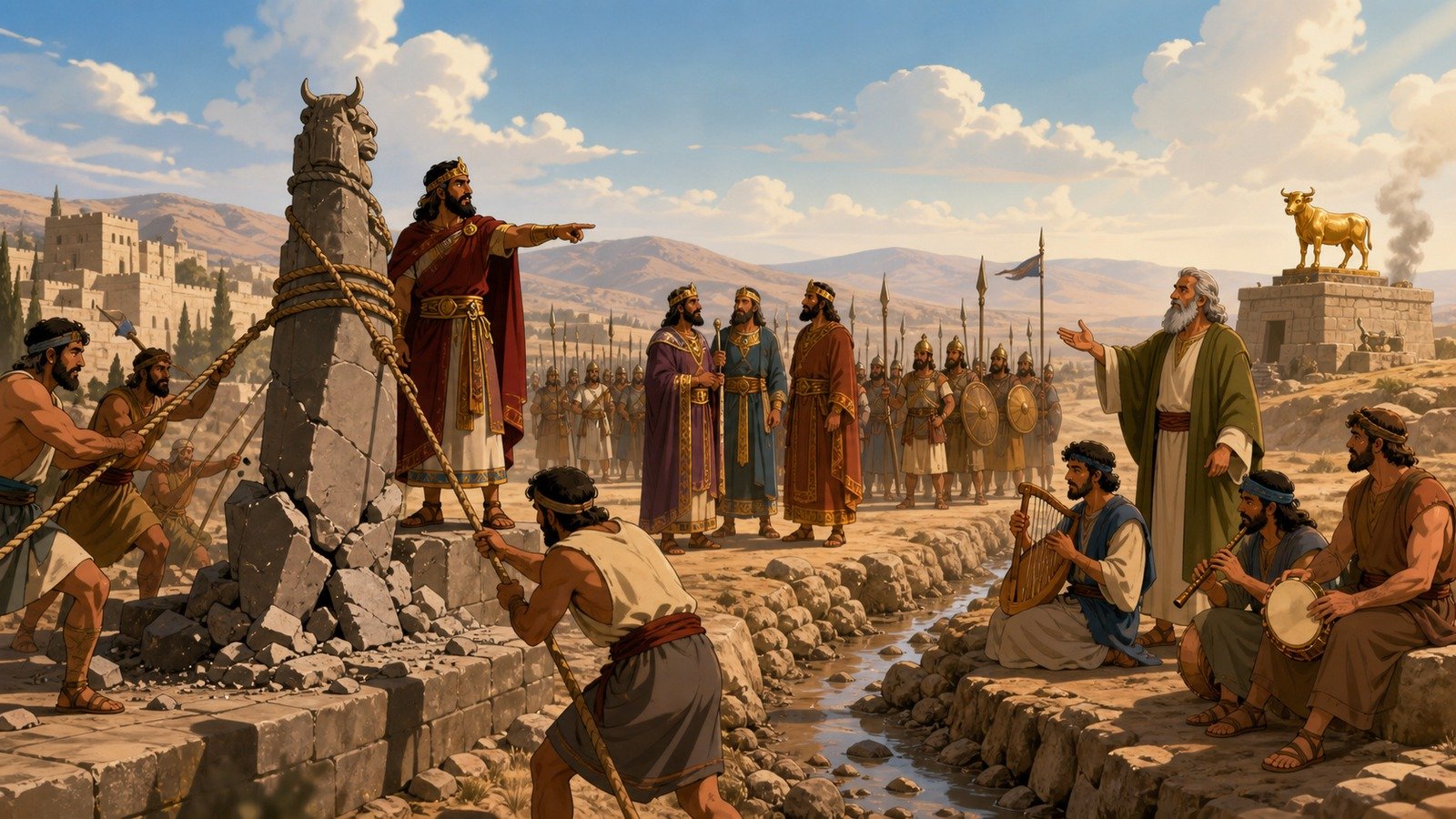
Ahab's second son Joram succeeds his brother and removes the more overt Baal pillar Ahab had erected, though he retains the golden calves; he campaigns with Judah and Edom against a rebellious Moab, a war narrated with Elisha's involvement.
Further context
3 min readTwelve years, and the verdict is qualified in an unusual way: he did evil, but not as his father and mother had done, because he got rid of the sacred stone of Baal that his father had made. He still clung to the sins of Jeroboam. A partial reform, honestly recorded as partial.
The defining episode is the campaign to bring Moab back under control. He recruits Jehoshaphat of Judah and the king of Edom, and the three armies take a roundabout route through the Desert of Edom to attack from the south, presumably to avoid the fortified northern frontier. After seven days they run out of water for the men and the animals.
Joram's reaction is to conclude that the LORD has called the three of them together to hand them over to Moab. Jehoshaphat's is to ask whether there is a prophet anywhere, and an officer says Elisha son of Shaphat is here, the man who used to pour water on the hands of Elijah, which is how a servant is described.
Elisha's greeting to the king of Israel is contemptuous: what do we have to do with each other? Go to the prophets of your father and the prophets of your mother. He adds that if it were not for the presence of Jehoshaphat he would not look at him or even notice him.
He calls for a harpist, and while the harp is played the hand of the LORD comes on him. The instruction is to dig ditches all over the valley, with a promise that there will be neither wind nor rain and yet the valley will be filled with water.
In the morning water comes flowing from the direction of Edom and the land fills with it. Flash floods from rain falling on distant high ground, arriving in a dry wadi under a clear sky, are a well-documented phenomenon in that terrain, and what is claimed is the timing rather than the meteorology.
The Moabites, drawn up at the frontier, see the sun shining on the water and take it for blood, conclude that the three kings have destroyed each other, and rush the camp for plunder. They are routed.
The end of the campaign is one of the strangest things in these books. Besieged in his last stronghold, the king of Moab takes his firstborn son, the heir to the throne, and offers him as a burnt offering on the city wall in full view of the attackers. The fury against Israel was great; they withdrew and returned to their own land.
Nothing explains that sentence, and interpreters have argued over whose fury it was ever since.
Twelve years, and a qualified verdict: he did evil, but not as his father and mother had done, because he got rid of the sacred stone of Baal that his father had made.
Partial reform of that kind is recorded of several kings and it is treated as insufficient every time, which is the standard the books apply throughout.
The reign is where most of the Elisha material sits: the siege of Samaria and its sudden relief, the Aramean raiding parties, the Shunammite woman and the recovery of her land. Joram is present in several of those scenes and is usually the man asking what to do.
He is killed by Jehu with an arrow between the shoulders while trying to flee in his chariot, and his body is thrown onto the plot of ground that had belonged to Naboth.