

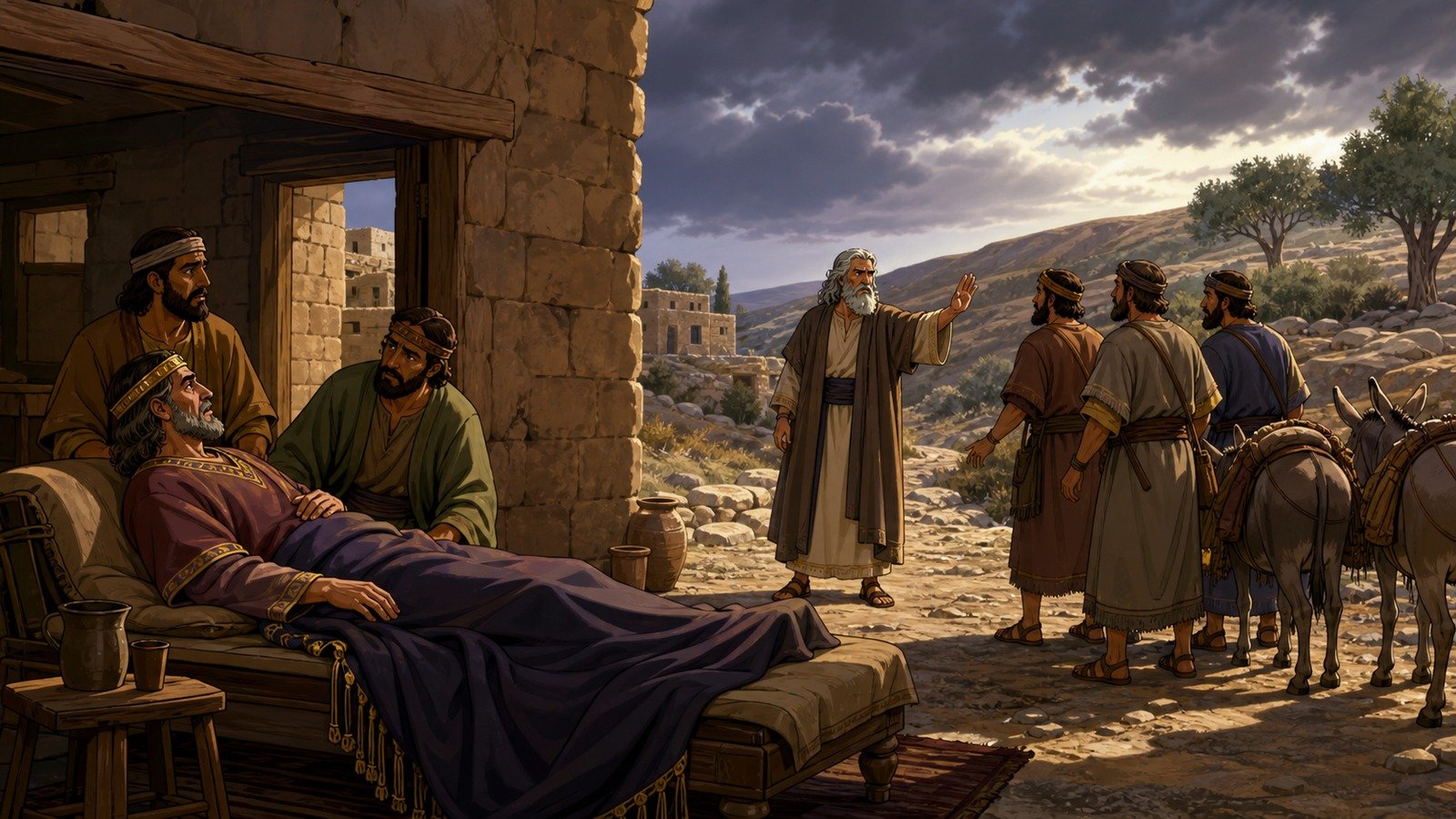
Ahab's son Ahaziah continues his parents' Baal worship; injured in a fall, he sends messengers to consult the Philistine god Baal-Zebub about his recovery rather than God, and Elijah confronts and condemns the enquiry before Ahaziah dies childless.
Further context
3 min readAhaziah of Israel reigns two years and does almost nothing except fall through a lattice.
The assessment is that he followed the ways of his father and his mother and of Jeroboam, and served and worshipped Baal, provoking the LORD to anger just as his father had done. Both parents are named, which happens rarely and is a way of saying that Jezebel's influence outlived her husband.
His reign opens with a loss. Moab, which had been paying an annual tribute of a hundred thousand lambs and the wool of a hundred thousand rams, rebels after Ahab's death. That rebellion is recorded from the other side on the Mesha Stele, where the Moabite king Mesha describes throwing off Israelite domination and attributes his earlier subjection to the anger of his god Chemosh. It is one of the few places where an event in these histories can be read in two accounts written by opposing sides.
Then he falls through the lattice of his upper room in Samaria and is injured, and sends messengers to consult Baal-Zebub, the god of Ekron, to find out whether he will recover.
Ekron is a Philistine city about fifty kilometres away, and the name of the god is worth explaining. Baal-Zebub means lord of the flies, which is almost certainly a deliberate Hebrew distortion of a title that would have been lord of the exalted house or something similar. Turning a foreign deity's name into an insult is a standard move, and this particular corruption survives into the New Testament as Beelzebul, used there for the prince of demons.
Elijah intercepts the messengers on the road with a question and a sentence. Is it because there is no God in Israel that you are going off to consult Baal-Zebub? Therefore you will not leave the bed you are lying on. You will certainly die.
The king asks what the man looked like and is told he had a garment of hair and a leather belt, and identifies him immediately.
Two companies of fifty men are sent to arrest him and both are consumed by fire on the hillside. The captain of the third company goes up and falls on his knees and asks for his life and the lives of his men, and Elijah goes with him to the palace and repeats the message to the king's face.
The two companies burned on the hillside are among the harder things in these books to read sympathetically, and nothing softens them. What can be said is that the men were sent to arrest a prophet on a king's order, that the third captain approached differently and was spared along with his fifty, and that the difference between the outcomes lies entirely in how the three of them addressed the man they had been sent to seize.
He dies without a son, and his brother succeeds him.
Falling through a lattice sounds trivial and describes a real hazard. Upper rooms opened onto flat roofs through screened openings, and the screen was there to keep out sun and insects rather than to bear weight.
What the episode is about is where he sent for information. He dispatched messengers to consult Baal-Zebub, the god of Ekron, one of the five Philistine cities, and the name means lord of the flies, which is very probably a Hebrew insult applied to a title meaning lord of the princes. The same name reappears in the Gospels as a title for the prince of demons.
Elijah intercepts the messengers on the road with a question that carries the whole point: is it because there is no God in Israel that you are going off to consult Baal-Zebub?