

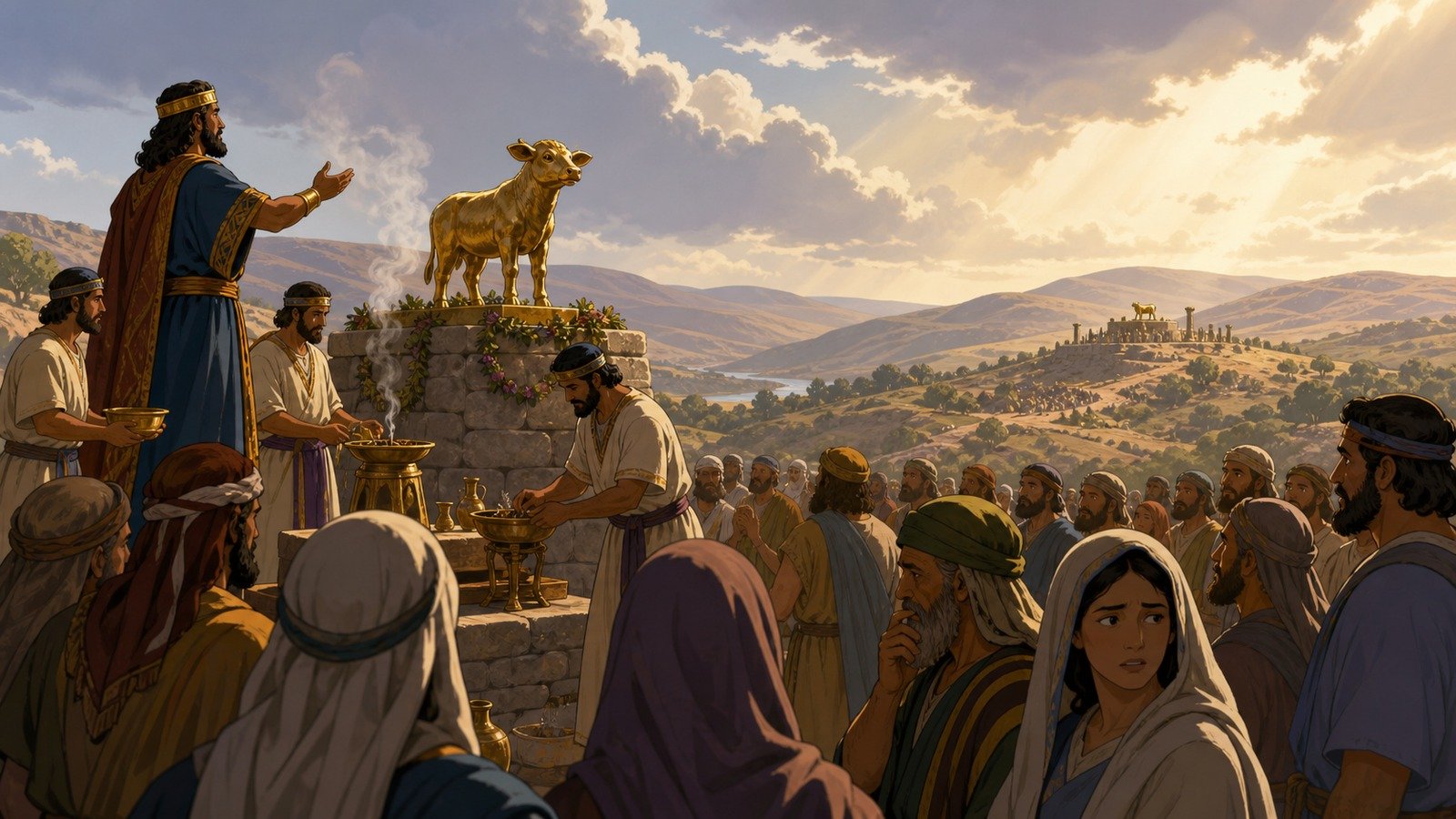
Fearing that pilgrimage to Jerusalem's Temple would draw the northern tribes back to Rehoboam, Jeroboam sets up golden calf shrines at Bethel and Dan and institutes a rival priesthood and festival calendar, a policy Kings repeatedly calls "the sin of Jeroboam" that every subsequent northern king is judged against.
Further context
3 min readJeroboam's problem is not military but liturgical, and he states it to himself in as many words. If these people go up to offer sacrifices at the temple in Jerusalem, they will give their allegiance again to their lord, Rehoboam king of Judah. Three times a year the whole nation was required to travel to a festival, and the festival was now in the rival capital.
His solution is two golden calves, one at Bethel in the south of his territory and one at Dan in the far north, so that nobody has to travel further than a day. The words he uses at the dedication are almost exactly the words used over the calf at Sinai: here are your gods, Israel, who brought you up out of Egypt.
Whether he intended a rival god or a visible pedestal for the same one is arguable, and bull imagery was standard across the region for a deity's mount rather than the deity itself. What is not arguable is the outcome. Within a couple of generations the shrines at Bethel and Dan are indistinguishable from Canaanite worship, and every northern king afterwards is assessed by whether he departed from the sins of Jeroboam son of Nebat, which he never does. The phrase becomes a formula repeated nineteen times.
He also builds shrines on high places, appoints priests who are not Levites, and moves the autumn festival from the seventh month to the eighth, a month of his own devising. That last detail is the one that gives the game away: a calendar is a claim to authority, and shifting a festival by a month makes attendance in Jerusalem impossible for anyone keeping his version.
The northern kingdom now has its own sanctuaries, its own priesthood, its own festival calendar and its own king, and none of them connects to the arrangements made at Sinai or to the promise made to David.
Dan has been excavated extensively, and a large stone platform at the northern end of the site, with a monumental staircase and an adjacent complex including an altar and cultic vessels, belongs to exactly this period and is generally identified as the sanctuary in question. It is one of the clearest correspondences between a described installation and an excavated one anywhere in these books.
A prophet from Judah confronts him at the altar at Bethel while he is offering incense, announces that a king named Josiah will one day burn human bones on it, and gives a sign. The king stretches out his hand and orders him seized, and the hand shrivels so that he cannot pull it back, and the altar splits apart. He asks the man to pray for him and is restored.
He changes nothing.
Bethel and Dan are chosen with care. Bethel lay ten miles north of Jerusalem and was the nearest major sanctuary to the border, catching anyone travelling south; Dan was at the far northern end. Between them they covered the kingdom.
Both sites have been excavated. At Dan a large platform of dressed stone with a monumental stairway was uncovered in the 1970s, dating to about this period, and a horned altar was found beside it.
The calves themselves are usually understood as pedestals rather than idols, since gods in the ancient Near East were regularly depicted standing on an animal, and the throne of an invisible God above a bull would have been defensible to the men who built it. The verdict recorded on it is not.