

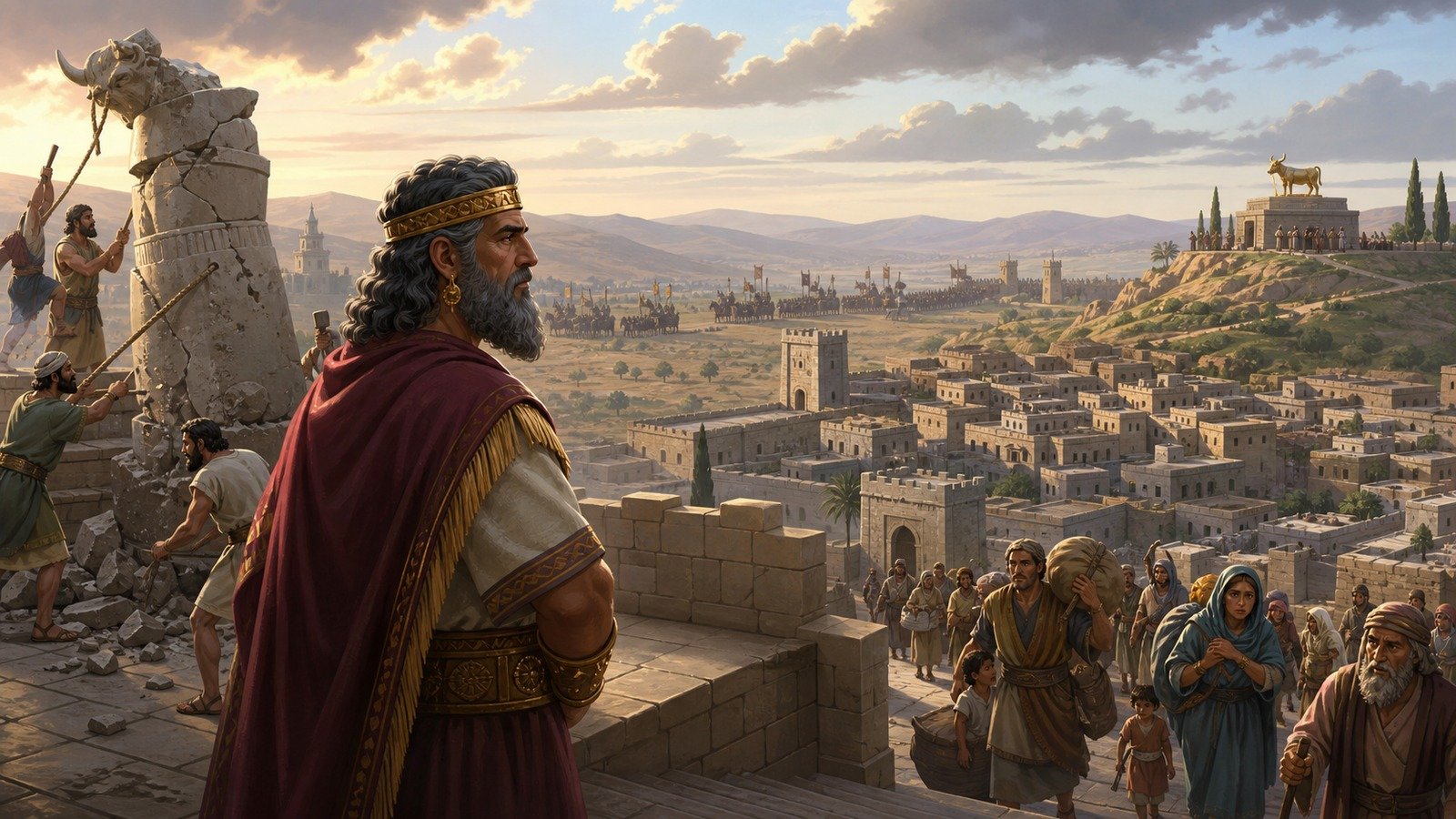
Despite his zeal against Baal worship, Jehu continues Jeroboam's golden calves, and his reign sees Israel's territory shrink under sustained Aramean pressure under Hazael.
Further context
3 min readJehu reigns twenty-eight years, the longest in the northern kingdom to this point, and the dynasty he founds lasts four generations and about a century, which is by a wide margin the most stable arrangement the north ever manages.
The assessment of him is the most carefully balanced verdict given to any king in these books. He is told that because he has done well in accomplishing what was right and has done to the house of Ahab all that was in mind to do, his descendants will sit on the throne of Israel to the fourth generation. And then immediately: yet Jehu was not careful to keep the law of the LORD with all his heart, and he did not turn away from the sins of Jeroboam, which he had caused Israel to commit.
He destroyed a foreign cult and kept the domestic one. The temple of Baal in Samaria is demolished and turned into a latrine, which is stated as being still the case when this was written down, and the golden calves at Bethel and Dan are untouched.
A century later the prophet Hosea, naming his own son Jezreel, announces that God will punish the house of Jehu for the massacre at Jezreel and put an end to the kingdom of Israel. The same act is commended in one book and condemned in another, and both statements stand. What that pair of judgements appears to distinguish is a commission carried out and the relish with which it was carried out, and Jehu piled seventy heads at a city gate and rode over the body of a queen.
One phrase attached to him has outlived everything else about him. Driving like a maniac, as the watchman on the tower at Jezreel describes it, is how a Hebrew idiom for reckless speed entered English, and it is the only thing most people who have heard of Jehu know about him.
Militarily his reign is a disaster and the reason is straightforward. By eliminating the house of Ahab he destroys the anti-Assyrian coalition that had held the region together, and by removing Jezebel he ends the Phoenician alliance. He is left facing Hazael of Aram alone, and in those days the LORD began to reduce the size of Israel, with Hazael overpowering the Israelites throughout their territory east of the Jordan: Gilead, Gad, Reuben and Manasseh, from the Arnon gorge northwards.
The tribute he pays to Shalmaneser III in 841 BC, shown on the Black Obelisk, is an attempt to buy Assyrian protection against Damascus. It does not work, because Assyria turns its attention elsewhere for the next thirty years and leaves Israel exposed.
The Aramean pressure of these years is also the background to a great deal of the Elisha material, where Israelite kings are consistently on the defensive, cities are besieged and famine is normal. Those episodes read very differently once it is clear that the state they happen in has fifty horsemen and ten chariots left.
The kingdom he leaves his son is smaller, poorer and militarily helpless.
Twenty-eight years, and the assessment is split down the middle. He is commended for destroying Baal worship out of Israel, and condemned because he did not turn away from the golden calves at Bethel and Dan.
A promise is attached to the commendation: his descendants will sit on the throne to the fourth generation, which is what happened, and gives the house of Jehu the longest run of any northern dynasty.
What the reign cost is set out at the end. Hazael of Aram took all the territory east of the Jordan, from the Arnon gorge northward through Gilead and Bashan. The Assyrian pressure that had kept Aram occupied lifted, and Israel absorbed the whole force of it.
The Tel Dan inscription, found in 1993, is an Aramean victory stele whose fragmentary text refers to killing a king of Israel and a king of the house of David, and it is the earliest reference to David's dynasty outside the Bible.