

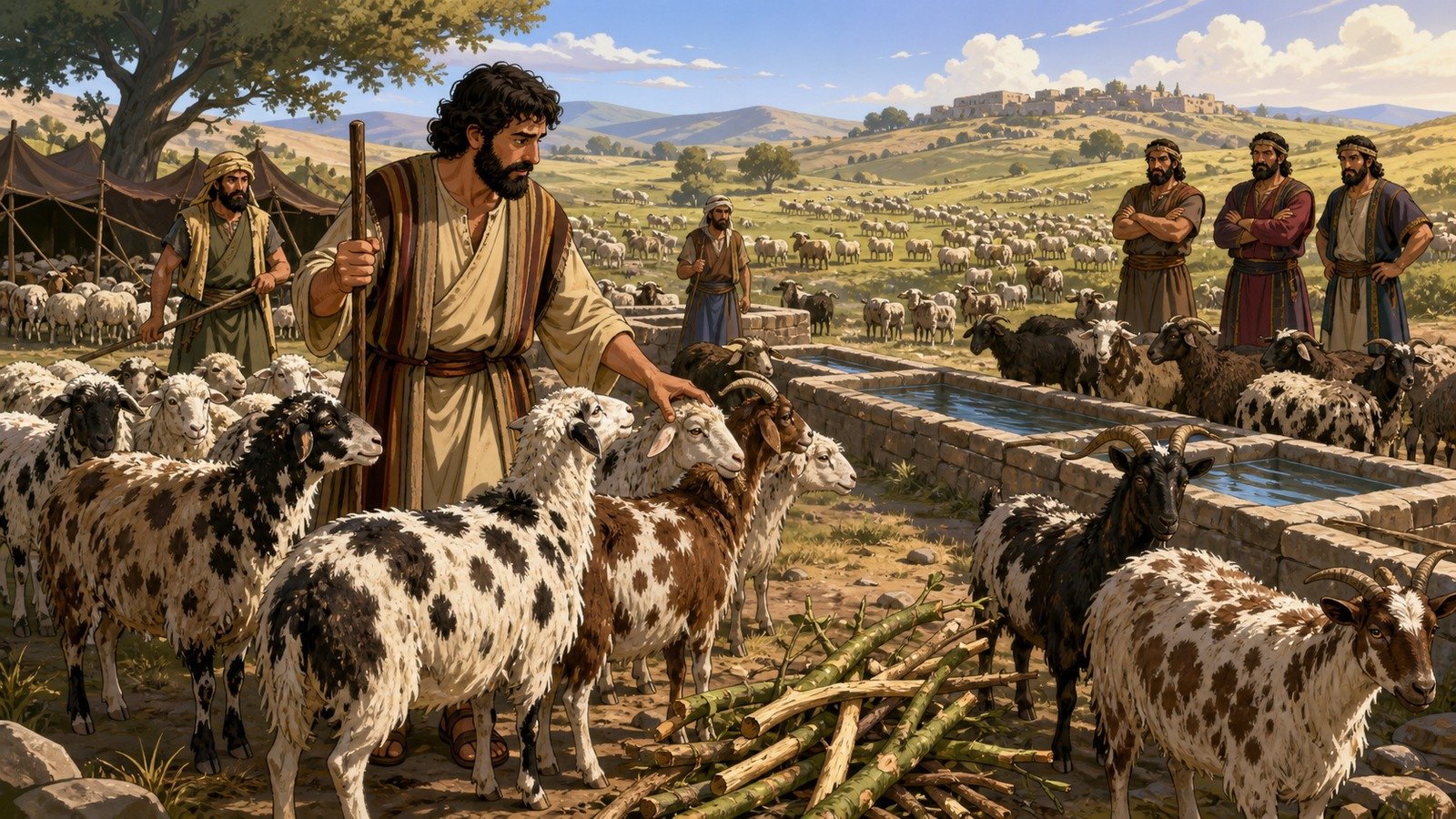
Jacob negotiates a wage of speckled and spotted livestock from Laban, then prospers through selective breeding practices, growing wealthy enough to provoke resentment from Laban's sons.
Further context
2 min readJacob asks to go home, and Laban does not want to lose him. The reason is stated with unusual frankness: I have learned by divination that the LORD has blessed me because of you. A man who owns household gods and consults omens has worked out that his nephew is profitable.
The wage agreement they reach turns on animal colouring. Jacob will take every speckled or spotted sheep, every dark-coloured lamb, and every spotted or speckled goat, and Laban keeps the rest. In Near Eastern flocks of the period the ordinary sheep was white and the ordinary goat was dark, so Jacob is claiming the exceptions, which looks like a modest share. Laban agrees at once, then removes every animal matching that description, hands them to his own sons and puts a three-day journey between them and Jacob, who is left tending pure-coloured stock and told to take his wages from whatever anomalies turn up.
What he does next is described in two quite different ways within a few sentences, and both belong in any honest account.
The first is the peeled branches. He cuts fresh poplar, almond and plane, strips the bark in stripes, and sets the rods in the watering troughs where the flocks come to drink and to mate, so that they conceive in front of the striped wood and produce streaked young. The belief behind that, that what a mother sees at conception marks her offspring, was widespread across the ancient world and survived in European folk medicine into the modern period. It has no basis in inheritance, and no claim that it does is made anywhere; what he did is simply reported.
The second description follows immediately and concerns something that works. He separates the flocks, and whenever the stronger animals were mating he put the branches in front of them, and when the weaker ones came he did not. The result was that the weak went to Laban and the strong to Jacob. Stripped of the rods, that is deliberate selective breeding of vigorous stock, and any herdsman doing it consistently would build a superior flock within a few seasons.
A third explanation comes from Jacob himself a little later, when he describes a dream in which he saw the mating animals and was told by an angel that the outcome had been arranged because of how Laban had treated him. Folk practice, animal husbandry and divine intervention are all offered as accounts of the same result, and none is ranked above the others.
He ends up with large flocks, servants, camels and donkeys, having arrived twenty years earlier with nothing at all. The man who once tricked his brother out of a birthright has now spent two decades on the receiving end of a sharper operator, and comes out ahead by a combination of stockmanship and, on his own account, help he did not arrange.
That is also the point at which Laban's sons start talking. What they say, and what their father's face begins to look like, is what forces the family onto the road.