

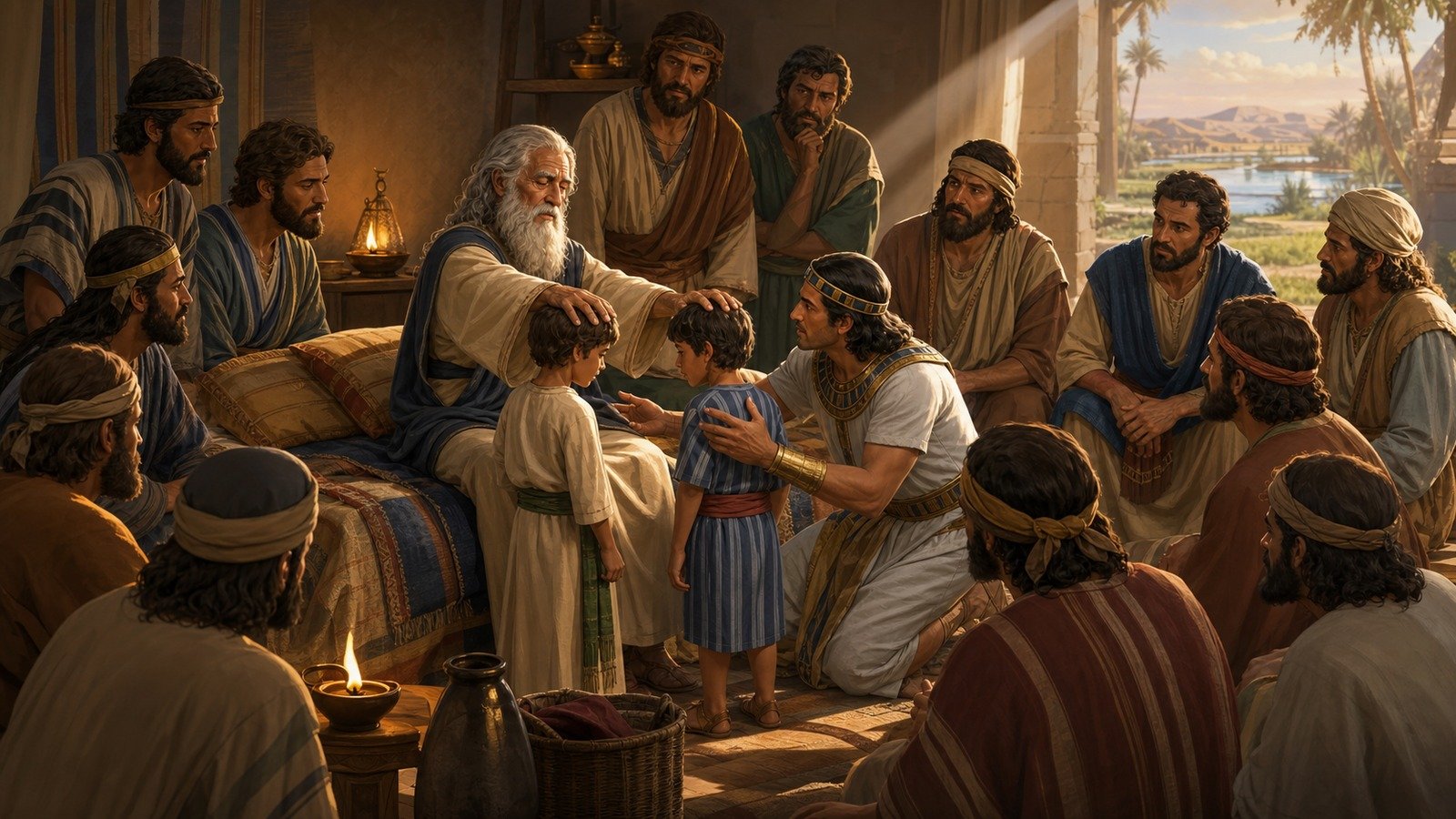
Jacob adopts Joseph's two sons as his own, giving each a share of the inheritance, and pronounces individual blessings and prophecies over all twelve sons as he nears death.
Further context
2 min readThe first of the two scenes is a legal transaction dressed as a family visit. Jacob tells Joseph that his two sons born in Egypt, Ephraim and Manasseh, will be reckoned as his own, just as Reuben and Simeon are his. That is an adoption formula, and its effect is to give Joseph two tribal portions instead of one, which is the double share belonging to a firstborn.
Then the hands cross. Joseph places Manasseh, the elder, at his father's right and Ephraim at his left, and the old man, whose eyes are failing, deliberately crosses his arms so that his right hand rests on the younger. Joseph tries to correct him and is refused: I know, my son, I know. He too will become a people, and he too will become great. Nevertheless his younger brother will be greater than he. A blind father blessing the younger over the elder is exactly the scene Jacob engineered against his own father, and he now performs it knowingly and in the open.
The second scene is a poem of some forty verses addressed to all twelve sons, and the word blessing does not fit several of them. Reuben, the firstborn, is told he is turbulent as the waters and will no longer excel, because he defiled his father's bed. Simeon and Levi have their anger cursed and are told they will be scattered in Israel, which points back to Shechem and forward to the fact that Simeon's territory is absorbed into Judah and Levi receives no land at all.
Judah receives the longest and most consequential section. He is compared to a lion, and the central lines say that the sceptre will not depart from Judah, nor the ruler's staff from between his feet, until a phrase whose Hebrew is among the most argued over anywhere. The word behind it can be read as a place name, as "until he comes to whom it belongs", or as tribute brought to him, and the ancient translations already disagree. What is clear is that lasting rule is attached to Judah, which is why these lines are quoted in every later discussion of the monarchy and of a coming king.
The remaining sons receive shorter oracles, many tied to the territory their tribes will hold. Zebulun by the seashore, Issachar between two saddlebags, Dan judging his people, Asher with rich food, Joseph a fruitful vine near a spring, Benjamin a ravenous wolf.
He then gives burial instructions, naming the cave at Hebron and listing who is already in it: Abraham and Sarah, Isaac and Rebekah, and Leah. The wife he did not choose is buried in the family tomb, and he asks to be laid beside her. Rachel, whom he worked fourteen years for, is under a pillar on a road.
One curiosity of translation attaches to this scene. Hebrews describes him worshipping as he leaned on the top of his staff; the Hebrew has him bowing at the head of his bed. The two Hebrew words for staff and bed share the same consonants and differ only in the vowels, which early manuscripts did not write, and the Greek translation chose one while the Hebrew tradition chose the other.