

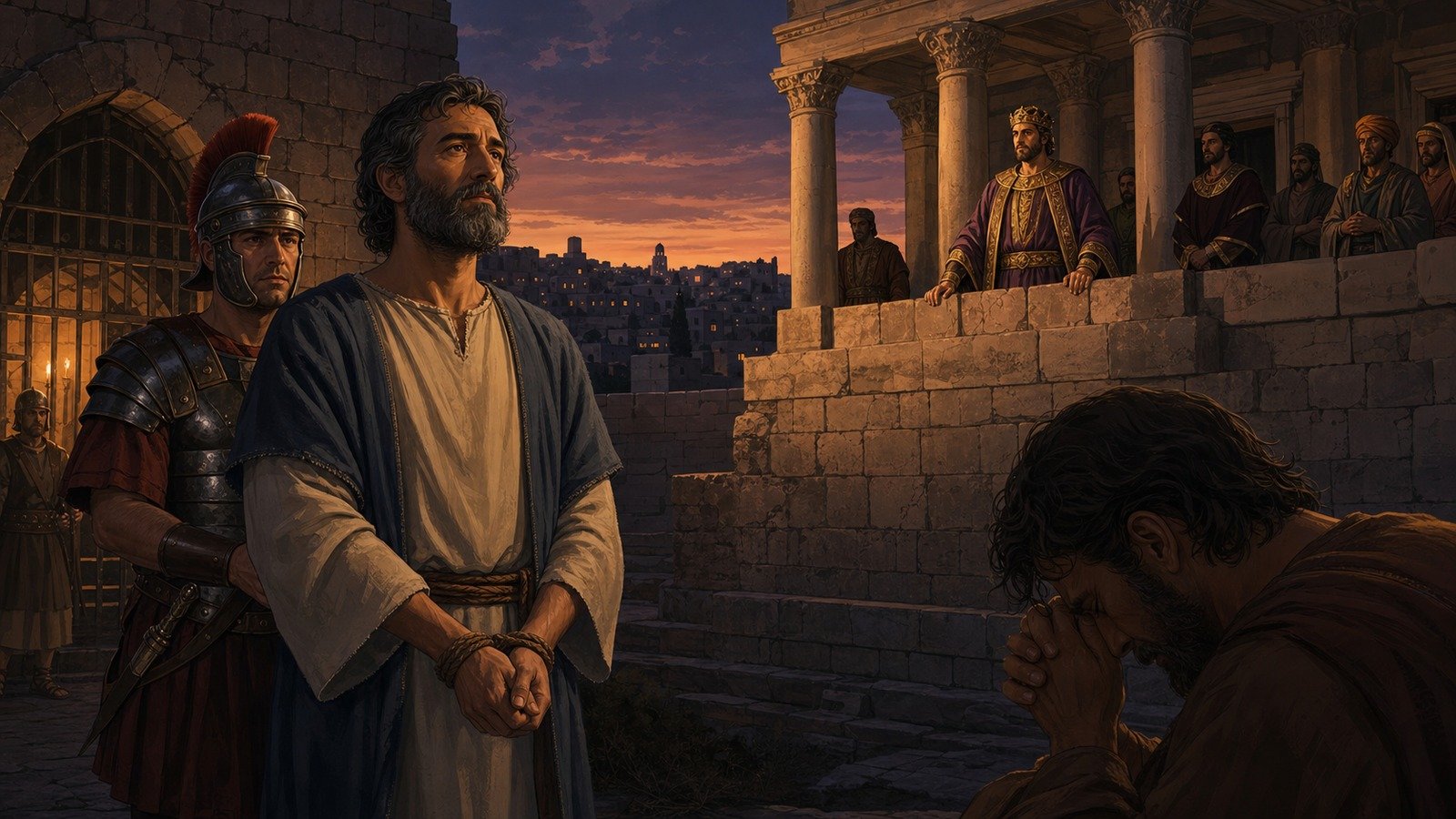
Herod Agrippa I, grandson of Herod the Great, has the apostle James executed to please his Jewish subjects, making James the first of the Twelve to be martyred.
Further context
2 min readKing Herod arrested some who belonged to the church, intending to persecute them. He had James, the brother of John, put to death with the sword.
That is the entire report of the death of one of the Twelve, and it is one sentence.
The king is Herod Agrippa I, grandson of Herod the Great, and his career is one of the more improbable in the period. Raised in Rome alongside members of the imperial family, he ran up enormous debts, was imprisoned by Tiberius for a careless remark about wanting Caligula on the throne, and was released and given a kingdom when Caligula duly became emperor. By AD 41 Claudius had added Judea and Samaria, so that for three years he ruled almost the whole territory his grandfather had held.
His policy at home was conspicuous observance. Josephus describes him as scrupulous about Jewish law, resident in Jerusalem, generous with sacrifices, and popular in a way no member of his family had managed before. Rabbinic tradition preserves a scene of him reading the law aloud at the Feast of Tabernacles and weeping when he came to the command about not setting a foreigner over you, with the crowd calling out that he was their brother.
That is the context for the execution. A ruler whose standing depended on being seen as a good Jew moved against a movement that had become an irritant, and when he saw that this met with approval among the Jews, he proceeded to seize Peter also.
Death by the sword means beheading, which under Jewish law was the penalty for certain offences and was also the ordinary Roman method for a citizen. James is the first of the Twelve to be killed and the only one whose death is recorded in the New Testament.
He is one of the three taken up the mountain and into the room where a dead girl was raised, one of the two who asked for the seats on the right and the left, and one of the pair nicknamed Sons of Thunder. When he and his brother had said they could drink the cup, they were told they would.
His brother John, by the earliest traditions, outlived all of them.
Nothing is said about how the church responded, and the report moves straight on to Peter's arrest, which is where the writer's attention goes.
Agrippa's reign was short and his three years were the last period in which anything like a Jewish kingdom existed. After his death Judea reverted to Roman procurators, and the drift towards the revolt of AD 66 begins from about that point.
That the death of an apostle is recorded in nine words, while Peter's escape from prison a few sentences later takes a page, is a matter of what the writer was interested in rather than of what he thought important.
Spanish tradition later made James the evangelist of the Iberian peninsula and placed his remains at Compostela, which became one of the three great pilgrimage destinations of medieval Europe. The tradition is late and the historical basis for it is slight.