

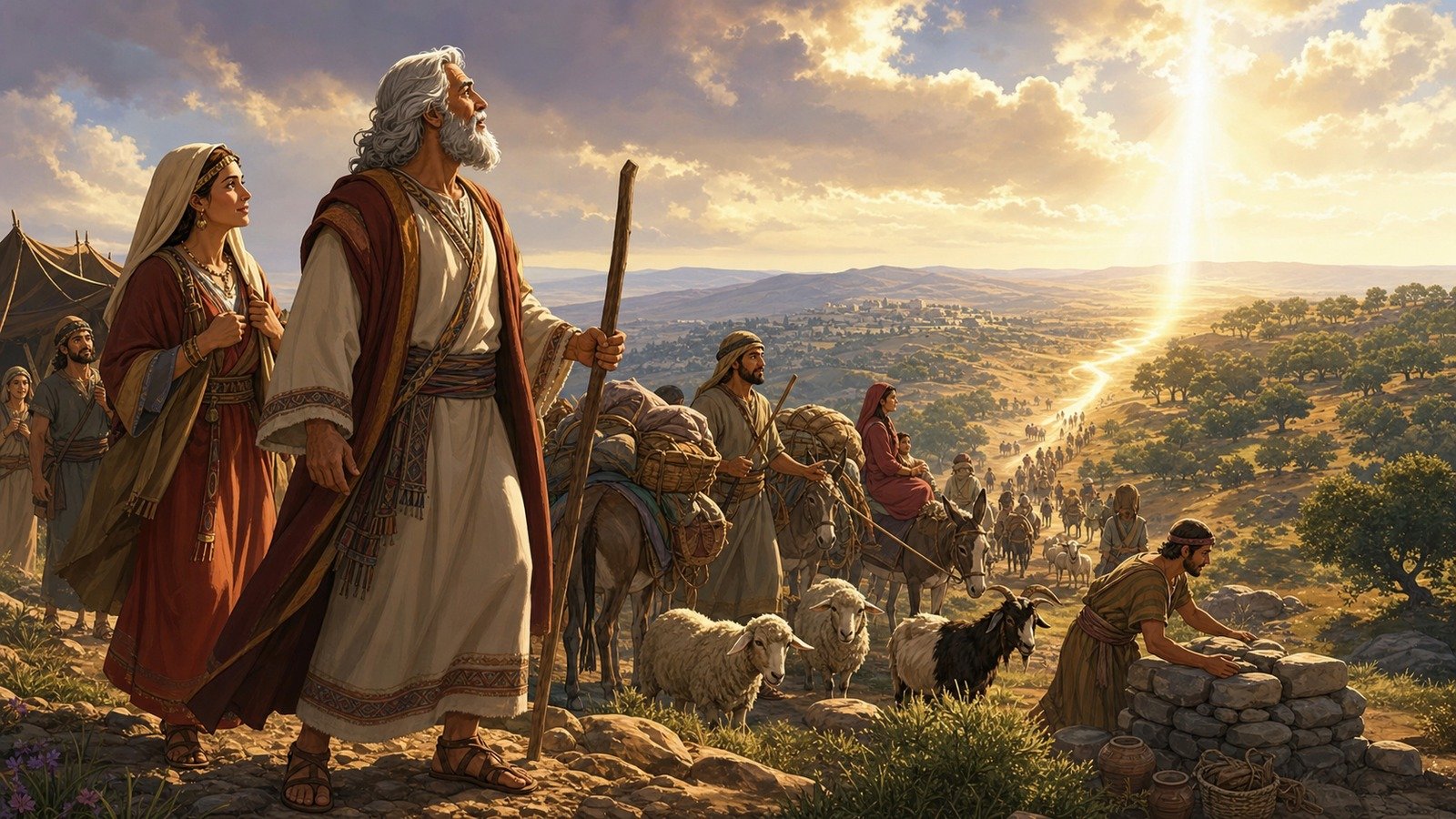
God calls Abram, aged 75, to leave Harran for a land he will be shown, promising to make him into a great nation and to bless all peoples through him. Abram, Sarai and Lot travel to Canaan and Abram builds altars at Shechem and Bethel.
Further context
2 min readThree things are stripped away in one sentence and no destination is supplied. Leave your country, your people and your father's household, and go to the land I will show you. In a society where identity, security and legal standing came from exactly those three, the instruction dismantles a man's position before offering him anything at all.
What is offered is a promise in seven parts. Abram will become a great nation, be blessed, and have a great name; those who bless him will be blessed and whoever curses him will be cursed; and all peoples on earth will be blessed through him. The third of those repays attention, because the builders at Babel had said, a few paragraphs earlier, let us make a name for ourselves. What they tried to seize is handed to a man who is told to leave everything and walk.
The scale of what is being asked becomes clearer against his circumstances. Sarai was unable to conceive, and that fact is stated flatly just before the call comes. A great nation is promised to a man of seventy-five with a childless wife, in a country he does not own and which is already occupied. Every element the promise requires is missing at the moment it is made.
He leaves Harran with his wife, his nephew Lot, everything they had accumulated and the people they had acquired there. The distances are substantial. Ur to Harran, following the Euphrates rather than crossing open desert, is roughly a thousand kilometres. Harran to Canaan is another six hundred. They are moving with flocks and herds, at the pace of animals.
He arrives at Shechem in the central hill country and stops at the great tree of Moreh, and there he is told that this land will belong to his offspring. Then a single clause changes the colour of the whole thing: the Canaanites were in the land at that time. The territory being promised is somebody's home, and he will live in it as a resident foreigner for a century without owning any of it except a burial cave. He builds an altar at Shechem, moves south into the hills between Bethel and Ai and builds another, then continues towards the dry country of the Negev.
One apparent inconsistency is worth settling. Terah is described as leading the family out of Ur towards Canaan, while the call is given at Harran. Stephen, addressing the Sanhedrin much later, says God appeared to Abraham in Mesopotamia before he lived in Harran. The usual reconciliation reads the Hebrew verb as a pluperfect, so that God had already spoken before the family left Ur, which the grammar permits. On that reading Terah's journey was a response to a call given to his son, and the years at Harran were a delay.
The date of about 2090 BC comes from traditional chronology, and its basis should be understood. It is produced by adding the ages in the genealogies and fixing the result against later Israelite history. No Mesopotamian or Egyptian record mentions Abram, and nothing excavated has been connected to him. A figure precise to the decade claims more than the method can deliver, and the calculation shifts depending on which manuscript tradition is counted.