

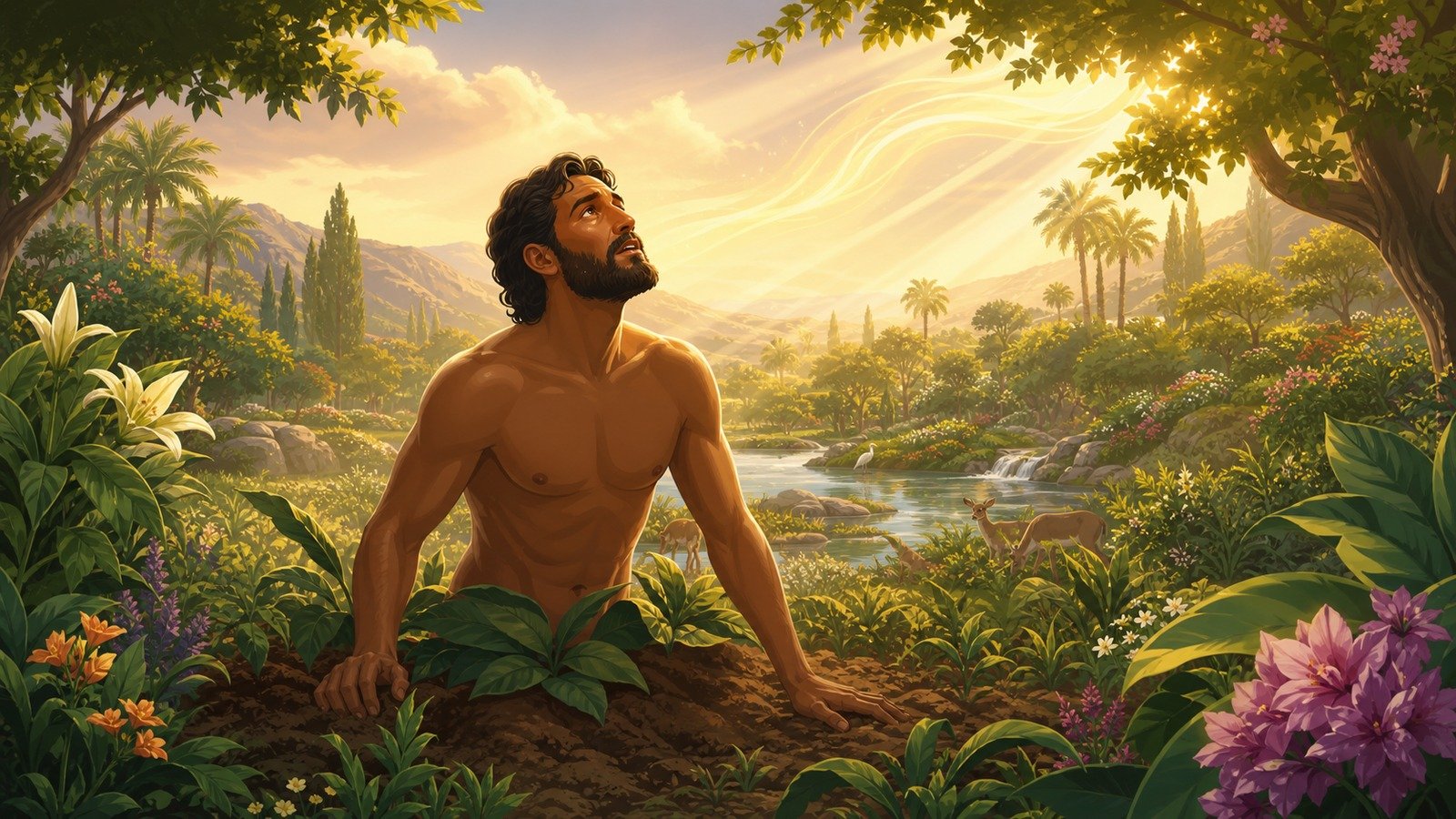
God forms the man from dust, breathes life into him, and places him in Eden to work and keep it, giving a single prohibition against eating from the tree of the knowledge of good and evil. This establishes humanity's original vocation and the one boundary the following chapter's temptation will target.
Further context
2 min readThe world begins dry in this second telling. No rain had fallen, no shrub had come up, and there was nobody to work the ground. A man (adam), later called Adam, is shaped out of the dust of the ground (adamah), with the verb a potter would use for moulding clay, and he becomes a living creature when God breathes into his nostrils. The play on words holds in Hebrew and disappears in English. Life here is breathed into someone rather than possessed by him.
He is placed in a garden planted "in the east, in Eden", and he is given work to do: to serve it (abad) and to guard it (shamar). The same pair of words turns up later for the duties of priests at the tabernacle. Work exists before anything has gone wrong. It belongs to the original arrangement, not to the punishment that follows.
Two trees are singled out from all the rest: the tree of life, and the tree of the knowledge of good and evil. He may eat from any tree except the second, and the penalty attached is death. That one restriction is the only limit in the scene, and it is set while the relationship is still whole.
The phrase about knowing good and evil is not as obvious as it looks. In Hebrew usage it can mean moral discernment, the capacity to judge for oneself what is right, and elsewhere it describes the mature judgement a child does not yet have and the very old have lost. On that reading the tree is not about information but about who decides. Others take the pair as a merism, a figure in which two extremes stand for everything in between, so that the phrase means knowledge of everything. Both readings have been argued for centuries, and neither is provable.
Eden is described with a precision that has never helped anyone find it. A river flows out of the garden and separates into four headwaters. The Pishon runs through Havilah, where there is gold, aromatic resin and onyx. The Gihon runs through Cush. The Tigris runs east of Ashur. The fourth is the Euphrates. The last two are well known and still flow today. The first two cannot be matched to any river with confidence, and the territories attached to them are themselves uncertain, since Cush ordinarily means the region south of Egypt and here sits alongside Mesopotamian geography. Sites have been proposed at the head of the Persian Gulf, in eastern Turkey where the Tigris and Euphrates rise, and in several other places. None accounts for all four rivers. The description also runs against the way drainage works, since it has one river dividing into four rather than four streams joining into one, and that alone would defeat any attempt to locate it on a map.
What the garden supplies is the terms of everything that follows. There is a place, a task, provision described as abundant, and one limit stated openly with its consequence attached. The whole of the next scene turns on that limit, and the first move made against it is to misquote it.