

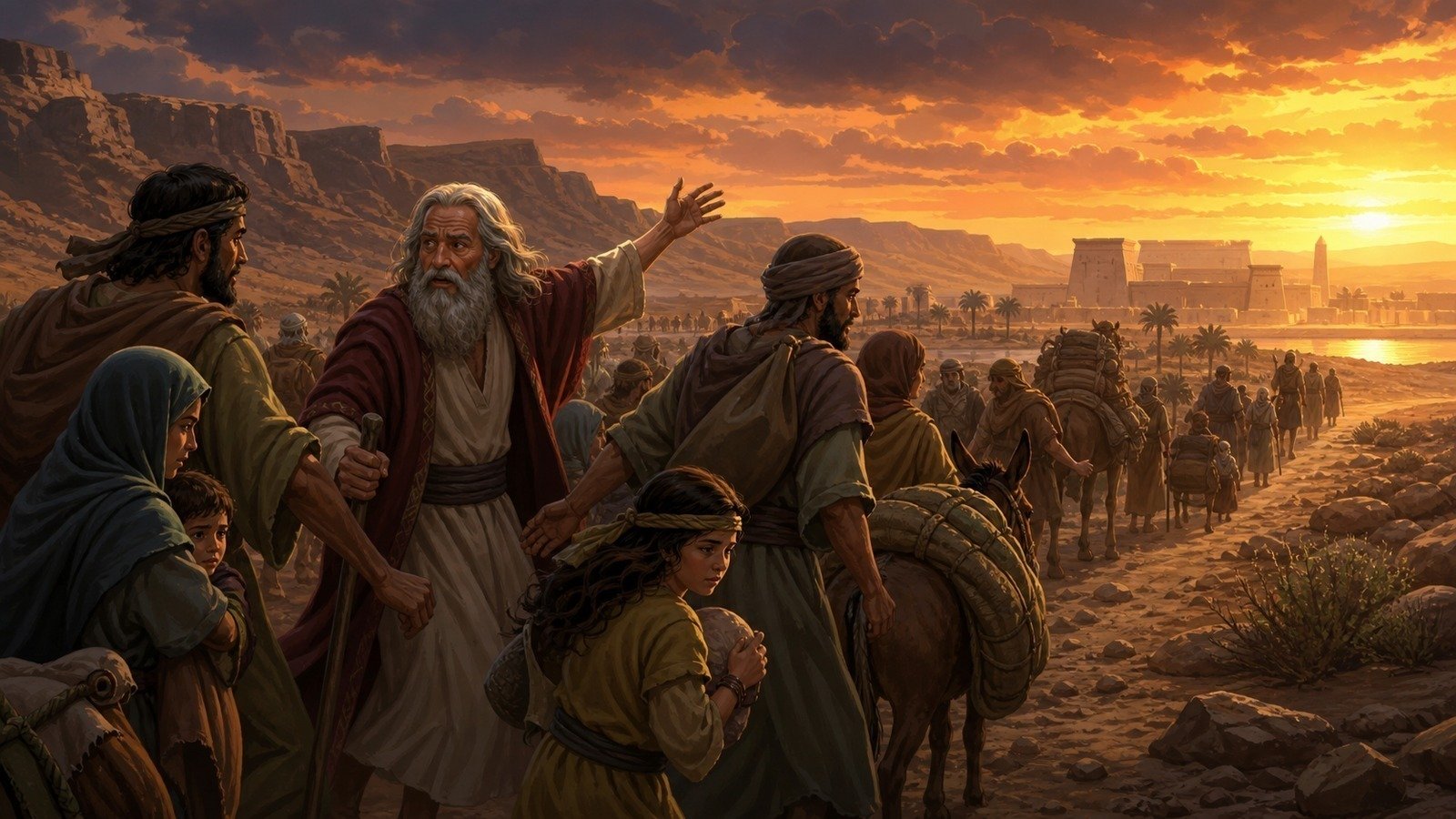
Fearing Babylonian reprisal for Gedaliah's assassination, the remaining population flees to Egypt against Jeremiah's explicit warning, forcibly taking Jeremiah himself with them.
Further context
3 min readAfter the assassination the survivors are terrified, and their fear is entirely rational: a Babylonian-appointed governor and a Babylonian garrison have just been murdered on their watch, and they expect reprisals.
They come to Jeremiah with a request that is unusually well phrased. Pray that the LORD your God will tell us where we should go and what we should do. And they add an oath: may the LORD be a true and faithful witness against us if we do not act in accordance with everything he sends you to tell us, whether it is favourable or unfavourable.
He agrees, and waits ten days. That interval is worth noticing, since he had been prophesying for forty years and could presumably have produced something immediately.
The answer, when it comes, is to stay. If you stay in this land, I will build you up and not tear you down; I will plant you and not uproot you, for I have relented concerning the disaster I have inflicted on you. Do not be afraid of the king of Babylon. And a specific warning about the alternative: if you go to Egypt to escape war and famine, the sword you fear will overtake you there, and the famine you dread will follow you.
They refuse. The response is immediate and it accuses him of lying: you are lying! The LORD our God has not sent you to say we must not go to Egypt. Baruch son of Neriah is inciting you against us to hand us over to the Babylonians.
They go, and they take Jeremiah and Baruch with them by force. A prophet who had spent four decades telling his country not to trust Egypt is carried into Egypt against his will by the last people left in Judah.
At Tahpanhes in the Delta he buries large stones in clay in the pavement at the entrance to Pharaoh's palace and announces that Nebuchadnezzar will set his throne over them. Babylonian records confirm a campaign against Egypt around 568 BC, though its outcome is unclear.
Tahpanhes has been identified with Tell Defenneh in the eastern Delta, where excavation in the nineteenth century found a large brick platform in front of a fortified building, which the excavator connected with the stones in this episode. The identification is not secure and the connection is looser still, but the site is a documented Egyptian frontier post with a foreign garrison, which is exactly where a party of Judaean refugees would have been settled.
The last recorded exchange of his life is with the refugee community, and it is the bleakest thing he ever hears. The women tell him they will keep burning incense to the Queen of Heaven and pouring out drink offerings to her, as they and their ancestors had done, because when they did that they had plenty of food and were well off, and it was when they stopped that everything went wrong. They have reversed the entire diagnosis, and the husbands are standing there agreeing.
The people left behind are terrified of Babylonian reprisals after the murder of the governor, and they ask Jeremiah what to do, promising in advance to obey whatever answer comes: may the LORD be a true and faithful witness against us if we do not act in accordance with everything he sends you to tell us.
He makes them wait ten days for an answer. When it comes it is to stay in the land and not go to Egypt, with a promise of protection attached.
They accuse him of lying and of being put up to it by Baruch, and they go anyway, and they take him with them.
That is the last thing recorded of a man who had told the truth for forty years to people who kept asking him for it and then doing the opposite, and the last thing he hears is a crowd of refugee women explaining that things had gone better when they were burning incense to the Queen of Heaven.