

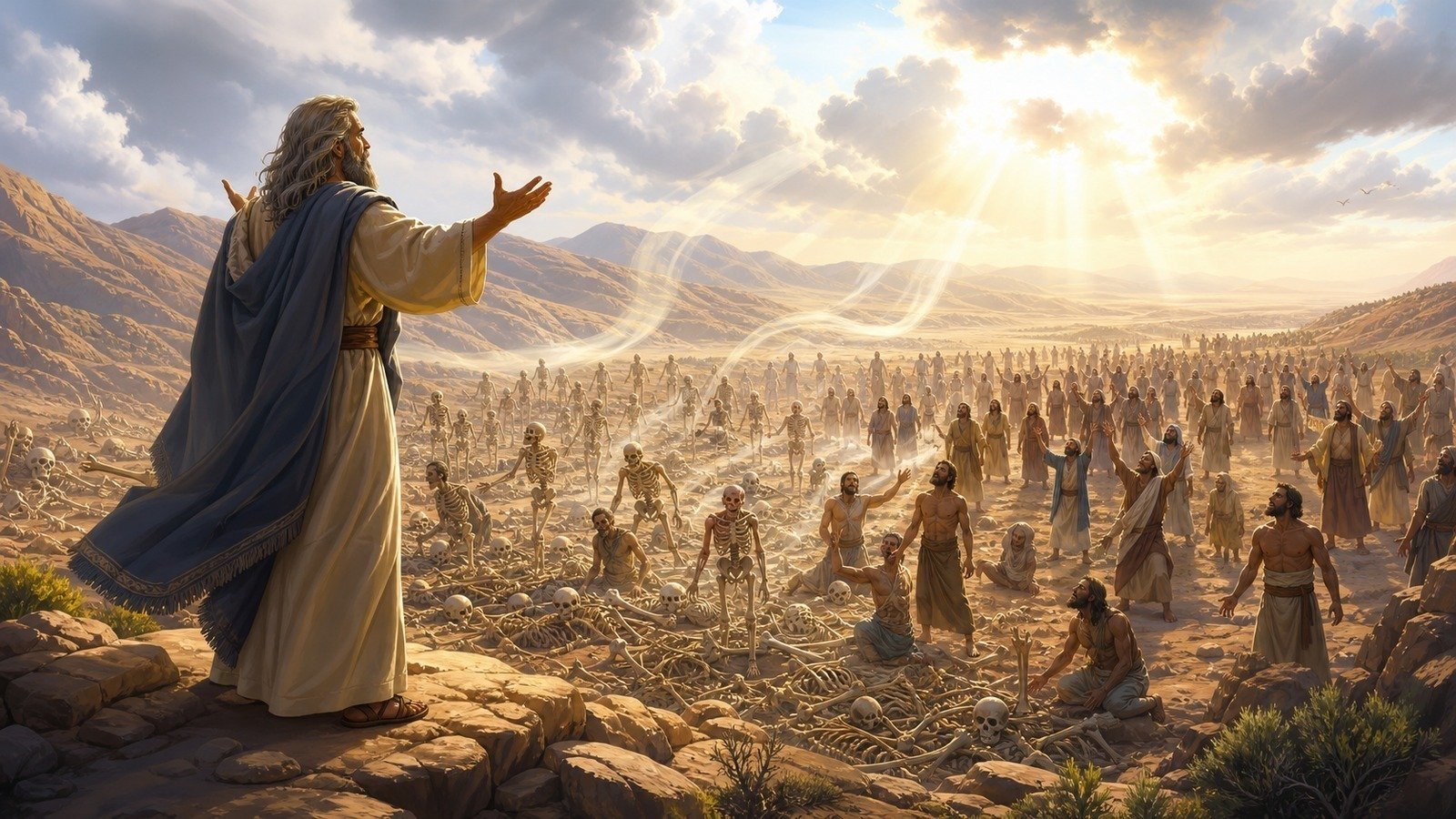
Ezekiel is shown a valley of scattered, dry bones that come together, are covered with flesh, and are finally filled with breath at God's command, a vision explicitly interpreted as a promise of national restoration for a people who felt utterly without hope.
Further context
3 min readEzekiel is set down in the middle of a valley full of bones, and he is led back and forth among them. Two details establish the state of them: there were a great many, and they were very dry. Not a battlefield with the dead lying where they fell, but a place where a battle happened long enough ago that nothing is left but scattered, bleached bone.
The question put to him is the one the whole vision turns on. Son of man, can these bones live? His answer refuses both options: Sovereign LORD, you alone know.
He is told to prophesy to the bones, which is an instruction to preach to an audience that cannot hear, and as he does there is a noise, a rattling sound, and the bones come together, bone to bone. Tendons and flesh appear and skin covers them, but there is no breath in them.
Then a second command, to prophesy to the breath. The Hebrew word runs through the whole vision and carries three meanings at once: breath, wind and spirit. Come from the four winds, breath, and breathe into these slain, that they may live. Breath enters them, they come to life and stand up on their feet, a vast army.
The interpretation is supplied immediately and it is not about individual resurrection. These bones are the people of Israel. They say, our bones are dried up and our hope is gone; we are cut off. That is a quotation of what the exiles were actually saying, and the vision is an answer to it. The promise is that graves will be opened and the people brought back to the land of Israel.
What it is addressing is a specific despair. The state has been destroyed, the temple burned, the king blinded and deported, and the population scattered across an empire. A nation in that condition is not injured; it is finished, and everybody involved knew it. Nothing in the ancient world came back from that. The Moabites did not, the Ammonites did not, the northern kingdom did not.
The two-stage structure is worth noticing. The bones are reassembled and covered with flesh and remain dead, and a second command is needed before anything lives. A restored community with its institutions rebuilt and nothing animating them is precisely the condition the returnees would find themselves in a generation later, and the vision anticipates it.
The vision is also the source of an idea that develops considerably later. Bodily resurrection as a personal hope appears only in a few places in the Hebrew scriptures, and this is not straightforwardly one of them, since the bones stand for a community. But the imagery it supplies, of graves opening and the dead standing up, becomes part of the vocabulary that later Jewish and Christian belief in resurrection is expressed in.
The valley is full of bones, and two details establish their state: there were a great many of them, and they were very dry. Nothing has died recently. This is a battlefield left for years.
The question put to him, can these bones live, gets an answer that is neither yes nor no: sovereign LORD, you alone know.
The reassembly happens in stages, with a rattling noise as bone comes to bone, then tendons and flesh and skin, and then a body with no breath in it. A second command is needed before they stand up.
The interpretation is given immediately and it is national rather than individual: these bones are the people of Israel. They say, our bones are dried up and our hope is gone; we are cut off. The vision is answering a sentence people were actually saying in the camps.
Spirituals sung by enslaved people in America built on it, which is a reading the exiles would have recognised.