

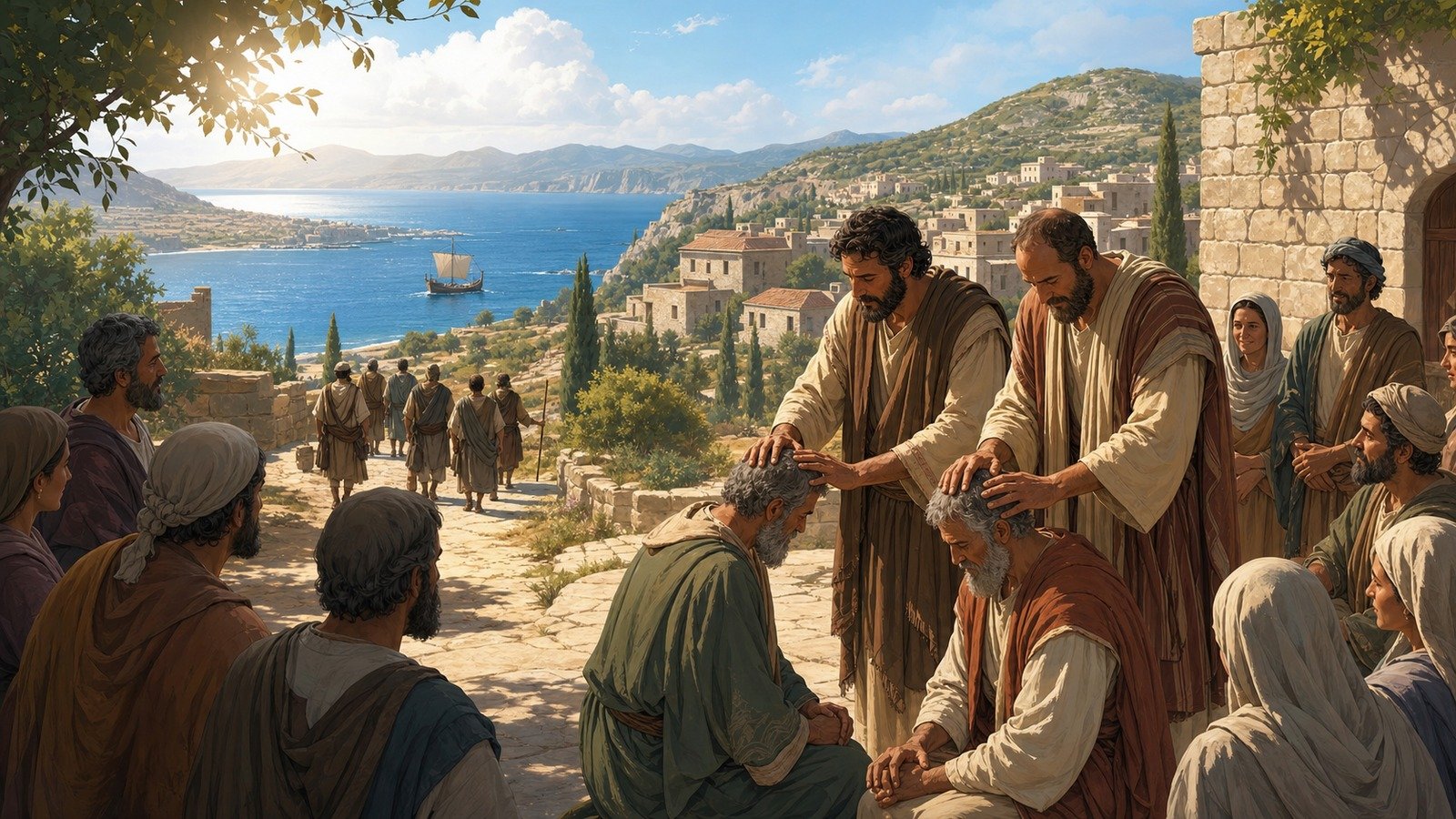
After preaching at Derbe, Paul and Barnabas retrace their route, strengthening the new believers, appointing elders in each church, and finally sail back to Antioch to report what God has done, "how he had opened a door of faith to the Gentiles."
Further context
2 min readAt Derbe, the furthest point of the journey, Paul and Barnabas preach and win a large number of disciples, and nothing goes wrong. It is the only city on the route where no riot, plot or beating is recorded.
From Derbe the sensible route home was east through the Cilician Gates and down to Tarsus, which would have taken them to Antioch in a fraction of the time. Instead they turn round and go back the way they came, through Lystra, Iconium and Pisidian Antioch, which means walking back into three towns that had recently tried to kill them.
The reason is stated: strengthening the disciples and encouraging them to remain true to the faith. We must go through many hardships to enter the kingdom of God, they tell them, which is not an inspirational slogan when delivered by a man who was stoned in that street.
Paul and Barnabas appointed elders for them in each church and, with prayer and fasting, committed them to the Lord.
That sentence is doing something significant. Congregations a few months old, in towns with pagan majorities, are given their own local leadership and left to run themselves. There is no supervisory apparatus, no resident missionary and no letters of instruction from a headquarters. Whatever the arrangement lacked, it produced churches that survived.
They pass through Pisidia and Pamphylia, preach at Perga, go down to Attalia, and from there sail back to Antioch, where they had been committed to the grace of God for the work they had now completed.
On arriving they gather the church together and report all that God had done through them and how he had opened a door of faith to the Gentiles.
That last phrase is the one that produces the next crisis. A door had been opened, Gentiles had come through it in numbers, and nobody had asked them to be circumcised or to keep the food laws.
And they stayed there a long time with the disciples.
The journey had covered perhaps two thousand kilometres by land and sea over about two years, and it established congregations in four cities that appear again in the letters.
The letter to the Galatians, on the majority reading, is addressed to these four congregations, and if that is right it was written not long after this visit, in response to teachers arriving and telling the new believers they had to be circumcised after all.
If so, it is the earliest of Paul's surviving letters or close to it, and its heat is the heat of a man defending churches he had been stoned for.
The Cilician Gates, the pass they did not take, is the route Alexander used and the one Paul travelled on his next journey out of Antioch. Choosing the long way round was a decision to spend weeks on people rather than days on distance.
Sailing back to Antioch closes a loop that had begun with the laying on of hands, and the report they give is to the congregation that sent them rather than to Jerusalem.