

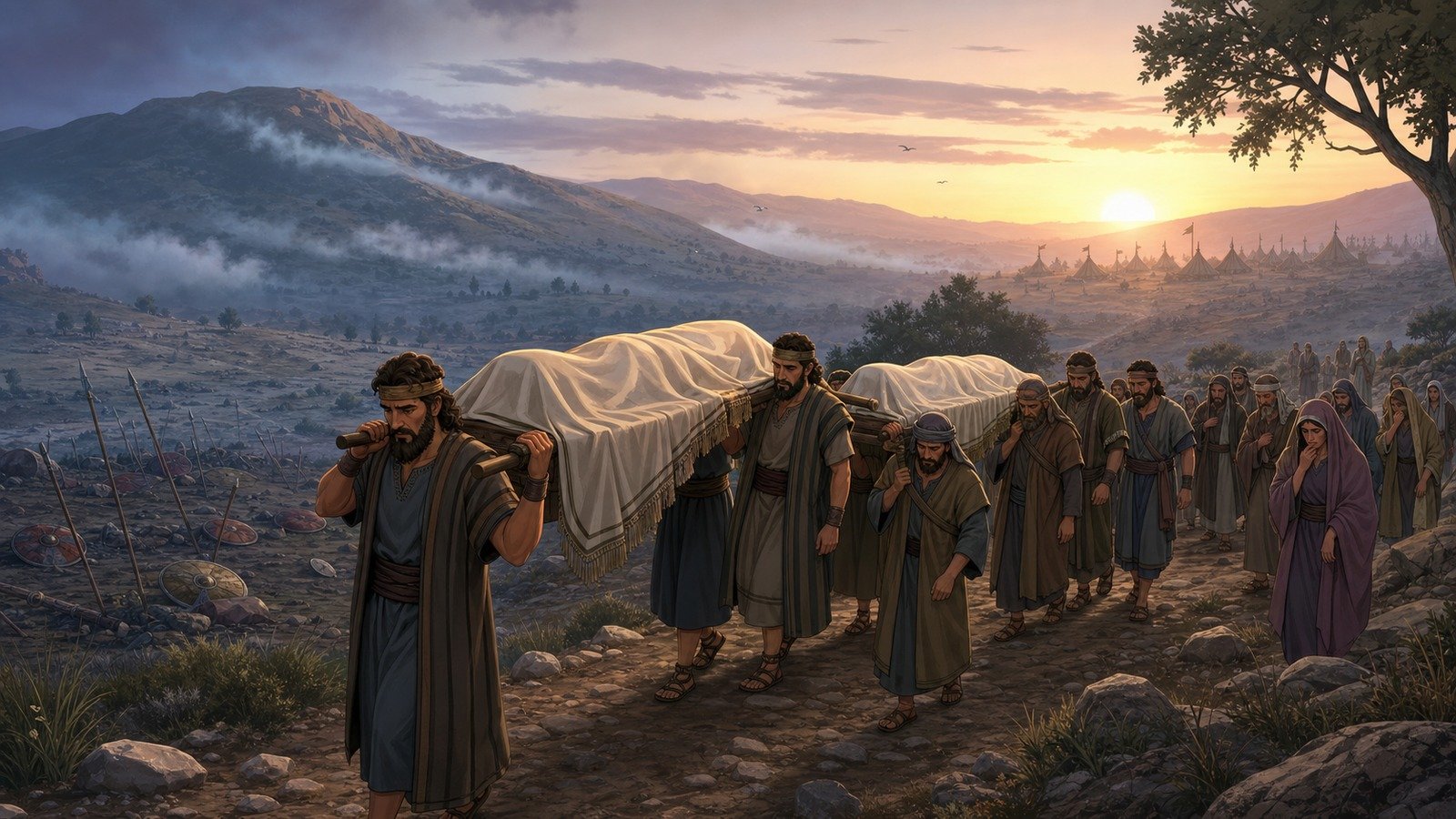
Israel is routed by the Philistines; three of Saul's sons, including Jonathan, are killed, and the wounded Saul takes his own life rather than be captured. Both bodies are later rescued and buried by the men of Jabesh-Gilead in gratitude for Saul's earlier deliverance of their city.
Further context
2 min readGilboa is a ridge on the south-eastern edge of the Jezreel valley, which is chariot country, and the Philistines have chosen the ground. The Israelites flee before them and fall dead on the mountain.
The pursuit closes on Saul and his sons. Jonathan is killed, along with Abinadab and Malki-Shua. The archers overtake Saul and wound him critically, and his last order is to his armour-bearer: draw your sword and run me through, or these uncircumcised fellows will come and run me through and abuse me. The armour-bearer is terrified and will not do it, so Saul falls on his own sword, and the armour-bearer, seeing him dead, does the same.
The Philistines find the bodies the next day when they come to strip the dead. They cut off his head, strip his armour, send messengers through their country to proclaim the news in the temple of their idols and among their people, put the armour in the temple of the Ashtoreths, and fasten his body to the wall of Beth Shan.
That is the point at which a town in the far north-east does something remarkable. The men of Jabesh Gilead hear about it, and every valiant man among them travels all night, takes the bodies of Saul and his sons down from the wall of Beth Shan, brings them back, burns them and buries the bones under a tamarisk tree, and fasts seven days.
The suicide is one of only a handful in the Hebrew scriptures and it is reported without any comment at all, neither condemned nor excused. What is described is a wounded man whose sons are dead, whose army has broken, and whose stated fear is not death but what will be done to him afterwards, which turns out to have been accurate.
Jabesh Gilead is the town whose men Saul rescued from Nahash the Ammonite in the first week of his reign, when the alternative was having their right eyes gouged out. Forty years later they cross enemy territory at night to take his body off a wall. It is the only unqualified act of loyalty anybody performs for him, and it comes from the people he saved before anything went wrong.
David's reaction, when a messenger arrives at Ziklag claiming credit for finishing Saul off in the hope of a reward, is to have the man executed for saying he killed the LORD's anointed. Then he composes a lament, and orders that it be taught to the people of Judah.
That poem contains no politics whatever. Saul and Jonathan, in life they were loved and admired, and in death they were not parted. It refuses to gloat: tell it not in Gath, proclaim it not in the streets of Ashkelon. It credits Saul with what he actually gave the country: he clothed you in scarlet and finery. And its refrain has become the standard English phrase for a national loss: how the mighty have fallen.