

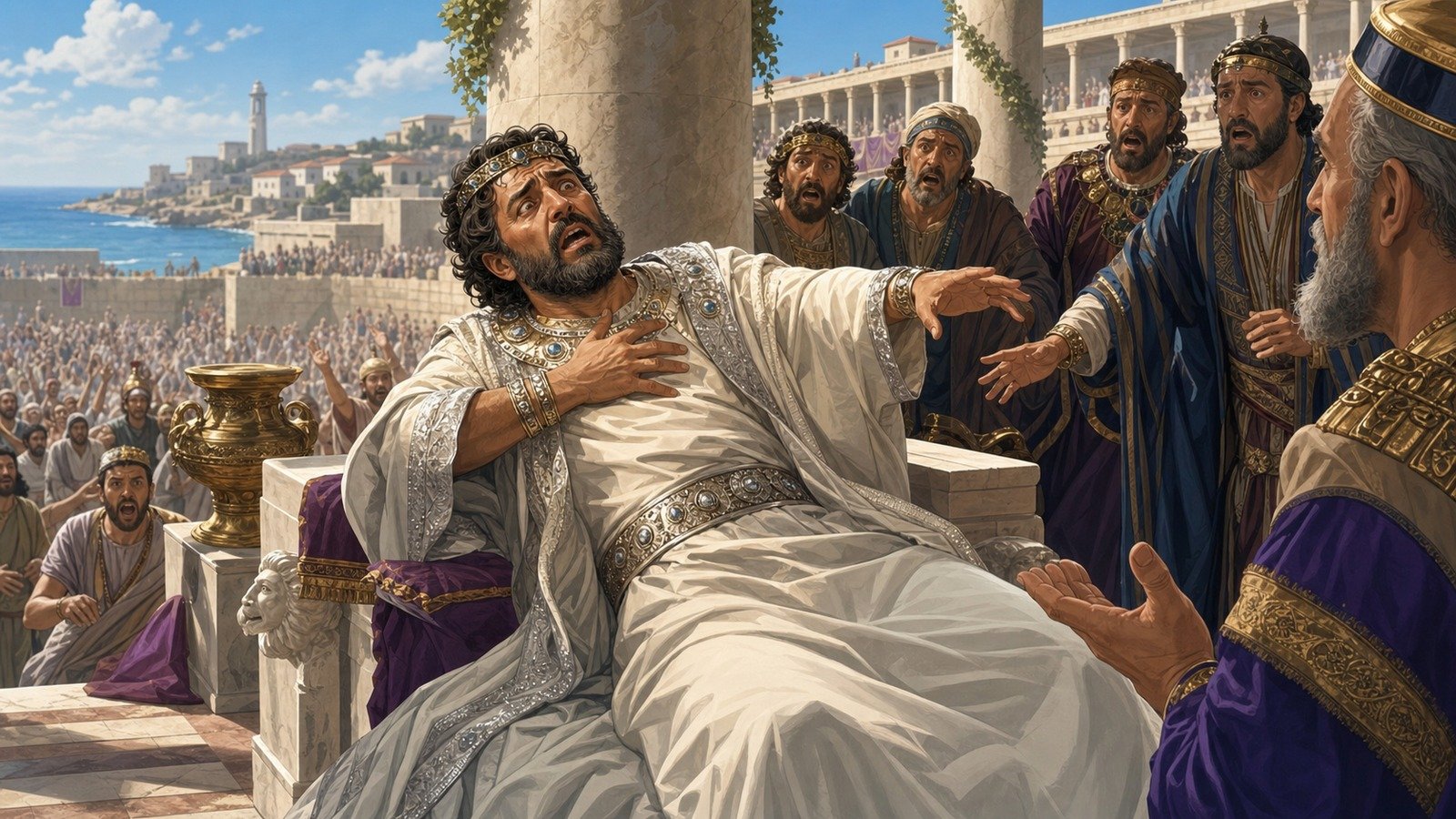
Accepting a crowd's flattering acclamation of him as a god, Herod Agrippa I is struck down by illness and dies; Josephus independently records his death in AD 44, giving this episode one of the New Testament's firmest dates.
Further context
2 min readHerod Agrippa I had been quarrelling with the people of Tyre and Sidon, and they came to him in a body seeking an audience, having secured the support of Blastus, a trusted personal servant of the king, because they depended on his country for their food supply.
That dependence was real. The Phoenician coastal cities had little agricultural hinterland and imported grain from Galilee, an arrangement going back to Solomon's day, and a king who closed the border had them by the throat.
On the appointed day Herod, wearing his royal robes, sat on his throne and delivered a public address to the people. They shouted, this is the voice of a god, not of a man. Immediately, because he did not give praise to God, an angel of the Lord struck him down, and he was eaten by worms and died.
Josephus describes the same occasion at greater length and from an entirely different vantage point, and the two accounts agree in a way that is unusual for this period.
He places it at Caesarea during games held in honour of the emperor. On the second day Agrippa came into the theatre at daybreak wearing a garment woven entirely of silver, and when the sun's first rays struck it the effect was dazzling. Flatterers called out addressing him as a god and begging him to be merciful to them. The king did not rebuke them. Then he looked up and saw an owl perched on a rope above his head, understood it as an omen, was seized with violent pains in his stomach, was carried into the palace and died five days later.
Both accounts have the robes, the acclamation as a god, the failure to refuse it, the sudden onset and the death. One adds worms and an angel; the other adds an owl and five days.
Agrippa was fifty-four and had ruled the reunited kingdom for three years. He died in AD 44, which is one of the firmest dates in the whole chronology of the early church and the peg from which several others hang.
Judea reverted to direct Roman administration, and its procurators over the following twenty years were, by Josephus's account, worse than what had gone before.
But the word of God continued to spread and flourish.
Josephus wrote his account for a Roman readership around AD 93, roughly thirty years after these events and independently of any Christian source. The overlap between the two versions is the closest agreement anywhere between the New Testament and a secular historian on a single incident.
Eaten by worms was a conventional way of describing a repellent death and had been applied to other hated rulers, including Antiochus IV. What the underlying illness was cannot be recovered; a ruptured appendix and intestinal parasites have both been proposed.
That the writer and Josephus tell the same story from different angles, with different supernatural furniture, is instructive about how ancient historians worked. Both regard the death as a judgement; neither invents the robes, the acclamation or the timing.