

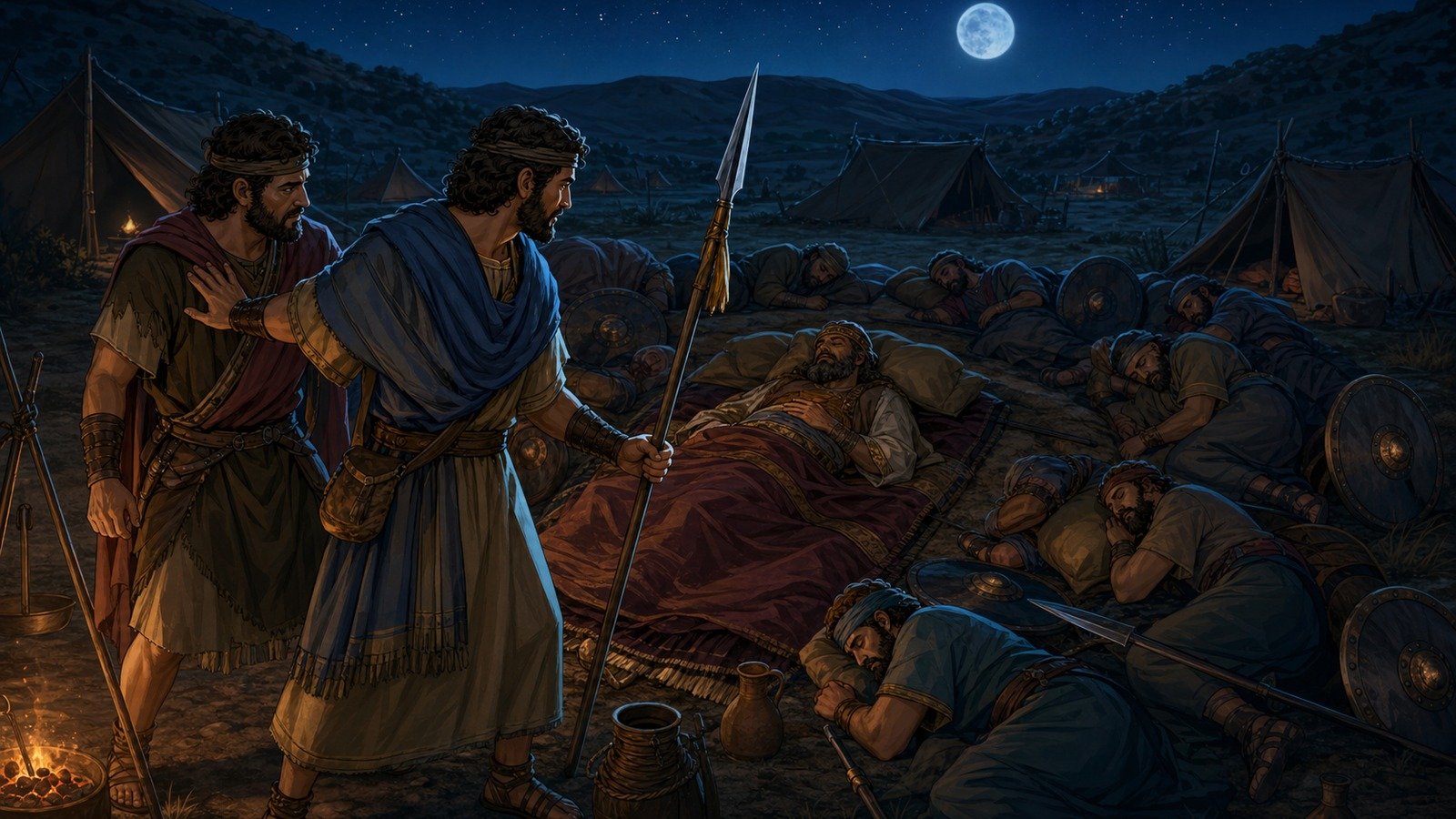
David sneaks into Saul's camp by night and takes his spear and water jug rather than killing him, again refusing to harm "the Lord's anointed" despite his men urging him to do so.
Further context
2 min readThe Ziphites inform on him for the second time, and Saul takes three thousand chosen men and camps on the hill of Hakilah.
This time David is not surprised in a cave. He sends out scouts, confirms the position, and goes to the camp himself at night with Abishai. They find the whole army asleep and Saul lying in the middle of the camp with his spear stuck in the ground by his head and Abner, the commander of the army, and the troops lying around him. A deep sleep from the LORD had fallen on them.
Abishai's offer is immediate and practical: today God has delivered your enemy into your hands. Let me pin him to the ground with one thrust of the spear; I will not strike him twice.
The refusal is the same as at En Gedi and it is put more sharply. Do not destroy him. Who can lay a hand on the LORD's anointed and be guiltless? As surely as the LORD lives, the LORD himself will strike him, or his time will come and he will die, or he will go into battle and perish. But the LORD forbid that I should lay a hand on the LORD's anointed.
He is not saying Saul will survive. He lists three ways the man might die and refuses to be any of them.
They take the spear and the water jug from beside his head and walk out of the camp, and nobody wakes because the LORD had put them into a deep sleep.
Then, from a hilltop at a safe distance, David calls out, and what he does first is humiliate the commander of the army in front of the troops. Are you not a man? Who is like you in Israel? Why then have you not guarded your lord the king? Someone came to destroy him. What you have done is not good. You and your men deserve to die, because you did not guard your master. Look around you. Where are the king's spear and water jug that were near his head?
Saul recognises his voice and calls him my son David, and the reply this time is closer to an argument than a plea. If the LORD has incited you against me, then may he accept an offering. If, however, people have done it, may they be cursed before the LORD, for they have driven me from my share in the LORD's inheritance and have said, go, serve other gods.
Saul admits he has sinned and acted like a fool and erred greatly, and invites him back. David sends the spear over with a young man and does not come.
The deep sleep is stated as a cause rather than a coincidence, and it is worth noticing what it does to the moral weight of the episode. David is not being praised for stealth. He is being placed, twice now, in a position where killing the king would be effortless and unobserved, and the whole point is what he does when the obstacle is removed. On both occasions the man urging him on has the better tactical argument.
They never meet again.