

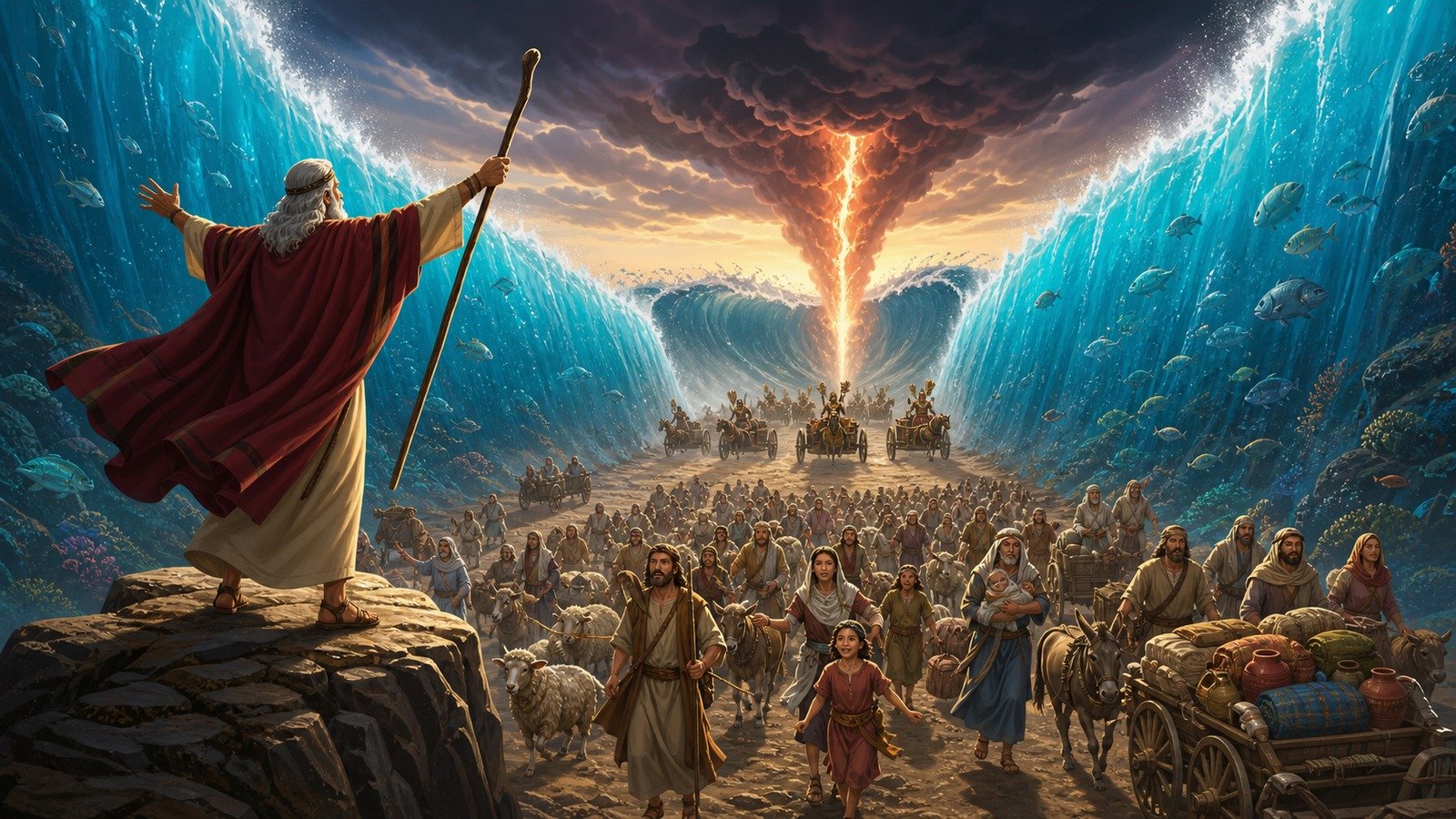
With Pharaoh's army in pursuit, God parts the sea, and Israel crosses on dry ground before the waters return and destroy the Egyptian chariots.
Further context
2 min readThe Israelites are told to turn back and camp at Pi Hahiroth, between Migdol and the sea, opposite Baal Zephon, and the reason for the manoeuvre is stated: Pharaoh will think they are wandering in confusion, hemmed in by the desert, and will come after them.
He does. He takes six hundred of the best chariots along with the rest of the chariotry of Egypt, and that detail matters. Chariotry was the elite arm of the Egyptian military, fast, expensive and useless on soft ground, and the pursuit consists of it.
The people's reaction on seeing the army is the first of many complaints and is phrased with bitter wit: was it because there were no graves in Egypt that you brought us to the desert to die? What have you done to us by bringing us out of Egypt? Did we not say to you in Egypt, leave us alone, let us serve the Egyptians?
Moses answers with two sentences the rest of the Hebrew scriptures keep returning to: the LORD will fight for you; you need only to be still. The reply he himself gets is less patient: why are you crying out to me? Tell the Israelites to move on.
The pillar of cloud moves from in front of the camp to behind it, between the two armies, and the crossing takes all night. The mechanism is described rather than left vague: the LORD drove the sea back with a strong east wind and turned it into dry land, and the waters were divided. The Egyptians follow, their chariot wheels come off or swerve so that they drive with difficulty, and at daybreak the water returns and the army that went into the seabed does not come out.
Which water this was is genuinely open. The Hebrew is yam suph, and suph means reeds; it is the same word used of the reeds where Moses' basket was placed. The rendering Red Sea comes through the Greek and Latin translations. Complicating things, the same Hebrew phrase clearly means the Gulf of Aqaba in a later description of Solomon's shipping, so it is not fixed to one body of water. Proposed crossing points include Lake Ballah, Lake Timsah, the Bitter Lakes, the northern end of the Gulf of Suez and the Gulf of Aqaba, and the three place names given cannot be located with confidence, which is what prevents the question being settled. Shallow lakes in the isthmus would suit the wind mechanism described; deep water would not.
No Egyptian source records the event, and none would be expected to. Egyptian royal inscriptions were commemorative rather than archival, composed to record victories and the maintenance of order, and defeats are systematically absent from them. The loss of a chariot force in a frontier district would not have been carved on a temple wall. That is an argument about the nature of the sources rather than a claim that silence supports anything, and it cuts both ways: the same silence means the crossing cannot be corroborated from the Egyptian side either.
Paul later describes the whole generation as baptised into Moses in the cloud and in the sea, using the crossing as a picture of initiation into a people.